
Pupils’ handling of materials, the use of tools, the production of artefacts, and the enjoyment of visible achievement are often seen as strengths of school craft. Those are valid educational points, but they do not necessarily mean that the discipline of craft becomes engineering education. A pupil might finish a fine artefact without considering anything about loading, fitting, material behaviour, polarity, surface treatment, maintenance, resource management, or user safety. A class might even contain an engineering topic in name but provide no trace of the pupil’s technical reasoning. Hence the key issue is not whether craft can incorporate technology and engineering education but how to make this relationship visible in teaching, feedback, and assessment.
State-of-the-art technology and engineering education puts an emphasis on the engineered world, criteria and constraints, modelling, testing, correcting, and judgement. Standards for Technological and Engineering Literacy define technological and engineering literacy by means of disciplinary practices, context, and human implications of engineering [1]. The Next Generation Science Standards position engineering design as problem definition, solution generation, optimization, and evidence-based iteration [2]. Literature reviews on STEM instruction at K–12 schools stress that integrated tasks involving knowledge, action, and intention are needed [3]. It is clear that the potential of school craft is its involvement with resistance, risk, measurement, fixing, representing, and testing. Yet that potential is weak if it can be assessed only in terms of product completeness or general claims about creativity.
The technical-craft article by Metsärinne, Salonen, Kallio, Virta, and Hilmola is the curriculum base, as Tables 3–7 give reasons for the existence of technical craft, its curricular content, the involved engineering fields, the objects of technical methods, and the pedagogical synthesis units of craft and engineering education [4]. That data allows to build the structure of the workshop but does not teach in itself. Technical concepts of mechanisms, materials, electronics, surface treatments, maintenance, design communication, goal setting, and evaluation acquire educational weight only through the pupil evidence. The research question addressed here is: how can the curricular categories of Tables 3–7 be transformed into responsible engineering episodes allowing technical reasoning, learner autonomy, diagnostic recovery, and socio-ecological consequences to be assessed in school craft workshops?
The contribution lies in the treatment of curriculum transposition as an evidence problem. It is not about the creation of new syllabus or addition of another teaching method. It is about the presentation of the possibilities of transforming the curricular categories in tables into episodes allowing learners to explain, test, fix, represent, and justify. The analytical object is WTC-50, the procedure is curriculum-to-workshop transposition, the result is the evidence structure of responsible engineering episodes, and the conclusion is about the accountable evidence in technical craft workshops.
The literature background includes technology education, design learning, situated cognition, scaffolding, maker participation, craft pedagogy, and assessment. The theory of situated learning provides the explanation of the educational power of school craft, as the knowledge develops by participating in meaningful activity [5]. In a craft room, pupils meet resistance from wood, metal, fiber, polymers, circuits, surfaces, mechanisms, and tools. However, situated activity requires guidance. Cognitive apprenticeship demonstrates that the learners need modelling, coaching, articulation, reflection, and gradual transfer of responsibility [6]. The relevance to school craft is direct as the pupils need modelling and procedures, but also opportunities to explain, choose, diagnose problems, and evaluate results.
The research of design education provides the second theoretical foundation. According to Cross, design has its epistemology including representation, constructive reasoning, and judgement [7]. The engineering design research presents the learning as problem scoping, idea generation, modelling, testing, decision making, and iteration [8]. The elementary engineering design research stresses the framing of problems and movement between ideas, models, and decisions [9]. However, those features suit school craft only if the tasks in the workshop are not reduced to imitating or decorating the work. Joint under loading, surface finishing, simple programmable output, reuse of material, and repairs can be the examples of design knowledge if the pupils are asked to explain the link between intention, constraint, process, and result.
The learning-by-design research shows how the construction of artefacts can be used to promote conceptual understanding if the pupils are required to test, discuss, and reflect on the design decisions. Kolodner and colleagues illustrate how problem-based and case-based reasoning can be incorporated in the design activity [10]. Fortus and colleagues demonstrate how the design of artefacts can support science learning if the task involves the concept useful for the decision making [11]. Doppelt reports that the design-based learning can enhance engagement if the learner goes through meaningful problems [12]. Apedoe and colleagues report on how engineering design can enter the high-school science through the concrete tasks related to heating and cooling [13]. The implication for craft is that the technical learning should be evident in the record of the pupil decisions, not in the artefact.
The scaffolding research clarifies the management of autonomy. According to Hmelo-Silver, Duncan, and Chinn, inquiry and problem-based learning require structured support, not minimum guidance [14]. Reiser explains how scaffolds act by structuring attention and problematizing aspects of complex tasks [15]. It is important for school craft as it contains genuine risks: sharp tools, machines, adhesives, heat, electricity, and material waste. The responsible autonomy cannot be given immediately. Observations, guidance, bounded choices, correction, and self-directed actions should be aligned with risk, knowledge, and evidence requirements.
The research on Finnish craft and maker education gives the subject-specific background. Lindfors and Hilmola connect craft with innovation learning [16]. Niiranen stresses the learning-by-doing in craft and technology education [17]. Rönkkö, Mommo, and Aerila report on the importance of design and craft for holistic learning in teachers’ view [18]. Jaatinen and Lindfors stress the importance of makerspaces as the school environment for innovation [19]. Vossoughi, Hooper, and Escudé warn on the necessity to examine the making in terms of culture, power, and equity [20]. Leonard argues that the maker initiative requires the inclusion by design, not just access to the equipment [21]. Thus, craft is regarded as practical, cultural, and technical simultaneously.
The literature on assessment is crucial for the present study as it is treated as the problem of visibility of evidence. Product-based grading rewards neatness, speed, previous home experience, or rescuing by the teacher, not the technical understanding. For the formative assessment, it is necessary to have evidence that can be discussed and improved during the ongoing learning. In engineering-related classroom tasks, evidence might appear as explanation, sketch, measurement, test, comparison, note on the fault, repairing log, material account, or justification of user safety. Thus, the literature points to the same requirement: the school craft needs the structured approach to the connection between the curricular categories and visible pupil evidence.
The study employs the data provided by Metsärinne et al. [4]. The data were reorganized to form the Workshop Transition Corpus known as WTC-50. This data consists of fifty entries: six entries of existence conditions, eleven entries of learning aims, eleven entries of engineering subjects, fourteen entries of technical method objects, and eight entries of pedagogy synthesis. The data are not intended to be used in the evaluation of pupils’ performance. Rather, it is a curriculum development data for assessing whether the entries in the table could be turned into learnable workshops.
| Evidence block | Units | Corpus role | Analytic field |
|---|---|---|---|
| Existence conditions | 6 | Defines why technical craft requires an educational rather than merely procedural interpretation. | Curriculum anchor |
| Learning goals | 11 | Converts general aims into assessable learner actions and forms of judgement. | Capability demand |
| Engineering fields | 11 | Identifies the technical content base from which workshop episodes can be constructed. | Content anchor |
| Technical method objects | 14 | Supplies concrete actions, processes, and representations that can produce observable evidence. | Workshop evidence |
| Pedagogy-synthesis units | 8 | Identifies how pupils participate in goal setting, project work, problem solving, monitoring, evaluation, and autonomy. | Autonomy demand |
The distribution shown in Table 1 demonstrates how the curriculum record supports more than merely an inventory of craft techniques. Six existence conditions provide the educational justification of technical craft. Eleven learning goals supply the learner-facing justification; eleven engineering disciplines and fourteen method object classes provide the technical substance; and eight pedagogy-synthesis units indicate how learners participate in planning, problem-solving, and evaluation. The interpretation here is that WTC-50 includes both substantive and participatory criteria. A curriculum unit is only usable for workshop design if it can be linked to what the pupil explains, tests, repairs, describes, makes, and/or defends.
The Curriculum-to-Workshop Transposition Method was executed in five steps. Anchor recognition identified the tabular role of each WTC-50 unit. Capability condensation reduced overlapping goals to learner capabilities. Workshop strand construction structured engineering disciplines and technical method objects into teachable content strands. Task transposition transposed content strands into responsible engineering episodes. Assessment alignment specified the evidence that the teacher could inspect, discuss, and grade. The method draws from design-based research because the design of a curriculum is treated as disciplined inquiry into situated educational activity [22]. Also, it subscribes to the idea that design research should make intentions visible through construction and investigation of learning environments [23].
Capability condensation yielded five capabilities: functional care, technical explanation, material-environmental judgement, design communication, and self-directed participation. Functional care is the learner’s ability to make the artefact or system function reliably and safely. Technical explanation is the learner’s ability to explain cause, sequence, force, material response, input-output reaction, or process effect. Material-environmental judgement is selecting and justifying materials and processes in terms of their durability, waste, reuse, energy, and risk. Design communication is sketching, drawing, diagramming, measuring, modelling, and explaining. Self-directed participation is goal-setting, monitoring, decision-making, correcting, and evaluating, all within the boundaries set by the teacher.
Workshop strand construction yielded seven content strands: mechanical reliability, material transformation, electrical and programmable control, surface modification, mobility diagnostics, energy and built-environment stewardship, and technical representation. The strands serve as building blocks for episodes rather than discrete subjects. An episode dealing with function-under-load may include mechanical reliability and material transformation. An episode dealing with control-behaviour may include electronics, programming, representation, and diagnostics. An episode dealing with resource stewardship may include materials, energy, built-environment thinking, reuse, and maintenance.
Four procedures are applied in the method. Dual Anchored Trace Layering involves having all units anchored by both a curriculum anchor and an evidence anchor. A unit is weak if it is only named in the planning language. It is a strong unit when learners provide evidence of their learning by explanation, testing, correcting, representing, or consequence justification. Therefore, a curriculum topic will not be considered to be learned simply because it is written in the lesson plan.
The Constraint-Responsibility Gradient controls learner autonomy. It has five levels namely, observation, guided procedure, bounded choice, diagnostic correction, and self-directed episode. These levels acknowledge that autonomous responsibility needs to be graduated. Dangerous tools, limited learner background, expensive materials, or complex systems may need a high level of teacher control while low risk materials or familiar processes could allow more learner choice. In this way, autonomy will be linked to safety, feasibility, and evidence, rather than assuming autonomy to be inherently positive.
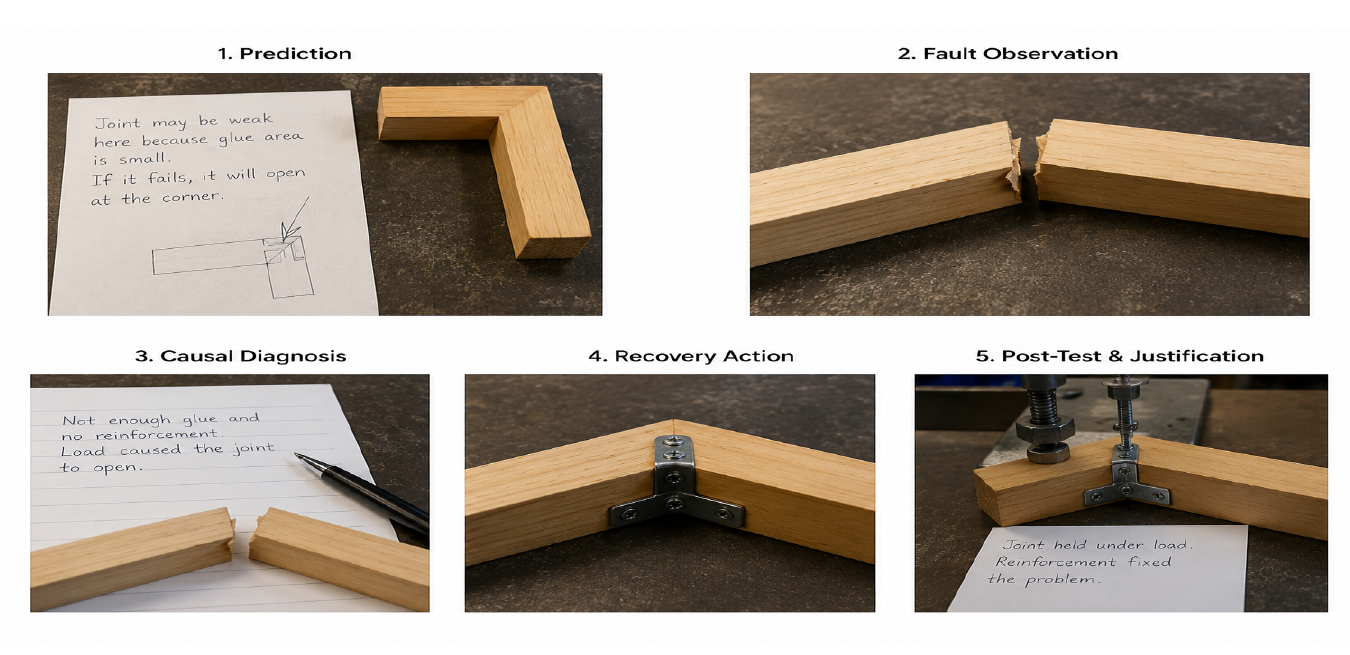
The Failure-Recovery Learning Cycle makes diagnostic work part of planned assessment. This cycle includes prediction, fault observation, causal diagnosis, recovery action, and post-test justification. The teacher introduces a controlled fault or a naturally occurring fault within the workshop context. Then learners explain the expectation, what actually happened, the cause of discrepancy, the correction undertaken, and the evidence showing improved outcomes. The repair process becomes part of technical learning, rather than a hidden disruption.
The Socio-Ecological Consequence Scan makes a link between technical decision making and responsibility. Four questions are asked about every episode concerning who is using the artefact/system, the risks or maintenance responsibilities associated with its usage, the material, energy, or waste consequence of using it, and its social, cultural, or aesthetic meanings. This scan is concise to ensure that it facilitates craft practices and does not replace them with general discussion. This ensures that pupils link technical decision making with use, care, and consequence.
Three controls were used during analysis. Traceability control entailed linking every episode to at least one WTC-50 evidence block. Assessability control entailed producing evidence other than the final artefact within every episode. Responsibility control meant having safety, user, maintenance, material, energy, waste, or social consequence in every episode. These controls ensured that the analysis was done based on the table material and not activity names.
The first result of the research is the conversion of fifty WTC-50 units into five capabilities and seven strands. The five capabilities define the goals of school craft as the technology and engineering education. The seven strands define the technical content base from which tasks could be designed. The recorded units have enough diversity for defining technology and engineering approach to craft but they become educational only when they are attached to the evidence. Functional concern means a visible proof of reliability and safety. Technical explanation means a definition of cause, sequence, behavior or process. Material and environmental decision means justification of choice between alternatives. Design communication means a drawing, diagram, measurement or model to guide actions. Self-directed participation requires documented decisions, monitoring, and evaluation.
| Capability area | Workshop content strands most directly involved | Evidence required from learners |
|---|---|---|
| Functional care | Mechanical reliability; mobility diagnostics; energy and built-environment stewardship | Load test, safety check, function test, maintenance note, or reliability comparison |
| Technical explanation | Mechanical reliability; electrical and programmable control; technical representation | Explanation of cause, sequence, force, polarity, signal, material behaviour, or system response |
| Material-environmental judgement | Material transformation; surface modification; resource stewardship | Material comparison, process justification, waste account, reuse decision, or durability argument |
| Design communication | Technical representation; control behaviour; material transformation | Sketch, CAD drawing, circuit diagram, dimension plan, annotated photograph, or process map |
| Self-directed participation | All strands, depending on task scope | Goal statement, decision log, monitoring note, correction evidence, and final evaluation |
The relationship presented in Table 2 is significant because it distinguishes between language of capability and language of evidence. Functional care is not determined by completing an artefact, but by a reliability test or safety check. Material-environmental judgement is not indicated by a piece of reused material, but by a comparison, a justification, or a waste narrative. Therefore, Table 2 highlights the assessment problem: all claims of capability should have a form of pupil work to look at.
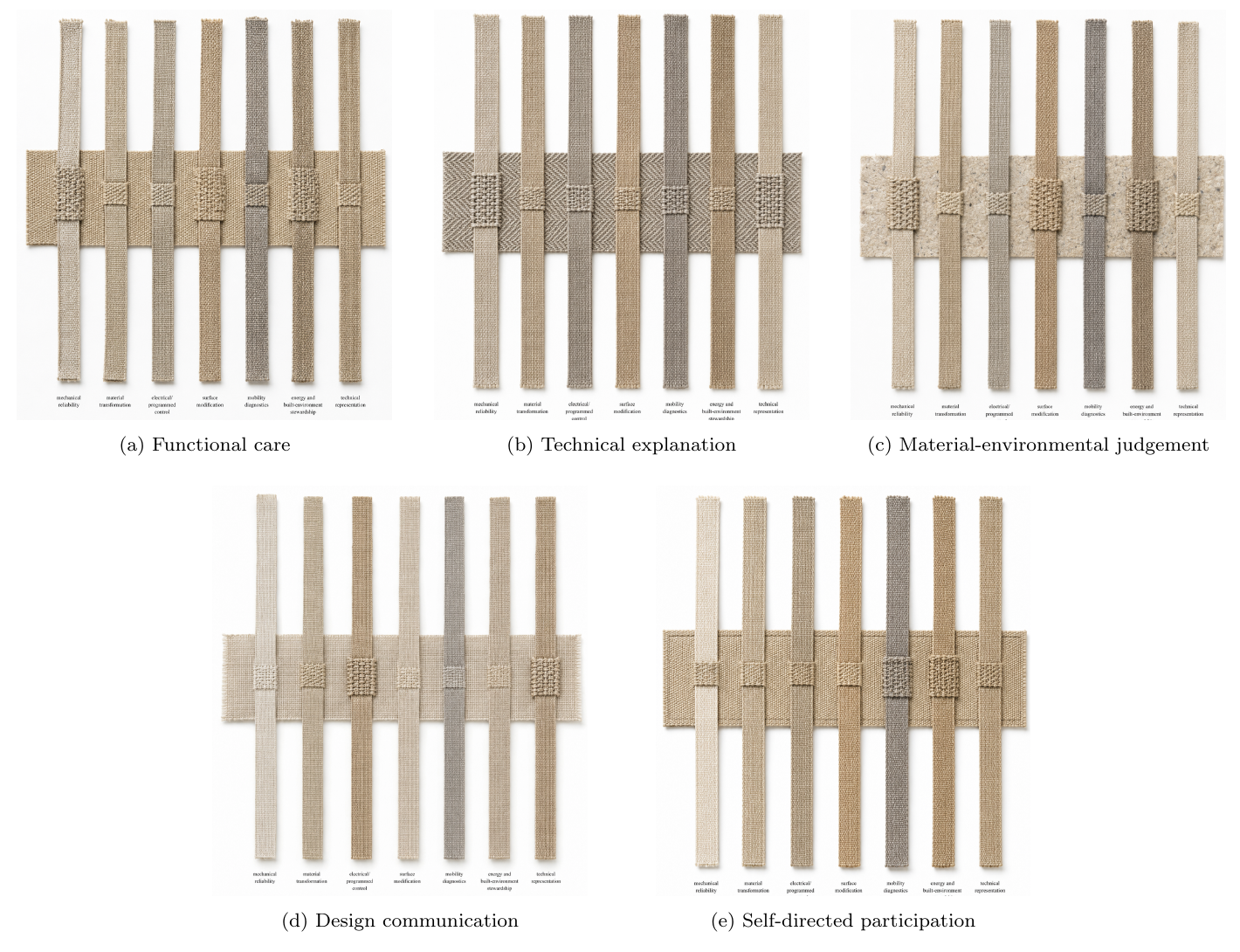
The loom of materials in Figure 1 represents the same transformation in its own way. The weaving of threads illustrates the fact that capabilities do not rest above the workshop practices as abstract goals; they run through reliability of mechanical parts, transformation of materials, electrical or programmatic controls, surface finishing, mobility diagnosis, energy and built environment stewardship, and technical representation. The message here is that the art of technical craft involves weaving of evidence into threads of explanation, action, and responsibility.
The visualization in Figure 1 builds on the findings in the table in the sense that no capability strand is complete unto itself. Functional understanding requires mechanical or diagnostic evidence; technical explanation requires representations or system behaviour; material environment assessment requires material comparison and consequences; design communication requires plans that impact the making process; and self-regulated learning requires evidence of decision-making and review processes. Such an analysis would prevent a teacher from considering the capability strands to be a mere list of requirements. They provide lenses through which to assess the quality of evidence generated by students within their workshop strands.
The second finding is a list of six responsible engineering episodes. In each of these episodes, a technical learning topic, an evidence requirement, and a responsibility question have been combined. It is important to note that these episodes are not projects but rather patterns that can be used to build lessons in various materials and tool sets available at the school. The function under load episodes may be about a wooden joint, a bridge model, a textile fastening, a cardboard construction, or a mechanical linkage. The control behaviour episodes may be about a switch circuit, a sensor-controlled output, a microcontroller, or a motorized device. The diagnostic care episodes may be about a bicycle brake, a small mechanism, a household device model, a worn joint, or a faulty circuit. The common feature is that pupils must produce evidence of technical control and consequence judgement.
| Episode | Technical learning focus | Required learner evidence | Responsibility question |
|---|---|---|---|
| Function-under-load | Mechanisms, structures, joints, moving components, and stability | Load test, failure symptom, adjustment record, and explanation of force or movement | What makes the artefact reliable in use? |
| Material-choice | Material properties, forming, joining, finishing, durability, and waste | Comparison of two materials or methods, selected process, and rejected alternative | Why is this material or method responsible for the intended use? |
| Control-behaviour | Electrical, electronic, automated, or embedded response | Circuit or control diagram, input-output test, and correction of malfunction | How does control change physical action safely? |
| Surface-performance | Coating, dyeing, etching, adhesion, cutting, oxidation, and appearance | Surface trial, preparation note, finish comparison, and durability observation | How does surface treatment alter function and meaning? |
| Diagnostic-care | Maintenance, repair, mobility systems, engine logic, and fault finding | Fault description, causal hypothesis, repair or adjustment, and post-test | What evidence shows that the system is better rather than merely changed? |
| Resource-stewardship | Energy, construction, recycling, environmental engineering, and built environment | Energy or material account, reuse or maintenance plan, and consequence scan | What decision reduces risk, waste, or unnecessary resource use? |
The episode illustrated in Table 3 alters the planning unit. The unit is not an object like a package, a model, a textile product, or a piece of equipment. Instead, it is a decider, where there is a need to provide evidence for function, material, behavior, surface, diagnosis, or resource utilization. According to this definition, the table becomes flexible since the same episode could be enacted either through hand tools or using digital devices, as long as students offer the appropriate evidence and respond to the responsibility question.
The panels of the workshop in Figure 2 depict the six episodes into practical scenes. These do not add value aesthetically but help explain the types of physical evidence needed to make a responsible engineering claim.
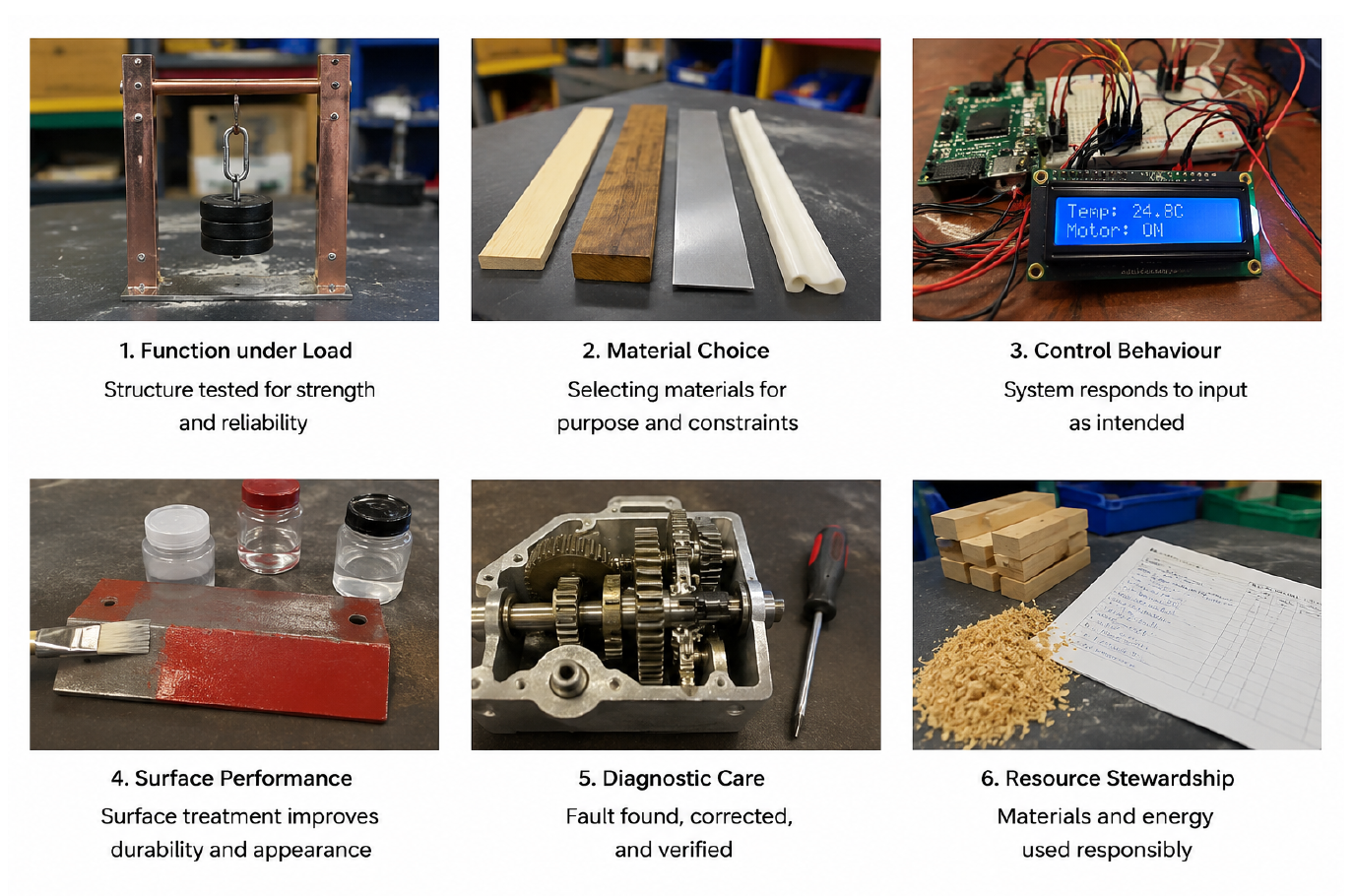
The six scenes in Figure 2 show that engineering in school craft does not require any sophisticated technology. Engineering takes place when the student tests if the structure carries the load, selects among materials with regard to the particular purpose, examines the circuit’s reaction, prepares the surface for its functioning, fixes the mechanism, or counts the material use. As a result, the new understanding of engineering becomes wider and assessable: technical significance is established in the connection between the decision, evidence, and consequence.
The third finding is the four-level trace-strength classification. This classification divides the declared curriculum relevance from the accountable technical learning. T1 is the situation when a teacher mentions the curriculum idea while the learner offers nothing to prove his or her knowledge. T2 is the situation when a learner enacts the idea in the form of visible actions or products. T3 is the explanation of the learner why the particular actions were technically justified. Finally, T4 is the explanation, testing, correction, and discussion of the consequences related to the decision made to use, safety, maintenance, waste or other aspect of the particular technique.
| Class | Description | Example in school craft | Assessment status |
|---|---|---|---|
| T1 Declared | The curriculum unit is named in the task but not evidenced by learner action. | A plan states that environmental responsibility is relevant, but pupils do not address material waste. | Weak |
| T2 Enacted | The unit appears in visible action or artefact production. | Pupils use reused material in a product. | Moderate |
| T3 Justified | The learner explains why the action or method was technically appropriate. | Pupils explain why reused material required reinforcement or surface preparation. | Strong |
| T4 Accountable | The learner explains, tests, corrects, and connects the decision to use, safety, maintenance, or consequence. | Pupils test the reinforced reused material, adjust the joint, and justify the final choice in relation to durability and waste. | Very strong |
The categories of traces presented in Table 4 show that the assessment is getting stronger as the amount of evidence gets more complete. T2 is not being ignored, since visible making is an essential part of crafting. The weakness is the way T2 is used as evidence of T3 or T4. The reusable material can be visible on T2 level, but it is only on T3 and T4 levels when the material is described, tested, corrected, and linked to durability or waste. This table provides the teachers with a diagnostic vocabulary to improve tasks without introducing new themes.
The fiberboard re-use scenario in Figure 3 proves that the same material choice can be located on four different evidence levels. This example shows that the trace strength does not depend on the artefact, but on the relationship between the artefact, the explanation, the test and the consequences.
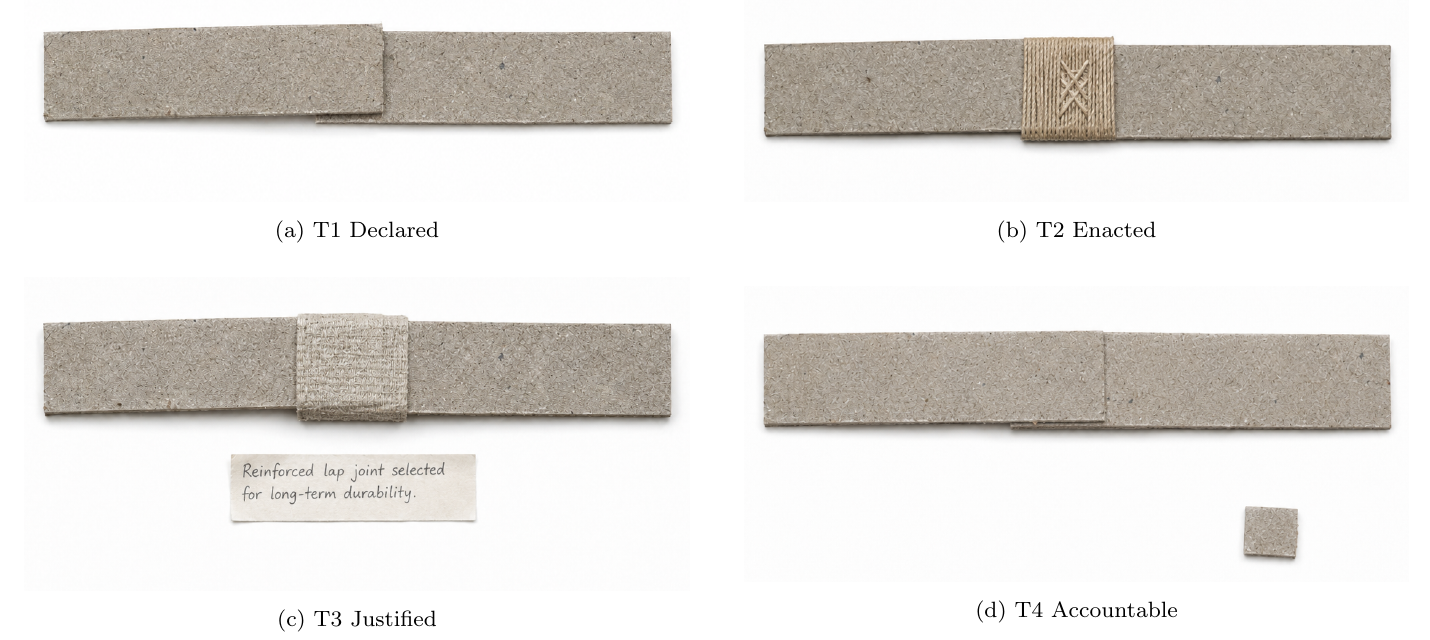
The visual process illustrated in Figure 3 makes clear why a teacher should not conclude that high-level learning is occurring based on the type of material used. At T1, the curriculum concept is named only. At T2, the joining process becomes evident. At T3, the learner explains the reinforcement needed for durability. At T4, the proof must include testing, correction, and a rationalization of use or wastage. This reading makes the figure a useful marking rubric: Feedback can point out what further evidence is required to enhance the learning process.
Fourth, the constraint-responsibility gradient shows how the learner’s autonomy increases through five levels corresponding to risk, prior knowledge, and evidence requirements. It protects against two typical mistakes: leaving the pupils stuck at copying stage forever and jumping too soon to open-ended learning without the necessary technical and safety preparation. The staged model allows for observation and guided procedure as proper early learning stages, bounded choice as controlled access to decision making, diagnostic correction as a progression of engineering judgment, and self-directed episodes as full learning episodes.
| Level | Learner responsibility | Teacher control | Suitable evidence |
|---|---|---|---|
| 0 Observation | Names function, risk, material, or system behaviour. | Teacher demonstrates and controls all tools. | Labelled observation note |
| 1 Guided procedure | Performs a safe procedure according to a teacher-approved model. | Teacher fixes method, dimensions, sequence, and quality threshold. | Completed procedure record |
| 2 Bounded choice | Selects among approved materials, methods, forms, or dimensions. | Teacher fixes safety limits and available options. | Choice justification |
| 3 Diagnostic correction | Finds and corrects a fault in a partly functioning artefact or system. | Teacher defines fault range and test conditions. | Fault-recovery log |
| 4 Self-directed episode | Defines a need, plans, makes, tests, corrects, and accounts for consequences. | Teacher approves safety, feasibility, and evidence requirements. | Complete episode portfolio |
The staged architecture presented in Table 5 makes independence a technical term. Autonomy is not seen as something unconstrained. Every stage defines what the learner controls, what the teacher still controls, and what type of evidence there is. The idea behind this is that responsible autonomy is attained through expanding the scope of decisions for the learner while retaining safety, feasibility, and good evidence.
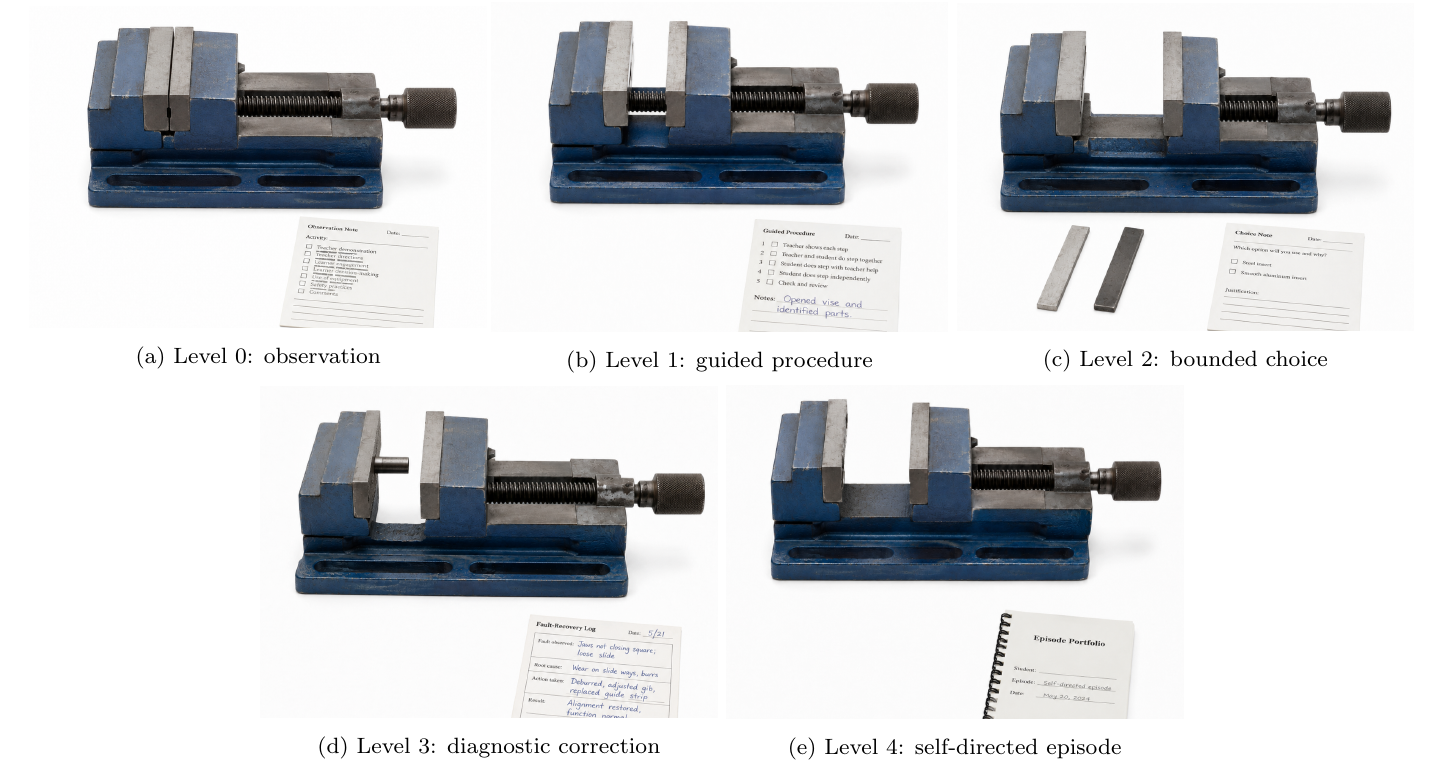
The workshop-vise progression shown in Figure 4 adds a physical analogy to the responsibility gradient. The varying vise configuration and the evidence card in each panel provide an illustration of how autonomy can be achieved gradually without stripping away the teacher’s safety responsibility.
This learning cycle allows a more complex reading of classroom progress. Observing and guidance become valuable stages since they allow making risk, process, and functionality tangible. Bounded choice gains educational value if students provide arguments in support of one safe choice being better than the other. Diagnostics is an important stage since the learner needs to interpret the cause rather than to perform the task according to the plan. Independent activity is most valuable if it comprises the entire episode portfolio. The staged approach facilitates inclusive engineering education since students can start from any level [24]. It also helps to foster accountable autonomy by enriching engineering practice [25].
The fifth learning cycle is Failure–Recovery Learning Cycle. According to the results of the analysis, failure may be used as evidence rather than be considered as workshop disturbance. This cycle includes five moves: prediction, fault observation, causal diagnosis, recovery action, and post-test justification. Each move provides unique evidence. Prediction gives insight into the learner’s anticipation of functionality. Fault observation indicates awareness of the symptom. Causal diagnosis indicates technical reasoning. Recovery action indicates corrective control. Post-test justification indicates state comparison.
| Cycle move | Learner action | Evidence produced |
|---|---|---|
| Prediction | States expected function or behaviour before testing. | Written prediction, sketch annotation, circuit expectation, material assumption, or load estimate |
| Fault observation | Identifies what did not work as expected. | Symptom note, measurement, photograph, teacher-observed demonstration, or comparison with criterion |
| Causal diagnosis | States a technical reason for the fault. | Explanation linked to material, dimension, force, polarity, sequence, adhesion, energy transfer, or user action |
| Recovery action | Makes a controlled correction. | Adjusted joint, rewired element, modified dimension, prepared surface, modified plan, or changed material |
| Post-test justification | Compares the repaired or modified state with the pre-correction state. | Test result and explanation of improvement, remaining limitation, or next modification |
The pattern of evidence in Table 6 indicates that failure is at its most forceful when it is not equated with breakage or fixing by the teacher. Prediction highlights what the student expects to happen; observation distinguishes symptoms from causes; diagnosis involves a technical cause; recovery demands controlled modification; and post-test justification checks if the change made things better for the artefact/system.
The wood joint failure/recovery record in Figure 5 exemplifies the chain of reasoning involved in a single repair episode. The prediction statement, break, cause statement, reinforced bracket, and post-test record make up a compact technical judgment.
Figure 5, which is the diagnostic record of a product, exemplifies how a perfect product is less convincing evidence than a recovered one whose problem is well documented. The reason is that it provides a basis for causality: the lack of joining area or reinforcement causes a failure; bracket reinforcement and retest are evidence of improvement. This is supported by productive failure literature [26]. The current study expands this concept to work-shop conditions, where problems have to remain safe, material, and testable [27].
The sixth finding is an assessment model composed of five evidence dimensions. This model distinguishes technical explanation, controlled actions, diagnostic recovery, representational planning, and consequence justification. These are represented by different artifacts that can be inspected by the teacher. It does not exclude the idea of the quality of a product; it only locates it in the context of evidence ecology. Product completion is part of the evidence, but it is not the whole story.
| Evidence dimension | What the teacher inspects | What the learner must show | Trace target |
|---|---|---|---|
| Technical explanation | Notes, oral explanation, annotated drawing, system diagram | Understanding of function, cause, sequence, behaviour, or process effect | T3–T4 |
| Controlled action | Safe tool use, accurate processing, quality of method execution | Technical control rather than imitation alone | T2–T4 |
| Diagnostic recovery | Fault log, test result, corrected artefact, comparison evidence | Ability to interpret failure and justify improvement | T3–T4 |
| Representational planning | Sketch, CAD file, circuit diagram, measurement plan, simulation | Technical intention made visible before or during making | T2–T4 |
| Consequence justification | Safety note, maintenance plan, material account, energy or waste reflection, user explanation | Connection between technical choice and responsibility | T3–T4 |
Controlled action ensures that the craft nature of the subject is preserved since the students must manipulate materials and devices competently. Technical explanation ensures that the action is not imitative. Representation brings out the intention. Diagnostic recovery brings out the judgement when the work does not behave as intended. Consequence justification connects the technical decision with the users, safety, maintenance, materials usage, and the environment. The deeper implication is that validity of the assessment is ensured when none of the types of evidence dominate the entire judgement.
The results reveal that school craft can be considered as accountable workshop evidence instead of either a list of techniques or an open design task. The WTC-50 record provides sufficient breadth for such interpretation as it contains purpose, goal, engineering field, technical method object, and pedagogic-synthesis unit. The primary contribution of the results is not their abundance of categories but their assesseability. A curriculum category becomes strong if it is tied with what a pupil is able to explain, produce, test, correct, represent, and justify.
The key distinction drawn by the results is the difference between enactment and accountability. Many craft tasks qualify as T2 since pupils visibly create something. T2 is indispensable, however, it does not equal technical understanding. If a pupil creates a thing using recycled material, she/he enacts a sustainability-related task. If she/he compares reused and new material, strengthens a joint, explains the reinforcement, tests the result, and justifies the reduction of waste, then she/he produces accountable technical evidence. Such distinction is crucial in protecting practical craft from being superficial and engineering education from being abstract.
The capability-strand result contributes to the discussion on design learning by showing how broad intentions of learners can be linked with concrete workshop strands. The engineering design learning is usually defined through modelling, testing, and iteration [8]. However, design knowledge also requires representation, constructive reasoning, and judgement [7]. The current analysis shows how these concepts can be localized in school craft: functional care is evidenced by reliability checks, technical explanation is done through cause and process accounts, material-environmental judgement is done through justified selection, design communication is done through representations guiding creation, and self-directed participation is done through decision and correction records. The contribution is operational: capability becomes visible through evidence, not assertion.
The responsibility gradient changes the meaning of autonomy. While open-ended work is sometimes considered as more authentic than guided one, the results reveal that the former depends on the relation between risk, knowledge, choice, and evidence. The teacher-controlled demonstration can be the most responsible when pupils are meeting with a hazardous tool for the first time. Guided procedure can be the most responsible when learners require process fluency. Bounded choice can be appropriate when alternative options can be safely compared. Diagnostic correction can be appropriate when pupils can interpret system behaviour. Self-directed work can be appropriate when pupils can perform the whole evidence chain. Such interpretation is consistent with research indicating that meaningful inquiry requires structured support [14]. It also reflects the point of view that scaffolding should direct learner’s attention towards the essential aspects of complex work [15].
The failure-recovery result has a special significance for the craft pedagology. While workshop faults are usually considered as distractions, problems for teachers to solve, or mere failures, the analysis shows that faults can become one of the most powerful evidences when they are safe, bounded, and documented. Prediction, fault observation, causal diagnosis, recovery action, and post-test justification require a pupil to relate the material behaviour to technical reasoning. A weak bond, unstable construction, wrong polarity, improper surface preparation, or material waste can become a concise engineering investigation. The key is that failure needs to be made interpretable, not just allowed to occur.
The socio-ecological consequence dimension extends technical judgement without turning the craft into detached commentary. Pupils do not need broad essays to demonstrate their responsibility. They need concise connections between technical decision and consequences: material selection influences durability and waste; surface treatment influences safety and maintenance; electrical or programmable control influences user’s behavior and energy use; repair influences the lifespan; the modelling of the built-environment influences comfort, access, and resource consumption. Such interpretation is consistent with technology literacy standards, linking design with human and environmental consequences [1]. It is also consistent with the equity-oriented maker education, in which participation in the designed world involves material, cultural, and social dimensions [20]. Such participation has to be designed into maker activities rather than presupposed by access to the tools and equipment [21].
The assessment implications are significant. Grading the product may reward neatness, speed, previous experience, or assistance of the teacher more than technical understanding. The expanded assessment model minimizes this risk by requiring multiple types of evidence. A learner whose artefact is not visually polished may have a good diagnosis and explanation. An artefact may be attractive yet a learner may need to justify her/his material selection, test performance, or consequences. The model does not lower the standards; it makes the standards clearer and more aligned with technology and engineering education.
The results also show that the method can work even with unequal school resources. The well-equipped workshop can use the sensors, programmable devices, computer-assisted design, measurement tools, and fabrication equipment. Resource-limited classroom can use paper constructions, reused fibreboard, textile fastenings, hand tools, simple circuits, surface trials, mechanical toys, and maintenance tasks. The required unit is not an expensive device. The required unit is an episode in which function, constraint, representation, diagnosis, and consequence become visible. This is the point at which the study distinguishes from the research centered mainly around the equipment access or maker participation in general: the focus is on the evidence quality regardless of the material conditions.
Curriculum documents should describe topics together with the evidence. The statement about mechanisms, materials, electronics, environmental technology, maintenance, or representation should show what learners will produce, explain, test, diagnose, or justify. Without the evidence language, curriculum goals will remain too broad for classroom assessment. The WTC-50 analysis demonstrates that the table categories can become evidence demands if each unit is assigned both the curriculum anchor and workshop anchor.
Teacher education should see the transposition of the curriculum to the workshop as a professional skill. The teachers should be assisted in analyzing broad curriculum statements, identifying technical content, choosing the safe workshop methods, regulating the responsibility, designing failure-recovery opportunities, and assessing consequence reasoning. It requires judgment about when to scaffold, when to release responsibility, when to introduce the failure-evidence, and how to evaluate explanation together with making.
Workshop should allow multiple forms of evidence. Facilities do not have to be identical across schools, but they should allow material comparisons, mechanical testing, electrical or programmable control when it is possible, surface trials, drawing and measuring, repair, reuse, and reflection. The episode structure allows schools to start with low-risk tasks and expand when resources and teacher confidence increase. Its strength is in the fact that each episode has an explicit evidence structure regardless of the complexity of the artefact.
The research question was how the curricular categories can be transformed into responsible engineering episodes, which make technical reasoning, learner autonomy, diagnostic recovery, and socio-ecological consequence assessable in school craft workshops. The answer is that transformation occurs if each curriculum unit is given the evidence anchor besides the content anchor. The WTC-50 record demonstrates that the existence conditions, learning goals, engineering fields, technical method objects, and pedagogy-synthesis units can be transformed into five capability areas, seven workshop strands, and six responsible engineering episodes. These outputs are educationally meaningful since they specify what pupils need to explain, produce, test, repair, represent, and justify.
The main conclusion is that school craft can convey the technology and engineering education if the assessment goes beyond the product appearance and becomes oriented towards accountable workshop evidence. The responsible engineering episode is not merely a project, a topic, or an artefact. It is a bounded workshop event in which the pupils manage the technical decision under proper teacher control, produce the inspectable evidence, diagnose and recover from the faults when it is relevant, and connect the decision with the use, safety, maintenance, material usage, energy, waste, or social consequence. Such form of school craft retains its material, creative, and cultural nature and becomes a disciplined place for participation in the designed world.