
The performance of an alloy is influenced by the site of solutes, which other atoms occupy nearest neighbor sites to them, and in which manner such sites are embedded in the neighboring structure. Nearest neighbor solute environment impacts the short-range order and the resistance that dislocation motion encounters, solute pairing at a boundary modifies the effort needed to separate two grains, and solute diffusion in a rare-earth magnet improves coercivity as long as it is retained at a boundary phase segregating neighboring grains. Composition, therefore, is an incomplete design variable. Atom probe tomography provides quantitative resolution of chemical identity and local solute arrangement [1]. Standard atom probe methodology also delivers statistically reliable three-dimensional compositional data [2]. Electron diffraction and crystallographic methods identify ordering and orientation relationship [3]. Boundary analysis provides information regarding the chemistry and segregation states of the interface [4]. More recent atom-probe research has extended this approach to assessment of short-range-order [5]. Such techniques can also address phase segregation with depth dependency, but a chemical state discernible in a compositionally complex material is not necessarily a functional state. An insufficiently strong order signal can remain inside the random-state interval, a segregate boundary can become unstable, and a deep diffusion profile can outlive the phase structure providing magnetic isolation of adjacent grains. The research literature, therefore, must be analyzed at two interconnected levels: the detection of the solute arrangement and the validation of the same arrangement for its strengthening, cohesion, or magnetic separation property.
In the study of multi-component alloys, the mechanical behavior has been found to depend on more than average chemical composition [6]. Both high- and medium-entropy alloys demonstrate considerable solid solution strengthening [7]. Their mechanical properties also depend on phase stability and combined action of different deformation mechanisms [8]. Stacking-fault energy effects and deformation twinning extend the diversity of mechanical properties among the same compositional class of alloys [9]. The chemical ordering provides another important factor of variability [10]. The Cr–Co–Ni alloy is especially suitable for the analysis of the chemical order because its mechanical response is sensitive to the short-range order of the local chemical environment. The diffraction analysis has revealed the link between the local order and deformation properties [11]. The atomistic simulation has identified the correlation of ordered environment and roughened dislocation motion [12]. The microscopy-based research has also linked the local order with strengthening [13]. Atom probe tomography directly confirms the existence of such chemical environments [14]. The broader investigation of local chemical order corroborates the connection of the local order with the mechanical properties [15]. The effect of heat treatment dependent order on the deformation response was found in other studies [16]. The mere existence of local order, however, is not sufficient for the processing recommendations. The measured chemical preference must be distinguished from the statistical ambiguity, and must stay below the level where the chemical localization prevents uniformly deformation of the material. The 1200\(^\circ\)C–24 h Co–Cr–Ni state must, therefore, be regarded as a weak order reference, rather than a process endpoint, while the 500\(^\circ\)C–500 h state can be used as a controlled pair preference, but not as the beginning of the clustering.
Another example of the site dependency comes from the literature on the grain-boundary segregation. The segregation of solutes at the boundaries can affect the mobility and the interfacial structure of the boundary [17]. The appropriate segregation state can also stabilize the nanocrystalline structure [18]. The impact of segregation on the fracture behavior depends on the boundary character and the bonding of solutes [19]. The Rice–Wang model of the interfacial embrittlement serves as the reference because it distinguishes the thermodynamic preference for the boundary occupation from the mechanical work of the boundary separation [20]. The ferritic iron alloy with transition-metal co-segregated solutes makes this distinction clear. The Mo- and W-containing paired states allow preserving the coherent boundary response, while the Cu-containing pairs can exist chemically, but fail mechanically. The key parameter is, thus, not the segregation itself, but the paired occupation together with the cohesion of the boundary plane. The solute pair that is acceptable for one boundary cannot be generally applied to another boundary without matching occupation and separation characteristics.
The rare-earth permanent magnets provide a third case of the site dependency because the diffusion treatment is desirable only as long as it retains the magnetic microstructure. The performance of rare-earth permanent magnets depends strongly on microstructural control [21]. In Nd–Fe–B-based magnets, the coercivity is determined by the structure of the hard magnetic grains and their boundaries [22]. The grain boundary diffusion can enhance the coercivity through the modification of the near-boundary regions [23]. The chemistry of the boundary phase is essential for the magnetic separation of adjacent grains [24]. Recent diffusion investigations have underlined the necessity to retain the favorable shell-bondary combination [25]. The diffusion of Pr–Al in Nd–La–Ce–Fe–B magnets exemplifies the insufficiency of the penetration distance as the criterion. The process of 900\(^\circ\)C for 6 h followed by 480\(^\circ\)C for 4 h results in depth-dependent shell-bondary combination. In the range close to 100 \(\mu\)m, the outer Pr–Al rich shell, inner Al rich shell, main phase core, and high-Al non-ferromagnetic or anti-ferromagnetic boundary phase remain connected. With the increasing depth, the presence of Pr or Al can persist, although the high-Al boundary phase turns into the low-Al ferromagnetic or amorphous phase. The correct depth is, therefore, the region where both shell chemistry and the boundary phase persist, and not the maximal distance at which diffused elements can still be detected.
The principal research question is specific: which of the six measured solute states should be considered as a comparison condition, a design relevant state, or an excluded state taking into account the controlling failure condition of each physical site? The question does not inquire whether the solute is present. The question asks whether the detected atomic arrangement is characterized by the physical site, the diagnostic separation, the property direction, and the failure resistance needed for the processing guidance. The material set is held constant, and no other laboratory or computational procedure is added. The contribution is the direct interpretation of the Co–Cr–Ni local order, ferritic boundary pairs, and Pr–Al magnet diffusion to provide the material-oriented conclusions.
The three image panels in Figure 1 represent the physical site distinction applied in all subsequent analysis. The panel on Co–Cr–Ni alloy represents the nearest-neighbor occupancy inside an fcc lattice, the panel on ferrite alloy represents the paired boundary occupation, and the panel on magnet represents the depth-dependent shell-bondary state. The three cases are held separately in visual space because the same word, solute, refers to different physical entities in each material system.
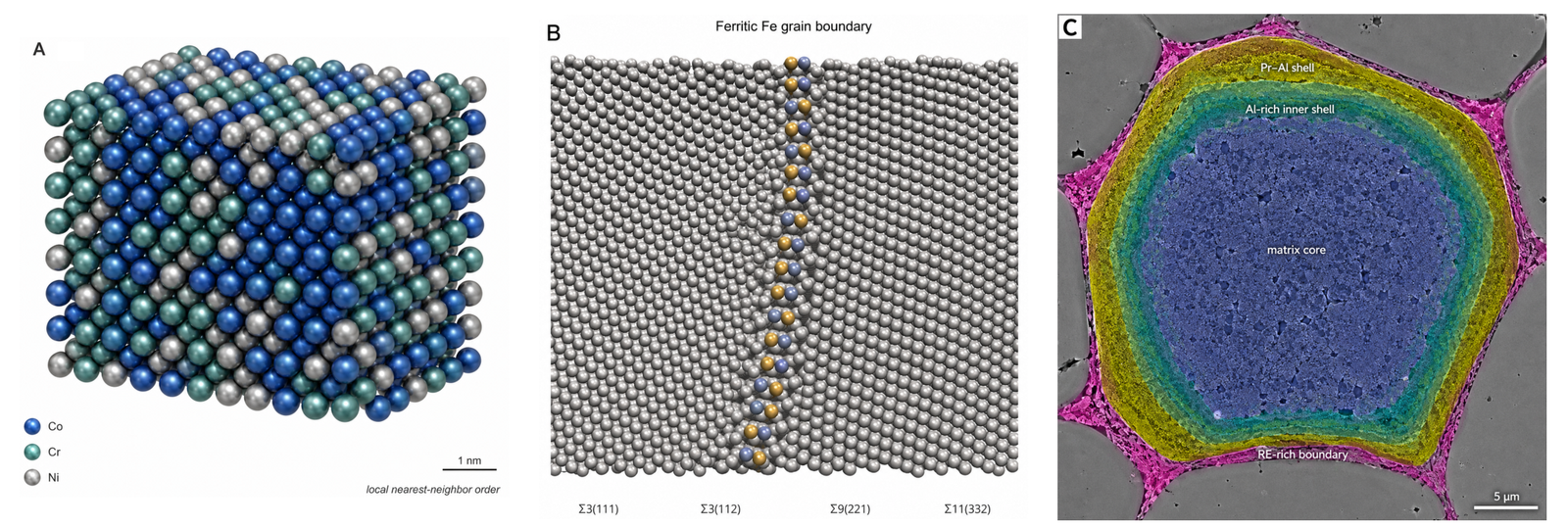
This visual comparison highlights the rationale behind site-specific logic in the manuscript. It is not possible to evaluate the Co–Cr–Ni configuration using the same method of evaluation of the ferritic boundary state, and vice versa. The point is not identical chemistry between systems but rather how well each system retains the atomic ordering which confers the relevant property response. The three figures above also explain why it would have been misleading to use a single number for each system. A number which describes pair ordering in Co–Cr–Ni has nothing to do with boundary cohesion, while a boundary phase composition of the magnet is irrelevant to alloy ordering.
The set of materials has three systems and six solute states. The first system is equiatomic Co-Cr-Ni. The two thermal states are 1200\(^\circ\)C-24 h and 500\(^\circ\)C-500 h. The property of interest is pair-specific local-neighborhood order. The contrast is provided by electron diffraction for diffuse order, and atom probe tomography for a random-state interval of approximately -0.00022 to +0.00022, judged against which the order is measurable. The latter interval is not a value of the mechanical property.
The second system is ferritic iron with transition metal co-segregants at model grain boundaries. The set of boundaries is \(\Sigma3(111)\), \(\Sigma3(112)\), \(\Sigma9(221)\), and \(\Sigma11(332)\) interfaces. The property of interest is not individual atom segregation but rather a paired boundary state. The Mo- and W-containing pairs are retained as potential candidates due to compatibility with cohesive boundary response, whereas Cu-Ti, Cu-V, Cu-Cr, Cu-Mn, Cu-Co, and Cu-Ni are excluded in pair occupation because it leads to reduced cohesion. Thus, boundary occupancy and separation resistance are interpreted jointly.
The third system is Pr-Al grain-boundary diffusion in Nd-La-Ce-Fe-B magnets. The processing conditions are 900\(^\circ\)C-6 h and 480\(^\circ\)C-4 h. Depth positions are characterized near 30 \(\mu\)m, near 100 \(\mu\)m, and near 500 \(\mu\)m; the first one corresponds to the near-surface region, the second one corresponds to the chemically resolved functional region, and the last one is related to penetration without similar boundary-phase continuity. In particular, near 100 \(\mu\)m the rare earth rich boundary phase includes Nd 5.20 at.%, Pr 22.30 at.%, Ce 1.61 at.%, La 0.72 at.%, Fe 53.07 at.%, Co 1.86 at.%, Al 13.75 at.%, and B 1.48 at.%. Also, in that region there is a Pr/TRE shell ratio usually around 58-68%, enrichment of Co and Cu at the shell-bp interface, and Ga enrichment in the high-Al boundary phase. Thus, the material is a test of functional depth, not only elemental penetration.
Four specific-material criteria are used. Site location means that the solute state must occupy the physical position to influence the property of interest. Diagnostic separation means that the solute state must be distinguishable from the ambiguity or functionally weaker chemically similar state. Property direction means that the observed or calculated effect should be favorable or at least worth direct testing. Failure control means that the solute state must avoid material-specific failure: near-random indistinguishability in Co-Cr-Ni, decohesion in ferritic iron, and loss of high-Al magnetic isolation in the magnet.
The values listed in Table 1 form the evidence boundary for each material system. The first two cases pertain to a numerical range of local order, the ferritic cases pertain to crystallographic boundaries and cohesion direction, and the magnet cases pertain to depth-dependent phase chemistry. Each case offers a particular kind of proof. The Co–Cr–Ni cases indicate that annealing cannot be interpreted without the random-state interval. The ferritic cases indicate that boundary occupancy cannot be understood in design terms without inclusion of cohesion sign. The magnet cases indicate that the composition at 100 \(\mu\)m matters because this composition stays coupled with a particular shell–boundary configuration.
| System | Solute state | Site class | Specific material value | Failure condition |
|---|---|---|---|---|
| Co–Cr–Ni | 1200\(^\circ\)C for 24 h | Local neighborhood | Local-order signal judged against \(-0.00022\) to \(+0.00022\) | Weak order not separated from random-state interval |
| Co–Cr–Ni | 500\(^\circ\)C for 500 h | Local neighborhood | Heat-treatment-induced pair preference measured by diffraction and atom probe tomography | Pair preference develops into excessive species localization |
| Ferritic Fe | Mo/W-containing boundary pairs | Interface | Paired states considered across \(\Sigma3(111)\), \(\Sigma3(112)\), \(\Sigma9(221)\), and \(\Sigma11(332)\) | Cohesion not retained under boundary-specific conditions |
| Ferritic Fe | Cu with Ti, V, Cr, Mn, Co, or Ni | Interface | Boundary occupation occurs with unfavorable cohesion sign | Chemically visible but embrittling pair state |
| Nd–La–Ce–Fe–B | Pr–Al shell and high-Al boundary near 100 \(\mu\)m | Diffusion depth | Boundary phase: Nd 5.20, Pr 22.30, Ce 1.61, La 0.72, Fe 53.07, Co 1.86, Al 13.75, B 1.48 at.% | Shell chemistry separates from magnetic isolation |
| Nd–La–Ce–Fe–B | Region approaching 500 \(\mu\)m | Diffusion depth | Pr or Al may remain detectable while high-Al boundary continuity weakens | Penetration without retained functional boundary phase |
The Co–Cr–Ni local-neighborhood case starts with diagnostic separation. The 1200\(^\circ\)C–24 h case is a weak-order comparison case since its local order value lies near the random-state interval. That does not render the case irrelevant. It helps provide the analysis with a point of reference against which the 500\(^\circ\)C–500 h case can be compared. In order for the lower-temperature, higher-duration annealing case to become design relevant, pair-specific ordering needs to remain well outside the ambiguity interval and avoid clustering. Heat-treatment decisions therefore need pre-, during, and post-annealing measurements to confirm selection by pair preference rather than highest annealing time.
The Co–Cr–Ni discrimination graph in Figure 2 clarifies the distinction. The middle band corresponds to the random-state interval, and the two thermal states are positioned relative to that band rather than simply compared in terms of high versus low temperature.
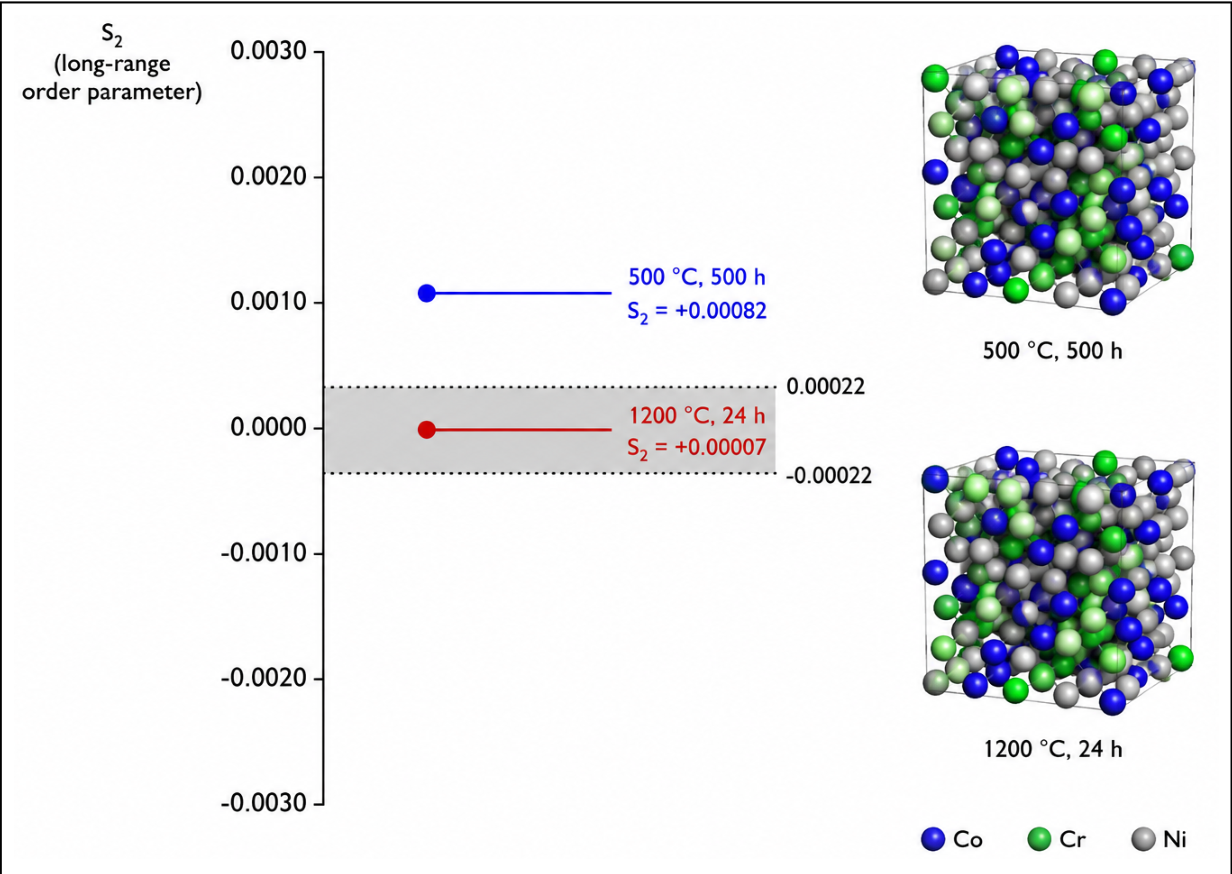
The message conveyed in Figure 2 is that the 500\(^\circ\)C–500 h state is not automatically better just because it has an order signal with greater magnitude. It has to be sufficiently distant from randomness to be reliable but not too localized within chemical boundaries as to be inconsistent with uniform deformation. Consequently, the figure suggests a cautious approach: choose the first stable pair-specific condition rather than automatically favor the maximum annealing time.
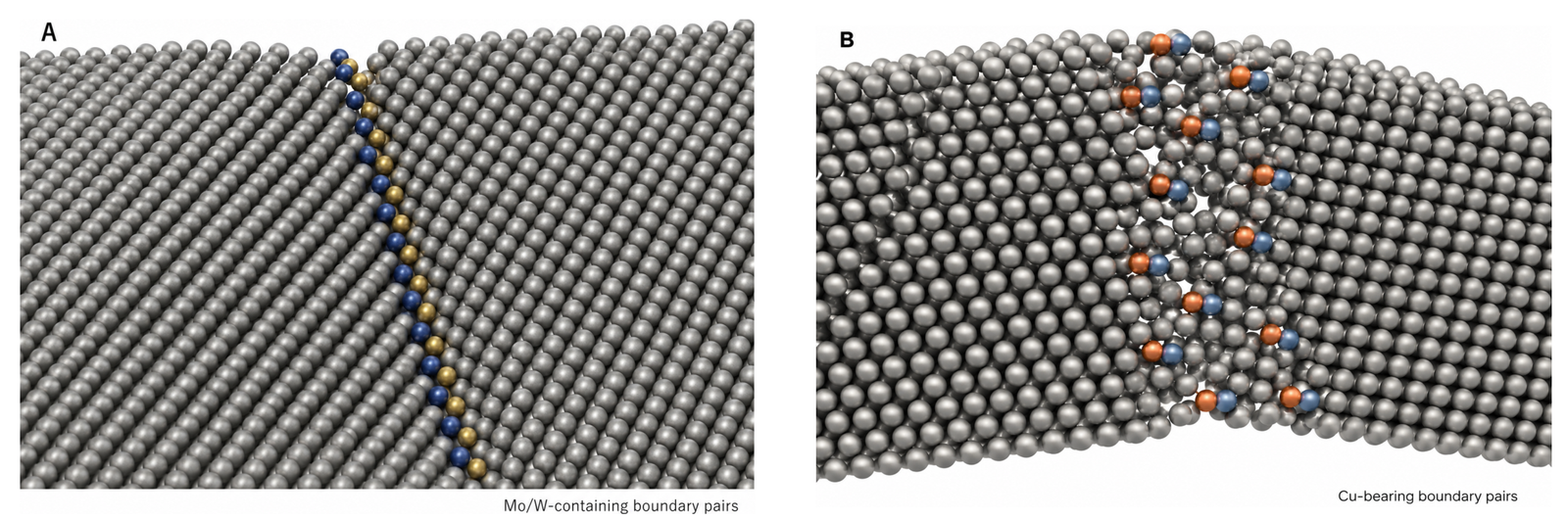
The case of ferritic iron is more definite since the two criteria of boundary occupation and cohesion sign may be contradictory. While the Mo and W co-segregants are still potential candidates for experimental confirmation due to the possibility that the boundary occupation will agree with the cohesion sign of the boundary pair, the Cu co-segregation pairs have a different verdict. For instance, if Cu co-segregated with Ti, V, Cr, Mn, Co, or Ni, the boundary might be chemically different, but its unfavorable cohesion sign makes the state not suitable for cohesion-preserving boundary creation. The lesson here is that the segregation of a boundary does not imply the strengthening of the boundary.
The images in Figure 3 depict the comparison between the two ferritic cases as physical boundary states instead of solute compositions. Such visual distinction is necessary since both of the states contain boundary chemistry, but only one of them can be interpreted cohesionally.
In light of Figure 3, the discussion of ferritic alloying needs modification. Mo and W cannot be treated as universally positive solutes, while Cu cannot be regarded as universally negative solutes. It all depends on the pairing state and the boundary plane on which such a pair operates. The relevant design object here is the pair–boundary combination rather than the solute name alone.
The Nd–La–Ce–Fe–B system is governed by retained microstructural functionality through depth. At 30 \(\mu\)m depth, the Pr–Al shell and boundary structures are very well formed. At 100 \(\mu\)m, the system contains the full chemistry of interest: the Pr–Al shell, the Al-enriched inner shell, the matrix core, and the rare-earth-enriched high-Al boundary phase; Pr 22.30 at.% and Al 13.75 at.% in the boundary phase. At 500 \(\mu\)m, the detectable solute distribution is already insufficient unless the high-Al boundary phase still plays its role in isolating magnetic effects.
There are three slices in Figure 4 illustrating the depth effect without assuming penetration to be the sole criterion for success. The state at 100 \(\mu\)m is visually central since it retains the shell–boundary combination relevant to coercivity.
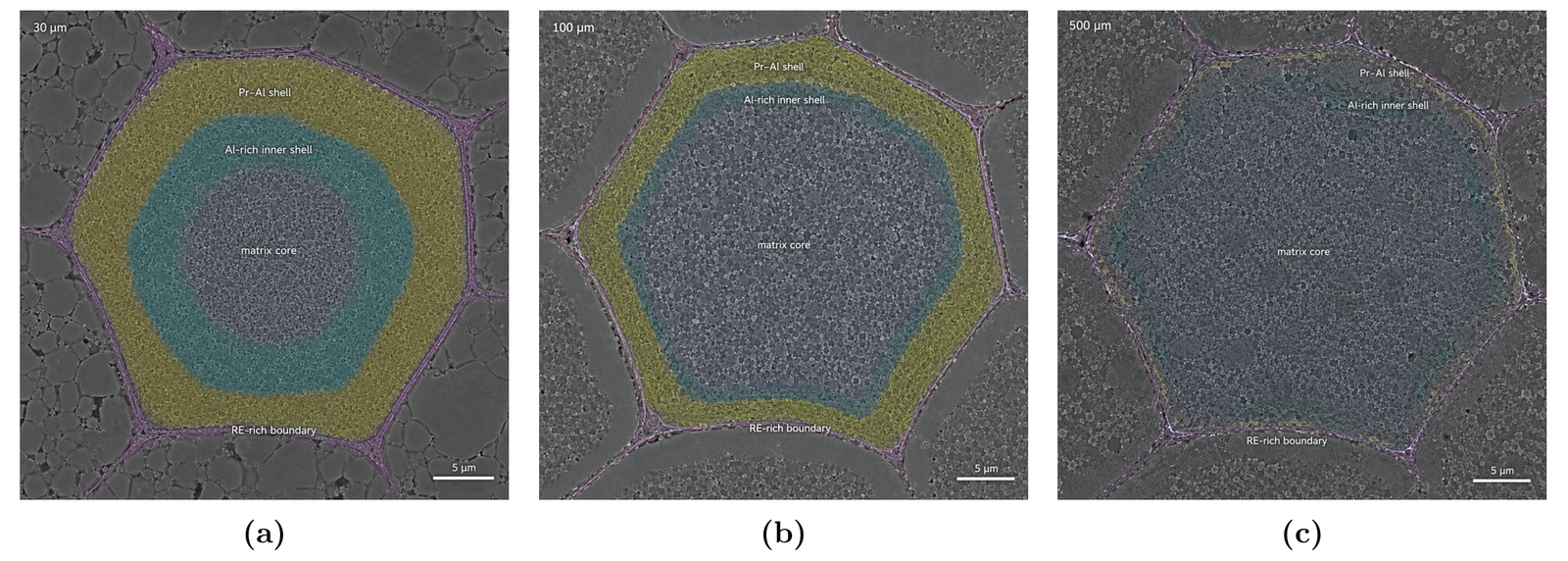
What this implies is that the magnet possesses a working depth rather than a diffusion depth. The ideal processing state does not occur at the deepest level of the Pr or Al signal. The ideal processing state occurs at the deepest level where the shell rich in both Pr and Al, the inner shell rich in Al, and the high-Al rare earth boundary phase are present in contact with the main phase. That is why the 100 \(\mu\)m composition is critical to the outcome.
| Solute state | Decision | Interpretive reason |
|---|---|---|
| Co–Cr–Ni, 1200\(^\circ\)C–24 h | Comparison condition | The local-order signal is too close to the random-state interval for direct advancement. |
| Co–Cr–Ni, 500\(^\circ\)C–500 h | Conditional target | Pair-specific order is useful only while it remains distinguishable without clustering. |
| Mo/W-containing ferritic pairs | Conditional target | Boundary occupation can be compatible with cohesion-preserving behavior. |
| Cu-containing ferritic pairs | Excluded state | Paired boundary occupation is not acceptable when cohesion is reduced. |
| Pr–Al near 100 \(\mu\)m | Conditional target | Shell chemistry and high-Al boundary phase remain coupled. |
| Pr–Al toward 500 \(\mu\)m | Excluded state | Chemical penetration can remain after the functional boundary phase weakens. |
The decision outcomes in Table 2 represent the answers to the classification problem of the research question. States six do not present any simple ordering from worst to best. Rather, they are divided into one weak-order comparison condition, three design-relevant states that require direct property validation, and two excluded states. That point is important since it implies that chemical visibility cannot be taken as a sign of functional value. It is also obvious from Table 2 that excluded states are not failures, but useful negative decisions which prevent unsuitable solute arrangements from going further.
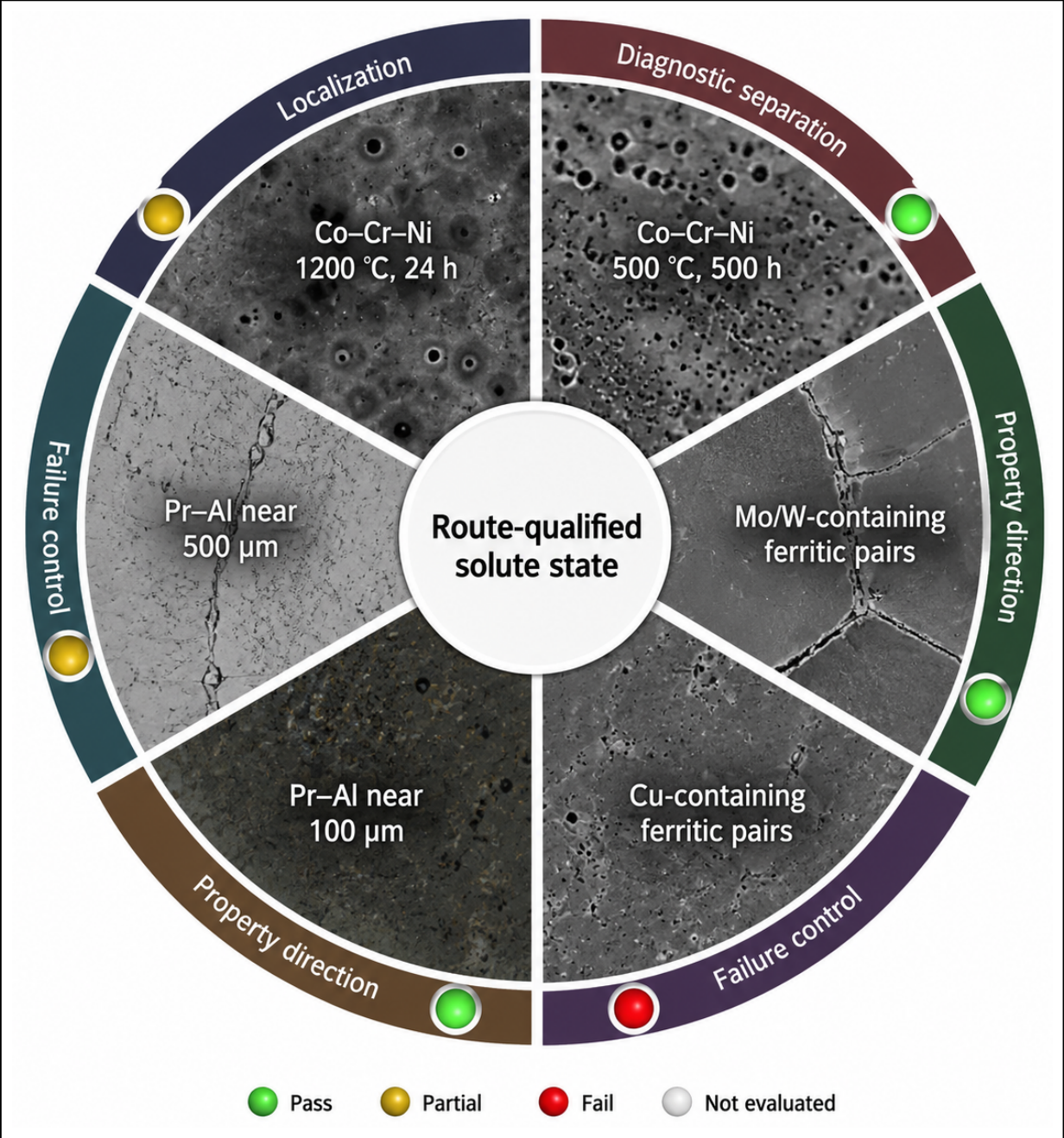
The circular summary in Figure 5 is an attempt to visualize the six decision outcomes in one graphic representation. It is valuable not as the additional procedure, but as the illustration of the different limits of the same four criteria in different materials.
The graphic presentation in Figure 5 explains why the design-relevant states cannot be grouped together into one category. Co–Cr–Ni needs stability window for local order, ferritic iron needs favorability for boundary pair cohesion, and the magnet needs persistence of shell–boundary complex with high-alloyed boundary. That figure also explains why the 1200\(^\circ\)C–24 h Co–Cr–Ni state is still valuable despite its exclusion as a processing point: it sets weak-order comparison condition.
As already noted, the most important result here is that the site-specific interpretation transforms the meaning of each case. For Co–Cr–Ni, it means that the lower-temperature anneal cannot be recommended only based on the higher local order formation. Instead, the recommendation comes if the pair-specific signal is clearly outside the \(-0.00022\) to \(+0.00022\) random-state interval and stays below the level at which clustering appears. This conclusion agrees well with the diffraction data showing that short-range order formation correlates with the material response to the loading [11]. Also, it agrees well with atomistic evidence on dislocation resistance in ordered environments [12]. The heat-treatment results confirm that the change in ordering affects the material response [16]. Thus, all these data reject the assumption that higher order is preferable, but they also demonstrate the importance of local order characterization before the choice of the annealing regime.
The ferritic case demonstrates the most stringent criterion. The co-segregated pair should be interpreted in terms of the cohesion effect sign. Mo- and W-containing pairs should be directly studied because the paired occupancy can be compatible with cohesive boundary behavior. The pairs with Cu and Ti, V, Cr, Mn, Co, and Ni do not correspond to this requirement when the paired state decreases the separation resistance. The reason for such difference is rooted in the Rice–Wang interfacial theory [20]. Similar studies on grain boundaries also confirm that the boundary occupancy and boundary strength are not interchangeable [19]. Thus, the ferritic test should combine chemical boundary analysis with grain-boundary-sensitive mechanical tests rather than study the enrichment alone.
The magnet case is illustrative as the example showing that the diffusion treatment should be evaluated in the context of phase continuity. Near-100 \(\mu\)m is the most instructive depth because the Pr–Al shell, Al-rich inner shell, core, and high-Al boundary phase appear together. The composition of the rare-earth-rich boundary phase (Pr 22.30 at.% and Al 13.75 at.%) demonstrates its importance only due to the boundary phase remaining part of the shell–boundary topology. The established results on coercivity of Nd–Fe–B alloys show that this parameter depends on the continuity and chemistry of the grain-boundary structure [22]. Also, similar detailed studies on boundary chemistry confirm that the magnetic isolation requires the retained intergranular phase [24]. The recent results on diffusion processing confirm that the shell–boundary structure should be preserved, but not maximized [25]. At depths close to 500 \(\mu\)m, the elemental detection can still remain even if the phase state providing the magnetic isolation weakens. Thus, diffusion duration and annealing should be controlled based on the retained boundary function, not maximum penetration distance.
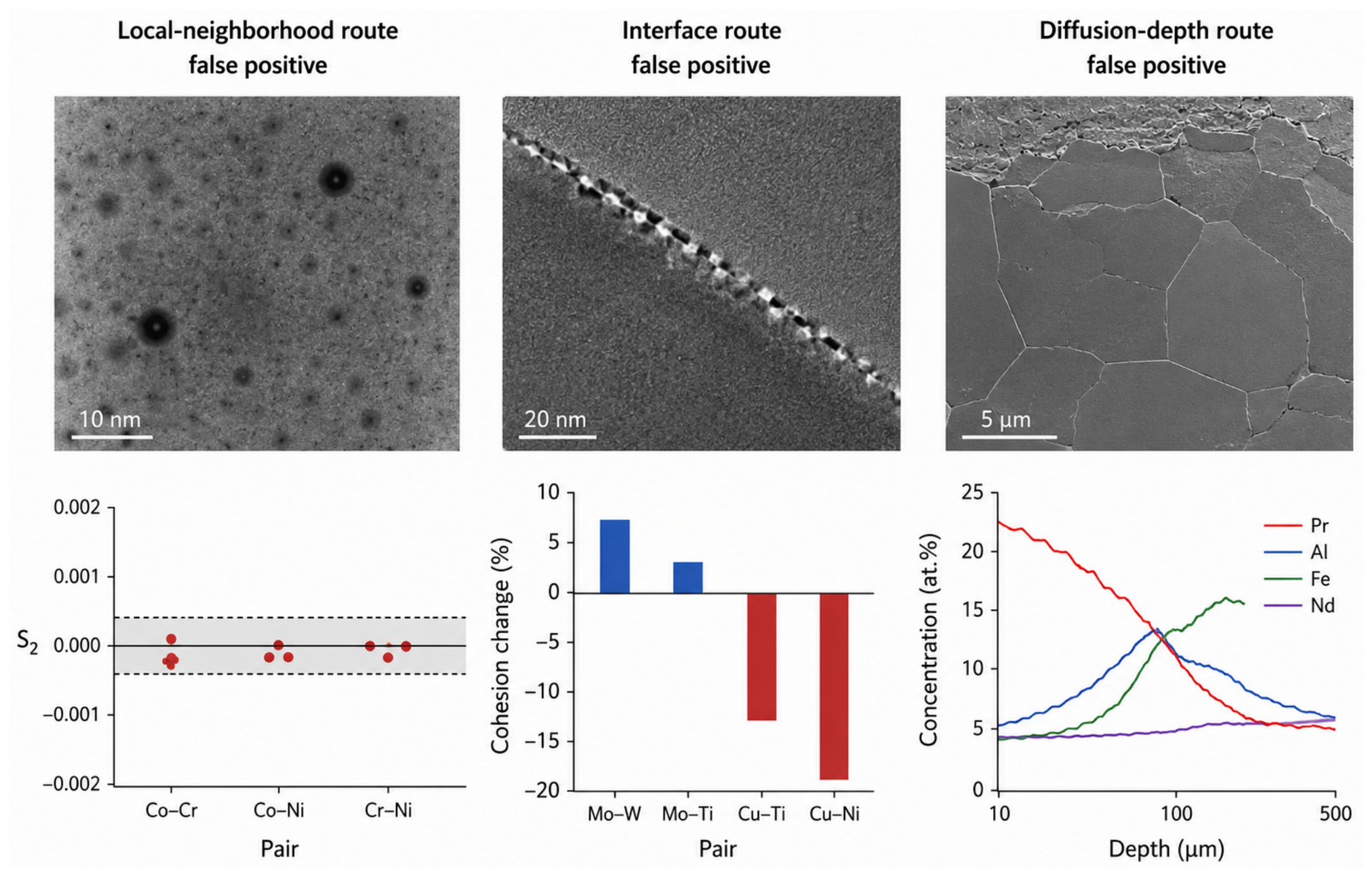
Secondly, the result shows that each case has its own misleading success signal. Local-neighborhood case can over-interpret the weak order within the random-state interval. The interface case can over-interpret the boundary occupation as strengthening. The diffusion-depth case can over-interpret the elemental penetration as magnetic functionality. These mistakes are not interchangeable, and the numerical evidence from one case cannot be transferred to the other case. The random-state interval in Co–Cr–Ni cannot evaluate ferritic cohesion; the ferritic cohesion sign cannot evaluate magnet shell persistence; and the 13.75 at.% Al boundary chemistry near 100 \(\mu\)m cannot evaluate local order in Co–Cr–Ni.
The false-positive comparison in Figure 6 illustrates this result. The interpretation of Figure 6 shows that the negative or excluded decision can be useful evidence. The weak Co–Cr–Ni state sets the discrimination limit, the Cu-containing ferritic states set the boundary chemistries that should be avoided, and deep Pr–Al penetration without retained high-Al boundary continuity sets the diffusion treatment limit. These conclusions minimize the number of unnecessary tests because they help to detect attractive chemical signals without the functional proof.
The most significant general implication is the stopping rules. In Co–Cr–Ni, the stopping rule is the earliest annealing conditions giving the reproducible pair-specific signal outside the random-state interval, but without the clustering appearance. In ferritic iron, the stopping rule is the boundary-pair conditions having the favorable cohesion sign for the boundary character under the testing. In Nd–La–Ce–Fe–B, the stopping rule is the deepest position where the Pr–Al-rich shell and high-Al boundary phase remain coupled. These stopping rules are more precise than the general recommendations on increasing order, segregation, or penetration.
The validation protocol in Table 3 provides specific relevance to the figures. It identifies what needs to be investigated in the subsequent experiment without modification to the protocol. The Co–Cr–Ni system needs an interrupted annealing schedule, the ferritic system needs boundary chemistry and tests sensitive to cohesion, and the magnet system needs a depth sectioned shell–boundary study tied to magnetism.
| Case | Primary check | Decision for further work |
|---|---|---|
| Co–Cr–Ni | Pair-specific signal outside \(-0.00022\) to \(+0.00022\) | Test the earliest stable annealing point that gives reproducible local order without clustering. |
| Ferritic iron | Boundary-pair cohesion sign | Advance Mo/W-containing candidates and reject Cu-bearing pairs that reduce cohesion. |
| Nd–La–Ce–Fe–B | Coupled Pr–Al shell and high-Al boundary phase | Optimize for functional topology depth rather than maximum Pr or Al penetration. |
The laboratory-oriented summary in Figure 7 presents the validation decisions in relation to the specimen configurations and measurement paths. The figure is best used as a collection of distinct initial experiments rather than as a common process.
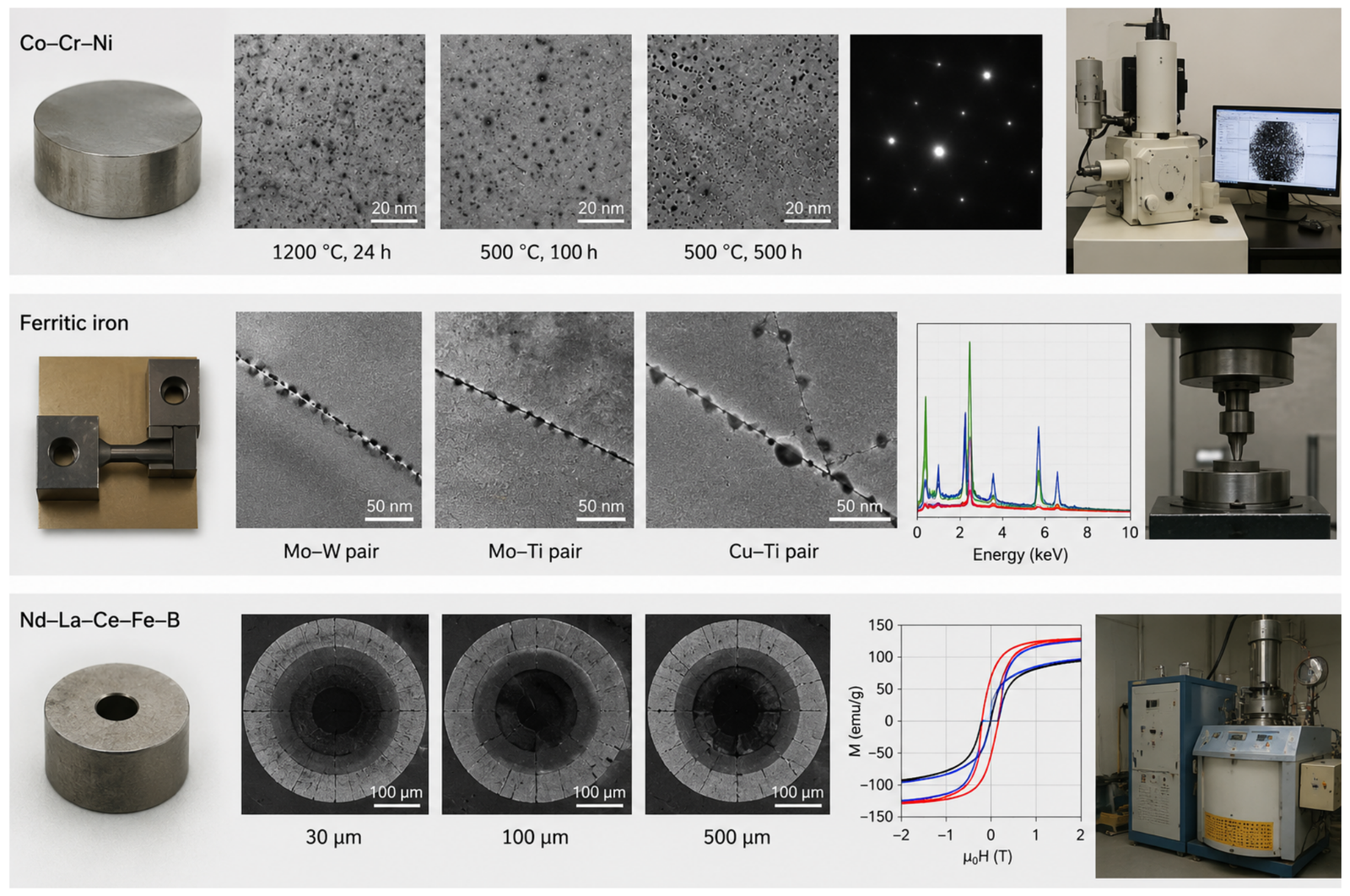
The interpretation of Figure 7 is that the weakness in each material case determines the subsequent experiment. Order requires quantification of local order above random variation, interface chemistry requires validation of cohesion, and diffusion depth requires validation that the shell and high Al content boundary phase remain bound. This avoids the problem of using a generic characterization protocol on three distinct material cases.
The findings point to three material-specific processing implications. Heat treatment of Co–Cr–Ni alloys should be guided by pair-specific diagnostic separation criteria rather than just annealing times. Selection of the 500\(^\circ\)C–500 h condition should occur only if it generates consistent local order that falls outside of the ambiguity zone and does not raise the clustering problem. The alloying of ferritic iron should not strive simply to enrich boundaries but to create paired states there that feature favorable cohesion signs and inhibit the formation of pairs with unfavorable signs of cohesion. Optimization of Pr–Al diffusion in Nd–La–Ce–Fe–B should focus on the depth range within which Pr–Al-rich shell, Al-rich inner shell, and high-Al rare-earth-rich boundary phase remain coupled.
Any transfer between related materials requires careful attention. A Co–Cr–Ni finding can be transferred only if the target alloy exhibits similar diagnostic separation for local order. A Mo/W ferritic alloy boundary finding can be transferred only if boundary character, impurity environment, and pairs’ occupation are similar. A Pr–Al magnet finding can be transferred only if shell chemistry and boundary phase continuity persist in the appropriate depth range. The object to be transferred is not the name of an element. It is the solute structure measurement along with its specific condition of viability.
The decision surface shown in Figure 8 summarizes the final classification. The 1200\(^\circ\)C–24 h Co–Cr–Ni state is retained as a comparison condition; the 500\(^\circ\)C–500 h Co–Cr–Ni state, Mo/W ferritic pairs, and the Pr–Al state near 100 \(\mu\)m continue to be design-relevant states to be confirmed directly for properties; and Cu-containing ferritic pairs and the deep Pr–Al state are excluded where their respective failure conditions control.
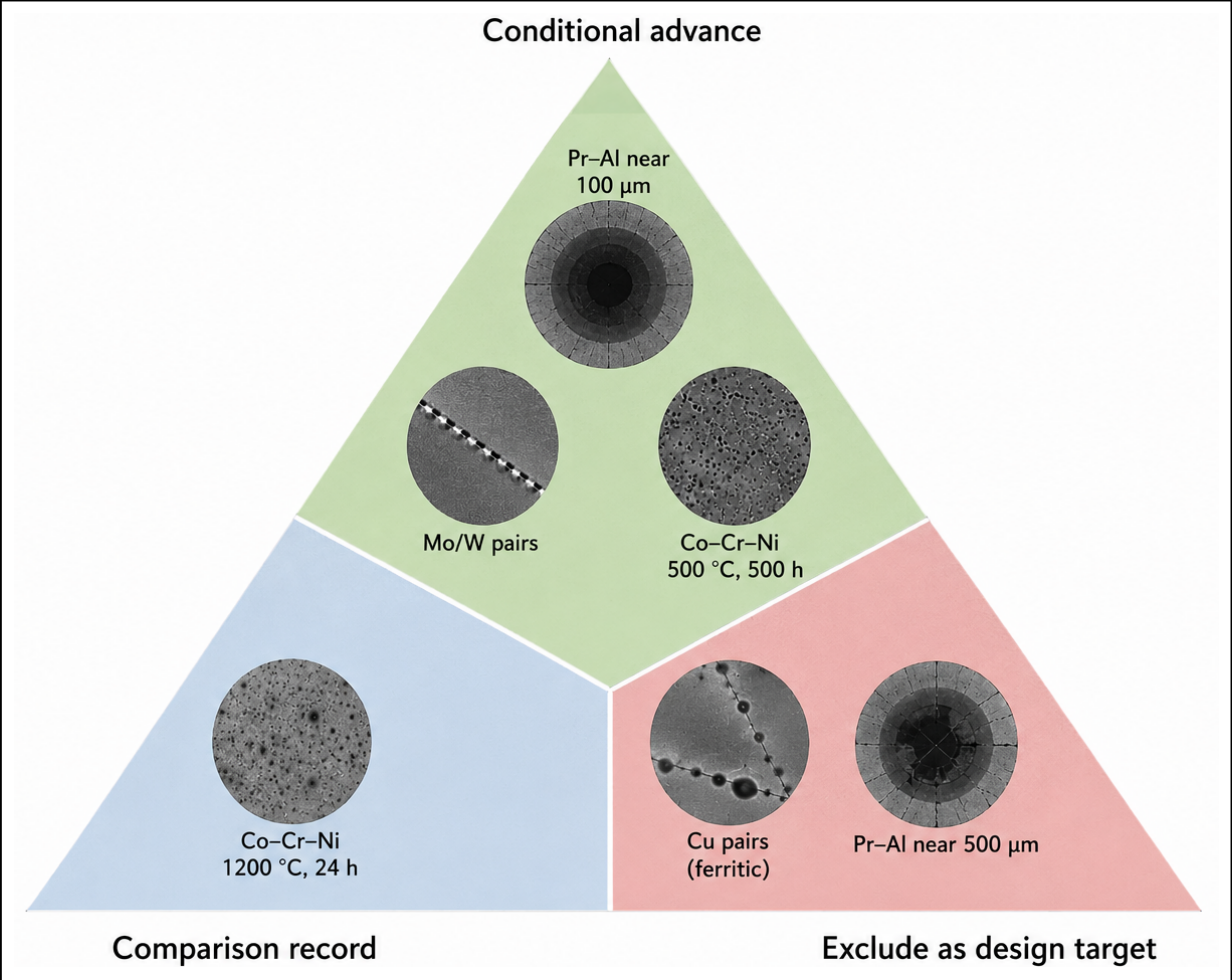
This visual classification is the reason why the six material cases could not be considered equivalent instances of successful solute control. Some cases are good candidates for targeted testing, one is the comparison condition, and two show the need for careful interpretation of chemically visible data. It is the main result since it transforms the material information into the decision instead of the generalized message about the importance of solute location. The decision surface also shows why the general statement that the conclusion could not be made in terms of control of solute atoms is inevitable. Control has different meanings in different regions of the triangle: comparison evidence prevents the over-reading of weak signals, selected states reveal the need for direct property check, and excluded states keep chemically visible yet physically ineffective arrangements from further investigations.
The research question was whether some of six material conditions could be chosen as comparison evidence, design-relevant states, or excluded states according to each material system’s particular site-specific failure condition. The result is that the chemical observation and retention of function on the appropriate physical site determine the usefulness of the solute evidence. The 1200\(^\circ\)C–24 h Co–Cr–Ni condition is the comparison condition because its weak-order signal falls within the \(-0.00022\) to \(+0.00022\) random-state interval. The 500\(^\circ\)C–500 h Co–Cr–Ni condition is the design-relevant state as long as pair-specific order is discernible and not clustering-dominated.
The ferritic iron provides another answer. Mo- and W-containing boundary pairs are the design-relevant states due to the compatibility of their paired boundary state with cohesion-preserving function. Cu paired with Ti, V, Cr, Mn, Co, or Ni is the excluded state if the paired boundary state decreases the resistance to separation. The magnet material offers a third answer. The Pr–Al diffusion becomes valuable near the point of the coupling of the shell and high-Al boundary phase, particularly close to 100 \(\mu\)m where the rare-earth-rich boundary phase contains Pr 22.30 at.% and Al 13.75 at.%. The area below 500 \(\mu\)m is not the design-relevant state if Pr or Al penetrate deeper than the isolation function of the high-Al boundary phase is lost.
The specific result is that the atomic-scale solute states turn into the actionable information only if the observed site, diagnostic separation, property direction, and failure condition coincide. Local-neighborhood state must be separated from the random uncertainty, interface state must provide cohesion, and diffusion-depth state must preserve the phase arrangement that confers on the diffusion treatment its magnetic properties. The material implication is obvious: Co–Cr–Ni heat treatment must be judged by pair-specific separation, ferritic boundary chemistry by cohesion sign, and Pr–Al diffusion by shell-boundary continuity.