
The practical side of laboratory instruction is an essential aspect of chemistry instruction, but there are more things that go into the first-year chemistry laboratory besides working with the equipment. It is a place in which students learn to interpret instructions, prepare equipment, monitor risk, observe change, document evidence, evaluate evidence, and interpret what they see. It is a combination of all these things that makes early practical instruction challenging for learners who have successfully navigated chemistry but still have not learned how to act like practical chemists. Therefore, the challenge is not just technical, but it includes such factors as confidence, anxiety, time-management, safety, documentation, independence, and knowing whether the results are reliable. Research on practical work notes that laboratory action alone is not enough to ensure learning [1]. Students require assistance to link practical action to the goal of the task [2]. Otherwise, laboratory work could turn into procedural compliance and not evidence-based knowledge [3]. Thus, the main educational challenge is to make chemistry accessible without simplifying the standards of laboratory practice.
Self-efficacy is an important factor in this context since it refers to students’ beliefs in their capacity to perform necessary actions [4]. These beliefs impact perseverance and reactions to difficulty [5]. Self-efficacy affects help-seeking and self-regulation [6]. It is related to academic self-concept but more specific to a task [7]. However, high self-efficacy is not always the desirable outcome in laboratory induction. When self-efficacy is used to help students perform actions and persevere in their effort, it should stay responsive to evidence and standards. Overestimation of one’s skills takes place when the student lacks necessary experience to assess the performance quality, a phenomenon well known in self-assessment research [8]. Thus, the goal of early practical instruction is not only whether students feel more confident, but whether their confidence becomes more aligned with laboratory practice.
Lab practice increases cognitive and emotional burden as students have to handle several interdependent tasks at once. Cognitive load theory explains why beginners have difficulties due to the competition of attention between conceptual reasoning, procedural instructions, equipment manipulation, safety considerations, and documentation [9]. Instructional design research also highlights the importance of managing interaction of several elements in complex learning tasks [10]. There are various instructional styles that can organize laboratory activity including verification and inquiry [11]. There are also several different goals that instructors might pursue during practical instruction, for example, technical competence, conceptual development, and scientific practice [12]. Students do not always interpret them in the same way [13]. In this case, Seery’s statement about lab being the place where students learn to conduct chemistry is particularly relevant as it recognizes practical instruction as more than lecture reinforcement [14]. Therefore, induction needs to prepare students for an environment where chemistry will be conducted, observed, documented, and explained.
Transfer is another major theoretical concept. Bransford and Schwartz describe transfer as preparation for further learning, not only the direct application of one task to another task [15]. This perspective is particularly suitable for first-year chemistry induction as an introductory course cannot teach every future laboratory competency, but still, it can prepare students to recognize what is important when formal laboratory work starts. Transition into first-year chemistry has already been addressed from the point of practical preparedness and differences between school and university expectations [16]. However, transition into first year also means assuming greater responsibilities for independent learning [17]. Cooking-related environment could lower the social and symbolic barriers of practical chemistry while retaining several characteristics of laboratory practice: measurement, sequence, cleanliness, timing, observation of changes in matter, controlled technique, and evaluation of results.
Chemical Kitchen course is a transitional practical setting for the first-year chemistry students [18]. Its educational value does not lie in replacing chemistry with cooking. Its value lies in the ability of using familiar material practice to rehearse habits that would be useful in the laboratory. Research on kitchen chemistry and domestic practical activity indicates that the familiar context can provide access to chemical ideas while remaining hands-on [19]. Research on mise-en-place and cross-disciplinary learning also emphasizes organization, timing, and embodied routines as transferrable professional practices [20]. Overall, transdisciplinary chemistry education can help students recognize chemistry in related adjacent practices instead of seeing it as a classroom subject [21]. Thus, kitchen induction can be seen as a threshold activity: it reduces the barrier of practical participation but gives students an opportunity to meet the standards of control and evidence for the first time.
Transfer surface in Figure 1 represents this threshold. Familiar kitchen practice and formal laboratory practice are not merged into the same activity; on the contrary, common practical habits between them are represented.
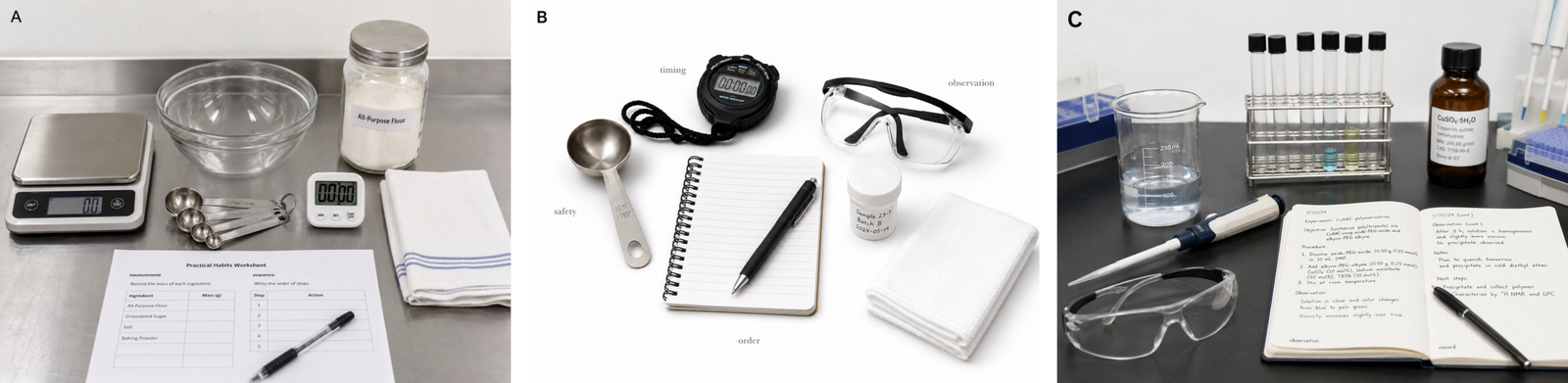
Three-panel surface helps define the conceptual boundary of the paper. Kitchen panel defines low intimidation entry to practical activity, the middle panel defines habits which are transferable between settings, and laboratory panel defines the strict environment where observation and measurement have to be formalized as the evidence. This interpretation keeps the course from being understood as mere decorative culinary analogy. It proves that confidence gained in a kitchen environment is educationally valuable if the student links it to subsequent record-keeping, workspace organization, safe behaviour, and chemical explanations.
The theory of meaningful learning provides further support to this interpretation. Novak emphasized the unity of thinking, feeling and doing in learning [22]. Galloway and Bretz introduced a similar framework into chemistry laboratories by emphasizing the cognitive, affective and psychomotor aspects [23]. The kitchen-based induction becomes educationally relevant because it impacts all these aspects: students handle materials, explain changes, and experience practical activity as something closer to them. Meaningful learning also implies feedback. Sadler explained that formative assessment includes learner’s understanding of the standards, comparison of his/her work with these standards and effort to decrease the discrepancy [24]. Similarly, White and Frederiksen showed the importance of modelling, inquiry, and reflection for making science practices accessible [25]. Thus, induction should not be limited to giving assurance. It should help the students realize what practical skills are now secure and what should be explicitly taught.
The evidence problem emerges from the literature mentioned above. The mean scale change of confidence can conceal educationally valuable information. Increase of confidence can be useful encouragement, but it can also indicate untested enthusiasm. Decrease of confidence can be discouraging, but it can also be the result of increased awareness of laboratory standards. The most informative question for early chemistry education can be formulated as the directional and interpretive one. The research questions are: What outcomes of the Chemical Kitchen induction demonstrate readiness for immediate entry to practical work? What outcomes demonstrate the need for transfer of practical knowledge to formal laboratory study? The answer to this question will emerge from the 75 pairs of self-efficacy scores, nine item directions, and 15 percents of free-response codes of the Chemical Kitchen course [18]. The course provided calibrated practical readiness: it encouraged many students to start practical chemistry, but it also indicated that organization, independence, accurate records, and complicated practical ideas still need to be learned.
The dataset used was composed of the results of Chemical Kitchen experiences of 75 freshmen chemistry students [18]. Three types of data were analyzed. The first type was that of paired self-efficacy movement, which was as follows: 46 students improved, 21 declined, and eight stayed the same. The group that improved progressed from an initial average of 3.35 to a latter one of 3.85 while the declining group went from 3.84 to 3.45. The Wilcoxon test produced \(p=0.0024\) with effect size \(r=-0.42\). The second type of data was the direction of nine significant survey-items. Five items were moving in the positive direction: completing all assignments, performing the most difficult assignment, developing careful techniques, maintaining the cleanliness of the workstation and safety in the laboratory, and perceiving the cooking-oriented laboratory class as less frightening than a chemistry-oriented class. Four items were declining: working individually, organizing abilities, recording observations and measurements accurately, and comprehending complicated practical concepts. The third type of data was the 15-code free response percentage for increased and decreased self-efficacy groups.
| Record element | Records | Analytical role |
|---|---|---|
| Self-efficacy movement | 75 paired records grouped as 46 increased, 21 decreased, and 8 no apparent change | Establishes the confidence-calibration profile of the cohort. |
| Significant survey-item directions | 9 item directions | Identifies whether confidence movement supports practical entry or reveals transfer demand. |
| Free-response codes | 15 paired percentage records for increased and decreased groups | Compares student interpretation across confidence-movement groups. |
| Synthesis categories | 4 readiness channels | Integrates movement, item direction, and salience into a practical-readiness account. |
Scope is set by the evidence summary in Table 1. Self-efficacy records establish the cohort-level movement; item directions establish which practical capabilities moved; and free-response percentages establish how students characterised the course. These elements underwrite a readiness framework because they establish confidence movement in relation to practical demands. They do not underwrite individual-level trajectories or predictive claims on future performance, hence the absence of such claims in the article.
Confidence-Workmanship Alignment connects self-efficacy to disciplined practical accomplishment. By “workmanship” is meant here skilled technique, proper and safe space organisation, accurate observations, trustworthy records, proper autonomy, and the link between the process and chemistry concepts. This reading makes no assumption of the positive value of high confidence levels; it considers whether confidence becomes more credible through engagement with practical demands. Growth in self-efficacy implies growth in entry confidence, while a fall in self-efficacy implies caution following engagement with practical criteria. The No Movement group stays constant as a category, since mean group levels were unavailable.
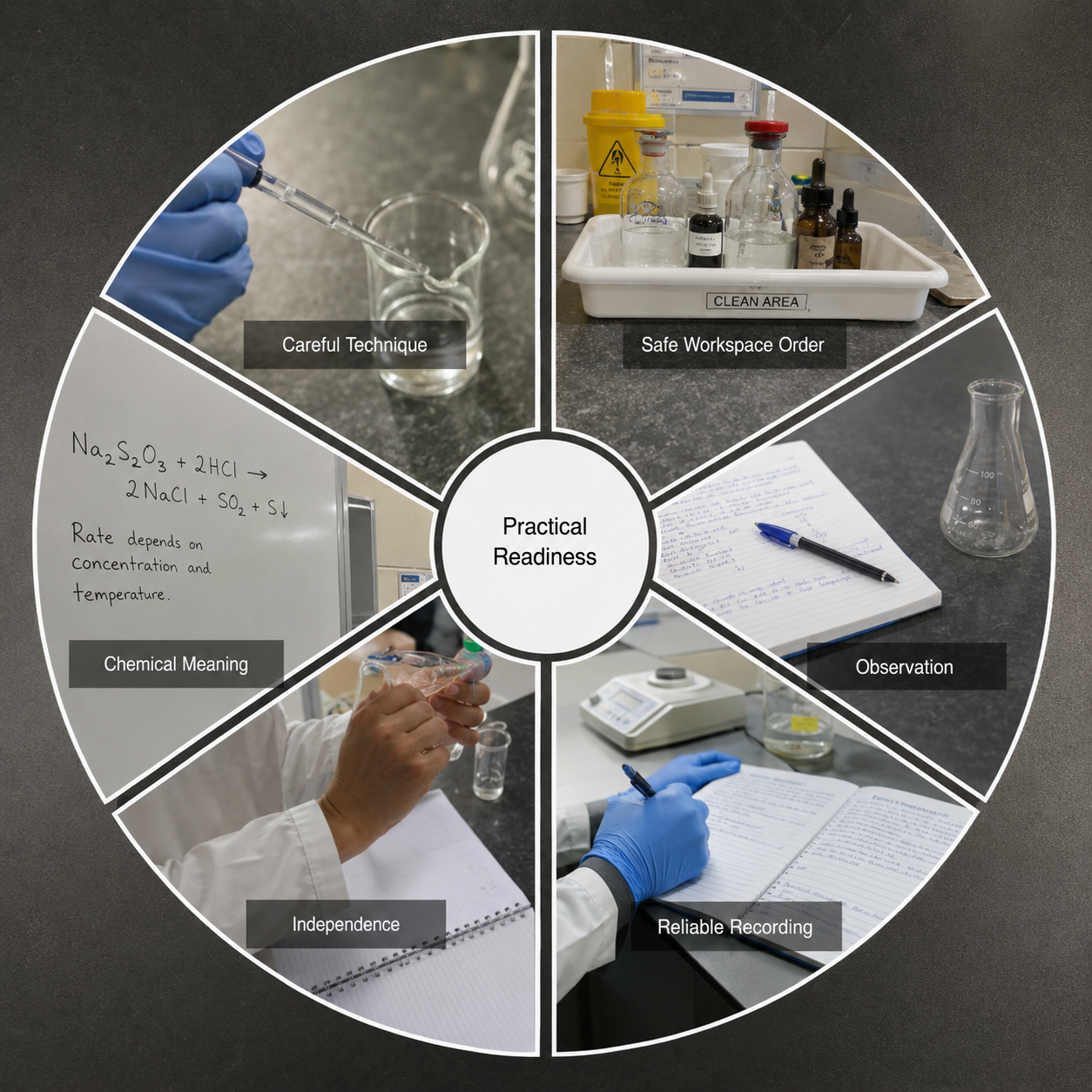
Workmanship field in Figure 2 presents the practical language used in this reading. The illustration keeps the analysis grounded in student accomplishments and not only in confidence levels.
Importance is found in the study because self-efficacy is not considered as an independent attitude. Skillfulness, safety, observation, recording, independence, and chemistry meaning are the practices within which readiness is expressed. Increase in confidence level is significant only insofar as it improves entrance into these practices. Confidence decrease is significant because it defines one of the practices that is seen by students as a challenging task. Learning in laboratory setting involves cognitive and affective components and not procedural achievement [23]. In addition, it involves practical and psychomotor performance [14].
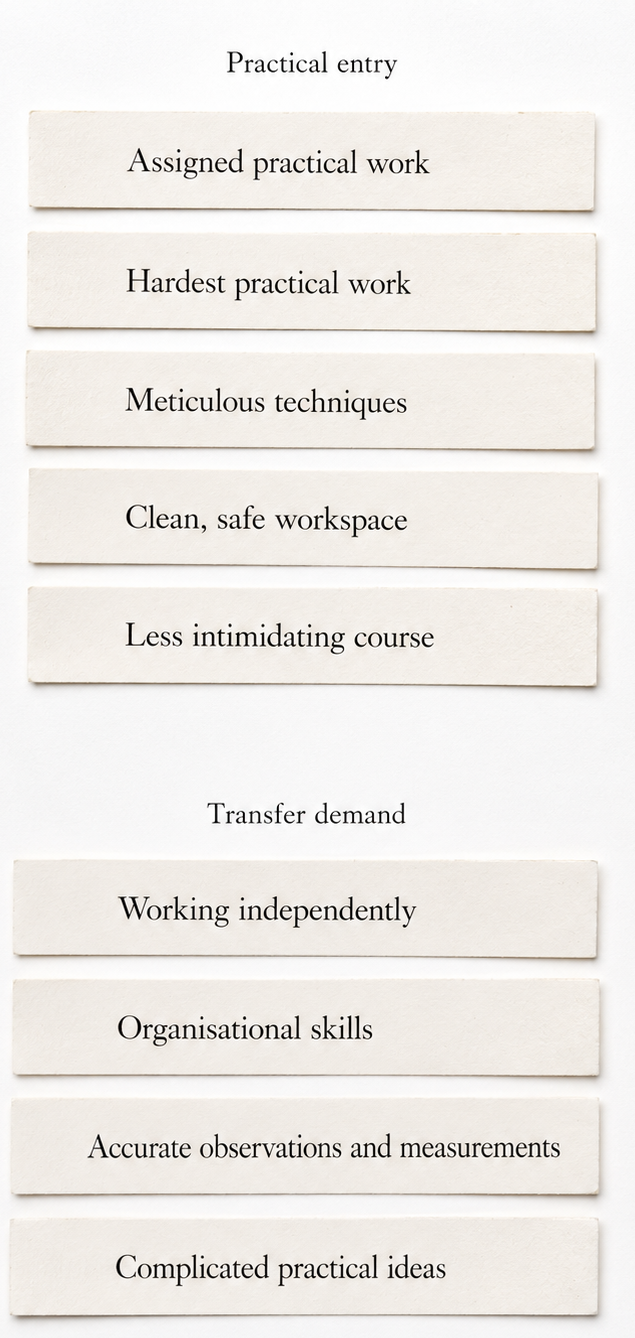
The Transfer-Burden Partition divides the nine survey items into two interpretative families. The items related to entrance into practices reduced the threshold of entrance into practical activity: completion of assignments, challenging practical work, careful technique, proper and safe conduct of a workspace, and reduction of intimidation. The transfer-related items increased visibility of future requirements of laboratory work: independence, organisation, recording, and complex practical concepts. The partition is descriptive and clarifies directionality but no inference test is introduced.
The Salience-Contrast Analysis ranks each free-response code in the descending order of the difference in percentage point between the confidence movement groups. For each code, the contrast is computed as
where \(p_{c,\mathrm{increased}}\) is the percentage of increased self-efficacy group assigned to the code \(c\), and \(p_{c,\mathrm{decreased}}\) is the percentage of decreased self-efficacy group assigned to the code \(c\). Positive values represent greater salience in the increased group; negative values represent greater salience in the decreased group. The computation ranks the 15 code percentages but does not transform percentages into respondent counts, estimate uncertainty, or individual-level pathways.
The value checking procedure paid attention to the consistency, directionality, and boundedness of interpretation. The group counts, means, item directions, and percentages were utilised exactly as course-level values. The concept of “transfer readiness” refers to cues prior to the transition into laboratory work or near it. It does not claim verified transfer outcomes. Such a boundary is required since the records lack connected information on laboratory grades, notebook evaluation, observations and performances.
The findings concerning the self-efficacy variable reveal calibration as opposed to just gaining in terms of confidence level. For the 75 paired sets of data, 46 students had an increase in confidence from 3.35 to 3.85, 21 students experienced a decrease in confidence from 3.84 to 3.45, and there were eight students who did not experience any change at all. The Wilcoxon test was significant (\(p=0.0024\), \(r=-0.42\)). In terms of education, the finding reveals the convergence of the two groups. Those students whose initial confidence levels were low experienced an increase, while those whose confidence levels were high experienced a decrease. This pattern does not correspond to uniform confidence inflation. This shows that the class brought about the students’ approach to a more reliable relationship between confidence and reality.
| Movement group | Students | Initial mean | Later mean | Interpretation |
|---|---|---|---|---|
| Increased self-efficacy | 46 | 3.35 | 3.85 | Confidence strengthened for students who began with lower practical assurance. |
| Decreased self-efficacy | 21 | 3.84 | 3.45 | Initially high confidence became more cautious after exposure to practical demands. |
| No apparent change | 8 | Unavailable | Unavailable | Confidence position remained stable in the course-level values. |
The movement values in Table 2 constitute the first answer to the research question. Immediate entry readiness is evidenced in the 46 students whose confidence grew following a familiar but rigorous practical course. Continued transfer demand is indicated by the 21 students whose confidence shrank following their exposure to practical standards. The shrinkage should not be interpreted as failure since the same set of records provides evidence that the course was of educational value. Instead, it indicates productive caution: students who started out highly confident found out that practical work performed in an organized manner and properly recorded is harder than they thought. Confidence fuels actions and perseverance on challenging tasks [4]. It must still be calibrated in light of the constraints in self-assessment [8]. Calibration is essential to proper self-regulated learning [6].
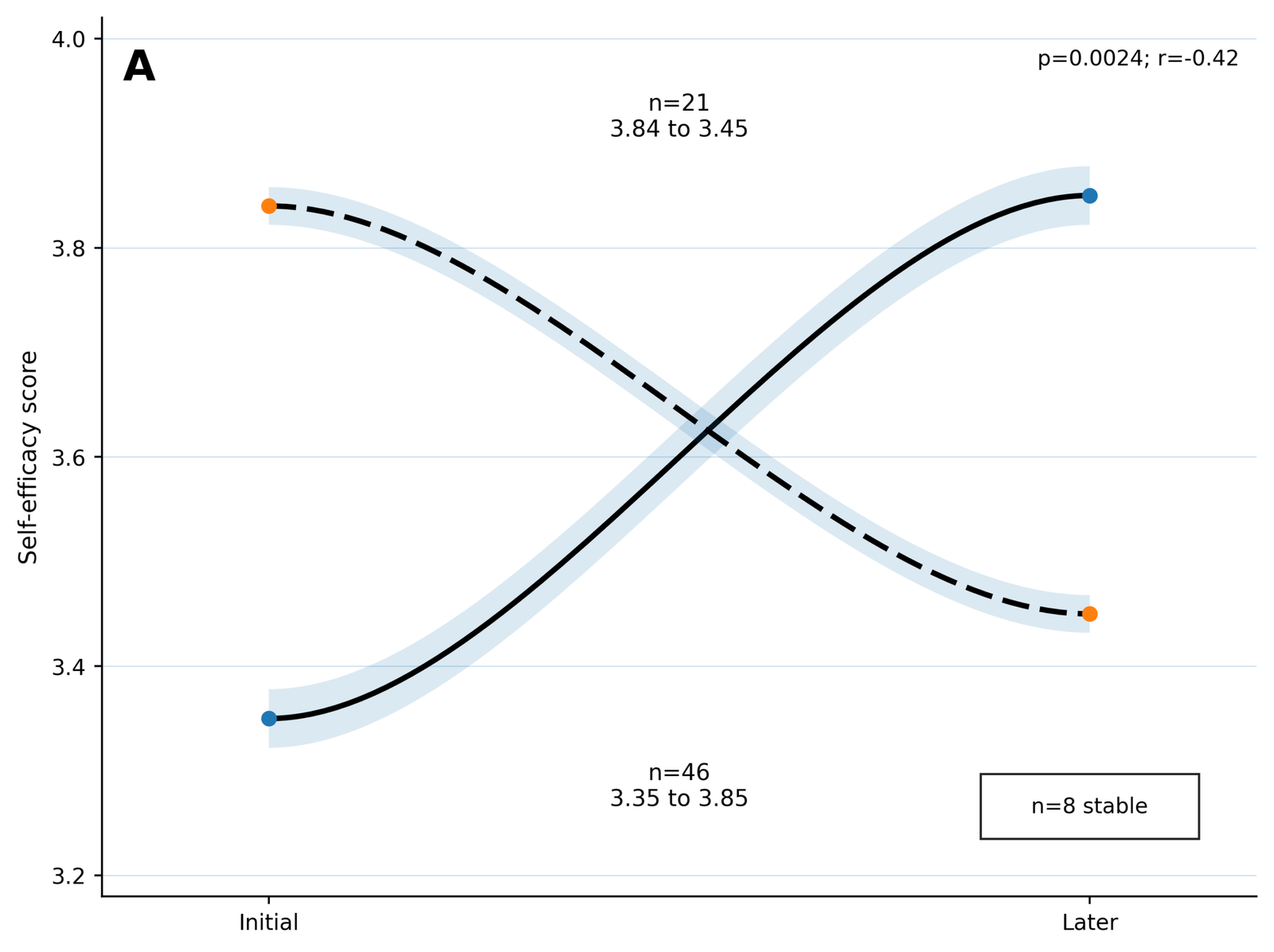
The convergence chart in Figure 3 gives the result without making up any individual responses. The bands rely exclusively on the given group averages and sizes.
Convergence visualizes the conclusion that the primary result is not a general increase in confidence. The increased group started out lower than the decreased group and finished higher than it started, whereas the decreased group went from initially high confidence to a more cautious position. For course design purposes, it is important to note that the two groups now require different treatments. Those whose confidence has increased need chances to transform entry motivation into dependable achievement. Those whose confidence shrank need systematic help to turn caution into systematic autonomy and not avoidance.
The item direction result identifies which kinds of confidence changed. The five significant upward moving items pertain to practical entry and visible craftsmanship: completion of practical assignments, performance of the most challenging practical work, practice of meticulous techniques, maintenance of a clean and safe working area, and reduction of intimidation with the cooking-oriented course. These are direct preconditions for practical chemistry entry. The four significant downward moving items relate to the burdens that come to the fore when students approach the formality of the lab: independence, organization, proper documentation, and complex practical concepts.
| Readiness role | Survey-item area | Direction | Interpretation |
|---|---|---|---|
| Practical entry support | Completing all assigned practical work; doing the hardest assigned practical work | Increase | Students became more willing to start, persist, and complete demanding practical tasks. |
| Manual and spatial entry support | Practising meticulous techniques; keeping the work surface clean and working safely | Increase | The course strengthened confidence in visible disciplined action and safe workspace order. |
| Affective entry support | Cooking-focused course as less intimidating | Increase | Familiar material practice lowered the threshold for approaching practical chemistry. |
| Coordination demand | Working independently; overall organisational skills | Decrease | Students recognised that autonomy requires planning, sequence, support-seeking, and coordination. |
| Evidence-production demand | Accurate recording of observations and measurements; understanding complicated practical ideas | Decrease | The course exposed the difficulty of producing trustworthy records and connecting procedure with chemical meaning. |
The item partition in Table 3 provides a more detailed answer than movement totals by themselves. The highest level of entry readiness is where the course has made students feel capable of completing, attempting, handling, organising and working safely. The highest level of transfer demand is where formal laboratory competence needs more than willingness to participate: students must be capable of planning independently, keeping good records, and comprehending difficult practical concepts. The movement downwards in these areas indicates what will need to be taught in the future. It points out precisely where the students require modelling, practice and feedback rather than mere encouragement.
The readiness partition in Figure 4 divides the nine significant item directions into practical entry and transfer demand. The upper and lower groups are meant to be seen as complementary outcomes.
The figure makes it evident that a carefully-designed induction can produce two sorts of useful information simultaneously: evidence that confidence has grown, and indications of where the next stage of teaching needs to be more overt. Such an interpretation is in line with transfer-as-preparation since readiness does not consist of the absence of difficulty; rather, it is the ability to recognize difficulty as a necessary part of learning to come [15]. Students becoming less confident about being able to work independently and make accurate records are not to be encouraged rhetorically, but rather provided with formative laboratory exercises in which the students can plan, record, explain and revise in accordance with criteria [24].
The free-response percentages provide a student language overlay for the results on confidence and item directions. The increased group focused more strongly on the importance of improving practical skills, enjoying the course, enjoying practicals or laboratory work, and the relaxed atmosphere of the course. The decreased group emphasized the difficulties related to COVID restrictions, transition difficulties, lack of confidence, broad understanding of chemistry, expectation of practical skill improvement, and the claim that the course was a good method of learning chemistry including practical skills. Thus, the decreased group does not simply reject the course in free response; in several areas, those who reported decreased confidence still see value in the course.
The values of salience in Table 4 explain further the reason for lower confidence levels. The largest negative difference was the opinion that the course was a useful way to learn chemistry, including practical skills: 60% for the group whose confidence decreased compared with only 17% for the group whose confidence increased. This finding differentiates low confidence from negative judgement. The students who had lower confidence might develop an understanding of the serious nature of chemistry study and therefore were more likely to consider the course educational. The second largest negative difference referred to the difficulties associated with COVID-19: 60% in the decreased group and 28% in the increased group. It means that the conditions of course delivery and transition disrupted students’ confidence. The largest positive difference was skill improvement, which accounted for 72% in the increased group and 52% in the decreased group.
| Free-response code | Increased group | Decreased group | Contrast |
|---|---|---|---|
| A good way to learn chemistry, including practical skills | 17% | 60% | -43 |
| COVID specific challenges | 28% | 60% | -32 |
| Improved my practical skills | 72% | 52% | +20 |
| Fun | 51% | 33% | +18 |
| It has been a difficult transition into undergraduate chemistry | 26% | 43% | -17 |
| I lack confidence in my ability | 2% | 19% | -17 |
| More relaxed or less intimidating introduction to practical chemistry | 26% | 14% | +12 |
| I am generally enjoying chemistry modules | 36% | 24% | +12 |
| I am enjoying practicals or laboratory work | 21% | 10% | +11 |
| I expect to improve practical skills during my degree | 13% | 24% | -11 |
| I expect to develop a broad understanding of chemistry | 17% | 24% | -7 |
| I am excited about Chemical Kitchen | 45% | 52% | -7 |
| I am concerned about how difficult the workload will be | 15% | 19% | -4 |
| I expect a positive challenge from university | 30% | 33% | -3 |
| Time management is a challenge or causing difficulty | 17% | 14% | +3 |
The contrast strip in Figure 5 arranges the 15 codes according to their percentage point difference. The negative values indicate greater salience in the decreased group. The positive values indicate greater salience in the increased group.
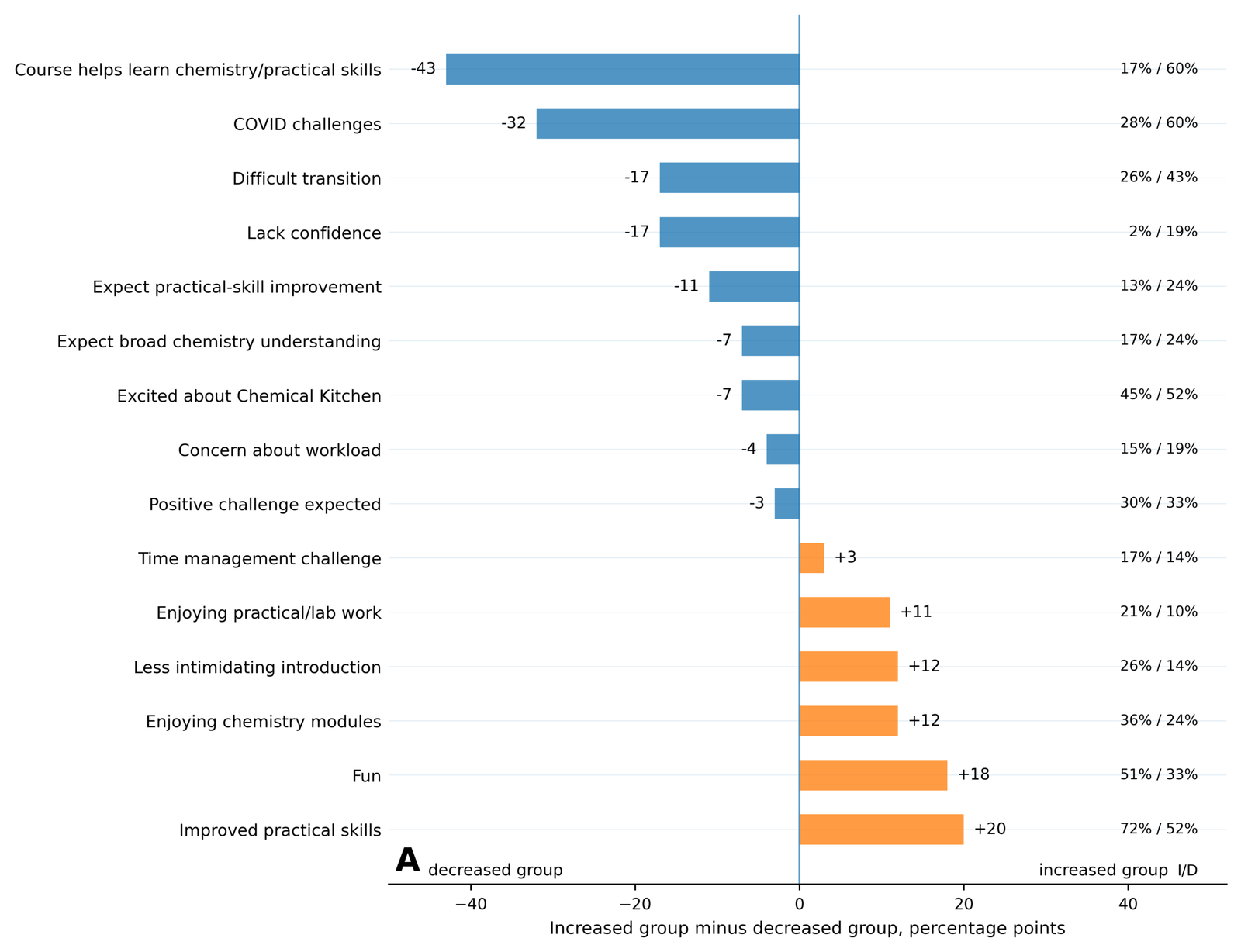
The central-zero diagram clearly demonstrates the two-sided affective nature of results. The students who had increased confidence were inclined to use enjoyment-related language and the language referring to skill development. On the other hand, those who experienced a decrease in confidence used the language of challenge, disruption, and education value. This finding is important because it demonstrates the coexistence of affective approach and disciplinary seriousness. For some students, the kitchen environment decreased fear and helped them engage in activities. For others, it made the students aware of how much chemistry still had to be learned. Both effects are valuable if later laboratory classes are based on providing explicit support for record keeping, organization, independence, and explanation.
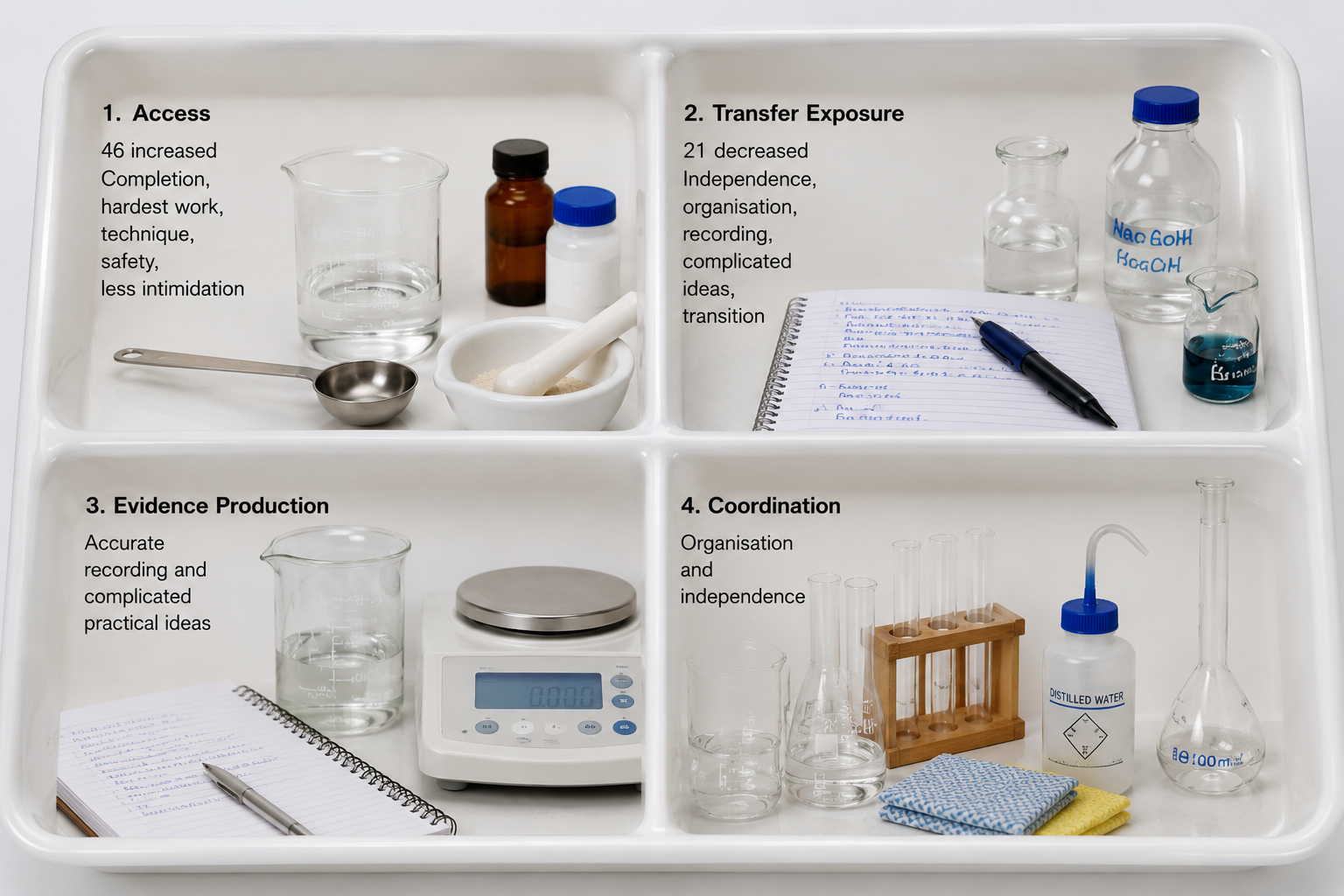
The combined result of readiness can be provided in terms of four channels. The access channel is justified by 46 students who had increased self-efficacy, upward movement in completion and difficulty, skill and safety gain, and salience of skill improvement and enjoyment. The transfer-exposure channel is supported by 21 students who had lower self-efficacy, movement downwards in independence, organization, recording, and complicated ideas, as well as greater salience of transition difficulty and lack of confidence. The evidence-production channel is supported by lower confidence regarding accurate recording and complicated practical ideas. The coordination channel is supported by lower confidence regarding independence and organization.
| Readiness channel | Evidence base | Educational implication |
|---|---|---|
| Access channel | 46 of 75 students increased; practical-skill improvement reached 72% in the increased group; confidence rose for completion, hard work, meticulous technique, safety, and reduced intimidation | Kitchen-based induction made practical chemistry more approachable and gave many students credible confidence to begin practical work. |
| Transfer-exposure channel | 21 of 75 students decreased; confidence fell for independence, organisation, recording, and complicated ideas; transition difficulty and lack of confidence were more salient in this group | The course revealed demands that require explicit support before confidence can transfer into formal laboratory performance. |
| Evidence-production channel | Accurate recording and complicated practical ideas were decreased-confidence domains | Later laboratory teaching should provide formative feedback on records, observations, and links between procedure and chemical meaning. |
| Coordination channel | Organisation and independence were decreased-confidence domains | Autonomy should be taught as planned, supported, and collaborative action rather than as isolated self-reliance. |
Table 5 links the result directly to course design. Access confidence and transfer confidence are different educational outcomes. Access confidence enables students to start, manipulate materials, tolerate difficulties, and perceive practical action as feasible. Transfer confidence is harder, as it calls for carrying habits of observing, recording, organising, and reasoning into the laboratory context. A student can develop the former type of readiness in the kitchen and still need scaffolded learning of the latter one.
The readiness plate in Figure 6 shows the four channels separately but in connection with each other. The design corresponds to the empirical structure of the result: the channels come from the same 75-student record set, but suggest different teaching approaches.
The plate interpretation informs a staged first-year practical sequence. The kitchen course can be positioned at the beginning of the sequence, because it develops willingness to handle materials, perform tasks, observe transformations, and access practical chemistry. Laboratory sessions can return to the domains where confidence is low. Entries in notebooks can be seen as evidence objects rather than personal reminders; students can compare samples, identify omissions, and correct their records before evaluation. Organisation skills can be exercised through pre-lab worksheets, timed preparation, and discussions of laboratory workspace organisation. Independence can be taught as autonomous activity with oversight, where students articulate their plans, execute them, and report instances and reasons for getting help. In such a sequence, induction will produce readiness signal and laboratory teaching will make use of it to provide targeted support.
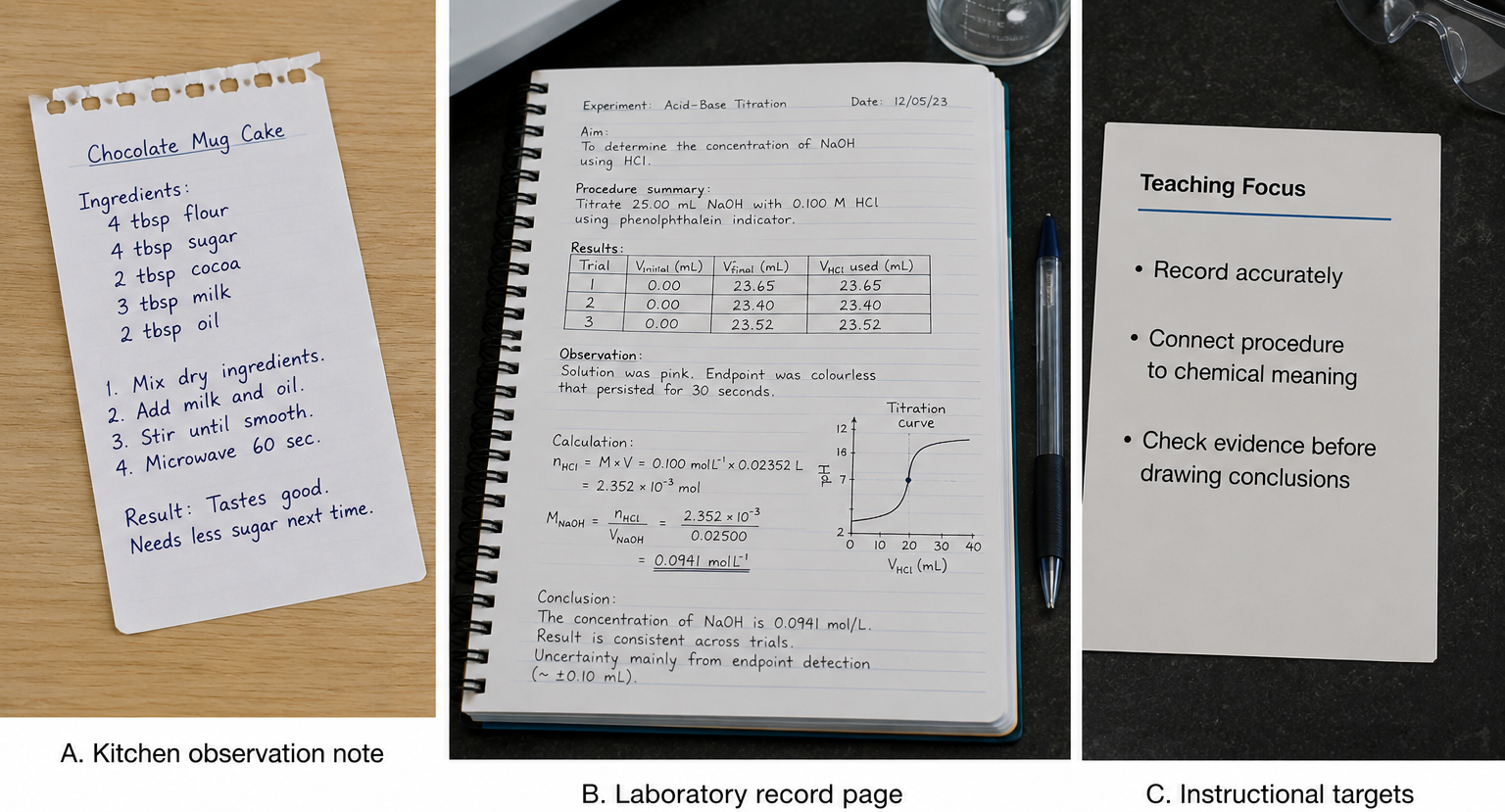
The record discipline in Figure 7 concentrates on the most tangible implication of the items with decreased confidence: informal observation should become structured evidence.
The final visual interpretation is that record keeping is not a trivial technical issue. Record keeping is the place where practical action turns into evidence that can be evaluated, shared and interpreted. Transition from a kitchen note to a laboratory record page is the core transfer problem revealed by the 75-student record set. The student may feel ready to perform after kitchen induction, but the study of formal chemistry requires recording of his or her action, explanation of its importance, and verification that the record confirms the conclusion. This is the very domain where further teaching can turn caution measured with calibration into laboratory skills.
The result also has implications for the course evaluation. The summary reporting only the change in self-efficacy level will not reveal the most valuable information contained in these records. More comprehensive evaluation should retain movement groups, analyse the changes of individual items and ask students to specify what became easier and more difficult. Such an application of course-level values will give instructors the information necessary to determine which areas of development should receive greater attention in the next course cohort: records, workspace organisation, planning, independence or transition from observing the kitchen process to observing chemical transformations.
The interpretation is limited. The records contain no respondent-level row, no subgroup identifier, and no post-laboratory performance score. The free response contrasts show salience, but not causality. The item partition identifies directional changes but does not validate the measurement scale. These limitations clarify rather than undermine the result. Seventy-five self-efficacy paired records, nine item directions, and 15 free response percentages are enough to answer the research question about readiness for entry and continued transfer demand; they do not indicate exactly how the laboratory performance of each particular student will change.
The research question was what aspects of kitchen-based chemistry induction showed immediate readiness for practical entry and what aspects showed continued demand for laboratory transfer. The answer is that in Chemical Kitchen there was calibrated readiness and not the uniform gain in confidence. The aspects of immediate entry readiness are: the 46 students who gained from 3.35 to 3.85, and also the positive direction of the items about completing assignments, practical work, techniques, safety of workplace behavior, and reduction of intimidation. These results suggest that familiar material practice could contribute to the start of practical chemistry of first year students in a credible manner.
The aspects of continued transfer demand are: the 21 students who decreased their scores from 3.84 to 3.45, and the negative direction of the items about independence, organization, recording of information, and complicated practical ideas. These results answer the second part of the question: the course has helped students see the laboratory standards. So, the decrease is not the undifferentiated negative result. It points at the domains which will require the additional support in order to convert confidence into reliable laboratory practice.
The free-response evidence explains how the two conclusions are possible. The increased-confidence students talked about improving skills and pleasure from practice, while the decreased-confidence students explained that the course helped them transition, experienced disruptions related to COVID, had low level of confidence, and found the course valuable for learning chemistry. Students who become more cautious did not lose interest in the course. On the contrary, they often recognized the educational value of the course while becoming aware of demands of chemistry practice.
From the point of view of curriculum design, the paper offers the precise conclusion: the kitchen-based induction should be used in order to open the access to practical chemistry, but then the students should receive the intentional instruction in records, organization, monitored autonomy, and chemical explanations. The course succeeds when it helps uncertain students to enter the practice, and when it helps initially confident students to see the standards of disciplined practice. Therefore, the coherent first-year laboratory sequence should connect the aims of affective access and evidence discipline.