
The instruction of operational amplifiers represents a challenging moment in the educational cycle for electronics, since the symbolic relations are straightforward, while the practical choices are not always apparent. While a student may successfully repeat the ideal gain equation for a typical amplifier, it can be doubtful whether he or she will decide correctly the terminal for a signal, estimate the role of feedback in determining the gain, understand the changing output polarity, identify saturation, or change a resistor in a way consistent with the measured response. Thus, the issue of operational-amplifier instruction is not only whether students remember an equation. It is whether they can shift from a well-known circuit equation to a practical decision in the real circuit. In that respect, operational-amplifier laboratories become a good case for studying the link between conceptual mastery and inquiry-oriented practical competence.
Virtual laboratories have become common in engineering education, due to their ability to repeat an exercise several times, change its parameters and see the consequences immediately, and to perform without permanent access to hardware facilities. Traditionally, laboratory teaching should be aimed not only at procedural success, but also at the ability to plan, to interpret, and to experiment [1]. Comparative laboratory studies, as well, emphasize the coordination of theory and measurement in hands-on, simulation and remote laboratories [2]. Virtual laboratories are able to achieve this goal through the active prediction, manipulation, and inspection of technical phenomena [3]. Summaries of non-traditional laboratories suggest that learning occurs depending on the design and the evaluation of an exercise [4]. A virtual laboratory is most useful when students explain the results of their observations, and not follow a series of predetermined clicks [5]. For electronic courses, this issue is especially important, since the circuit simulation displays the relation between the component parameters and the output behavior in a time efficient manner allowing learners to test their competing explanations.
Recently, the literature has become even more explicit in its understanding of virtual laboratories as not simply a substitute for physical sessions. Comparisons between physical and virtual laboratories confirm that the two laboratory types have their respective advantages in education [6]. A recent meta-analysis identifies the positive effects of virtual laboratories on the achievement in engineering education [7]. Systematic assessment research still shows the dependence of the outcomes on achievement and learning measures [8]. Review studies, as well, underline the importance of task design and its embedding in a course [9]. Studies of remote laboratories emphasize the need for activities embedded in the active engagement and reflection [10]. The same is true for blended laboratories, as they need some structured feedback rather than digital manipulation per se [11]. This research follows this line of discussion by identifying the moments in a virtual operational-amplifier sequence when learners develop their practical skills and the moments when they lose the connection.
In this context, the learning of operational amplifiers provides a particularly strong test. Inverting, non-inverting and differential amplifiers represent the interconnected issues, but they cannot be considered as interchangeable exercises. The inverting amplifier requires the understanding of inversion, virtual ground principle, and feedback ratio. The non-inverting amplifier keeps the feedback as the central idea, but changes the input position and output polarity. The differential amplifier requires the coordination of two inputs, resistor matching, and the interpretation of output as a difference relation. While a learner can easily perform the first task, he or she cannot necessarily transfer the stable practical reasoning to the second or third tasks. Therefore, this sequence is not just a series of circuit cases; it is a progression in which each task prepares students for the following one.
The literature on active learning and inquiry learning allows explaining the importance of such preparation. Active-learning research suggests that the students will learn better if they make a choice and interpret the consequences of it, rather than just receive an explanation [12]. The large-scale study in science and engineering courses confirms the advantage of active learning [13]. The literature on inquiry learning adds that scaffolding should facilitate the generation and evaluation of evidence by the learner, and not just protect him or her from any difficulties [14]. Meta-analytical evidence confirms that guidance is effective in inquiry learning if it is appropriate for the learner [15]. The feedback research emphasizes the necessity of clarifying the distance between the current and desired performance for the learner [16]. The feedback should guide the next learner’s actions, and support self-regulation [17]. In a virtual operational-amplifier task, this action will be technical: to connect the input, change the feedback element, to run the simulation, to compare the output and to justify the result.
There is another literature on laboratory work in engineering education warning about the danger of assessment becoming too narrow in its focus. Assessing engineering laboratories show that the measures of achievement often underestimate the processes of the use of knowledge during the experiment [8]. The experiential-learning literature stresses that laboratory outcomes include not only cognitive, but also psychomotor and affective aspects [18]. The situation becomes even more critical for virtual laboratories because a learner will receive a correct simulated output without showing the stable practical reasoning. On the contrary, a task might not demonstrate the highest final mean of inquiry skill, and yet reduce the variability of practical performance among students. Therefore, the challenge of assessment is to read the mean progress in conjunction with the distance between domains and the change in variability.
The present study was conducted with 138 undergraduate engineering students performing three virtual operational-amplifier exercises in TINA–TI [19]. The data of this study includes pre-test and post-test means with standard deviations of knowledge and inquiry skills in each exercise, and Pearson coefficient of correlation between knowledge and inquiry skills in general and in the conditions of guidance and non-guidance. This information is sufficient to investigate an instructional issue: what are the characteristics of knowledge and inquiry skill growth in three amplifier exercises, and which point in the sequence requires the special instructional development?
This research question is different from the question about the effectiveness of virtual laboratories. A positive post-test gain will partially answer the latter question. The answer for an instructor is rather related to the behavior of sequence, since the task might improve both domains and not carry the practical readiness to the following configuration. Another task might demonstrate a large knowledge–inquiry distance but reduce the variability of practical performance. This paper therefore investigates attainment, domain distance, carryover between adjacent tasks, relative dispersion, and the consistency of the knowledge–inquiry relationship in different levels of guidance. All calculations are purely descriptive and use only the pre-test and post-test means, standard deviations, and Pearson coefficients listed for the three amplifier tasks; no additional intervention and participant grouping are performed.
The numeric data comprised the pre- and post-class scores of 138 engineering undergraduate students who completed three operational-amplifier tasks in the TINA–TI digital world [19]. The included tasks were the inverting amplifier, the non-inverting amplifier, and the differential amplifier. Every task involved both pre- and post-scores regarding knowledge and inquiry skills. Knowledge involved comprehension of the circuit, how it operates, and its essential aspects. Inquiry skills involved the capacity to adjust the circuit, alter the circuit elements for obtaining the wanted result, collect and analyze observations, and apply critical thinking for achieving a circuit-based conclusion.
The included data also allowed for assessing knowledge-inquiry associations during guidance and non-guidance situations. Guidance meant having general information prior to the activities and help from the professor in case of significant problems for the students. Non-guidance meant completing the activity independently. These correlation values were not used for drawing causal conclusions. They were only used to see if knowledge and inquiry skills stay correlated in the two types of support settings. The data analysis is briefly described in Table 1.
| Record component | Numerical values | Instructional reading |
|---|---|---|
| Attainment | Pre-test and post-test means with standard deviations | Shows whether knowledge and inquiry skills increased within each task. |
| Domain distance | Knowledge minus inquiry-skill means | Shows how far practical performance remained below conceptual performance. |
| Task carryover | Adjacent pre-test, post-test, and gain differences | Shows whether one amplifier task prepared students for the next. |
| Relative spread | Coefficients of variation before and after each task | Shows whether score dispersion narrowed across the class. |
| Guidance relation | Pearson coefficients under overall, guided, and non-guided conditions | Shows whether knowledge and inquiry skills remained associated under support conditions. |
This organization keeps the work within the framework of the values listed above. This organization does not invent a new method of teaching, does not introduce the participant-level participant records and does not try to infer individual learning trajectories. The presented table also explains why the author considers the three amplifiers configuration in the sequence: the most important question here is not only whether the students learned better during each activity, but whether the result of one activity ensured the next one.
The calculations were limited to descriptive quantities obtained from the means, standard deviations and correlations mentioned in the paper. The absolute gain was calculated as the difference between post-test and pre-test means. Proportional gain was calculated as gain divided by pre-test mean and given as a percentage. Post-test domain distance was calculated as the difference between knowledge post-test mean and inquiry-skill post-test mean in the same exercise. The coefficient of variation was used to describe the relative spread: standard deviation divided by mean and multiplied by 100. The compression of the relative spread was the difference between pre-test and post-test coefficients of variation: the higher the positive value was, the more successful the narrowing of the spread.
The carryovers between the neighboring tasks were described by the three direct comparisons. The entry carryover was measured by the comparison of the next exercise pre-test mean and previous exercise post-test mean. The endpoint carryover was measured by the comparison of the next exercise post-test mean and previous exercise post-test mean. The gain carryover was measured by the comparison of the next exercise gain and previous exercise gain. Negative values indicated that the later exercise started below, finished below or gained less in the same domain than the earlier one.
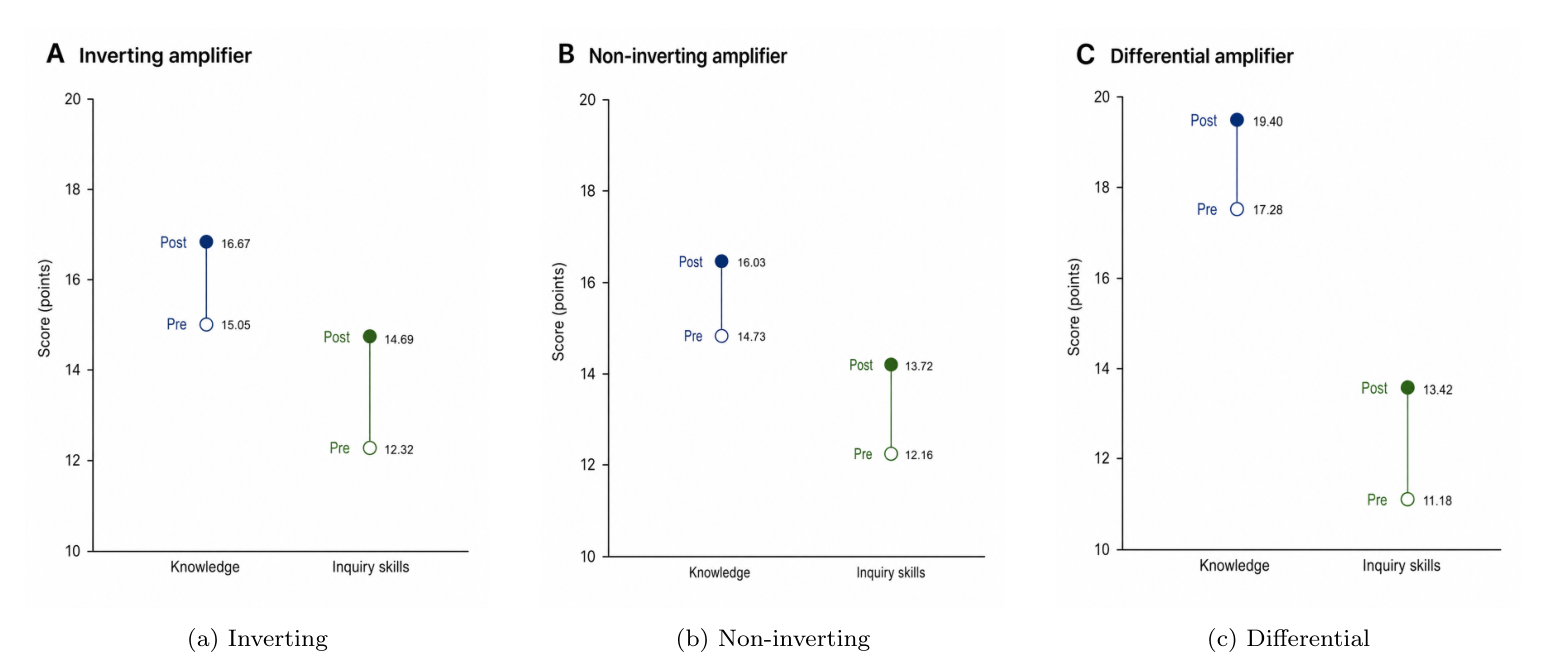
The empirical score data is shown in Table 2. The post-test mean was greater than the pre-test mean for all of the tasks. For all of the tasks before and after the virtual activity, the knowledge score was greater than the inquiry-skill score. The largest knowledge score was in the differential amplifier test, where it equaled 19.40, while the largest inquiry-skill score was in the inverting-amplifier test, where it was 14.69. This comparison clearly demonstrates that neither conceptual attainment nor practical inquiry reached its peak at the same point in the sequence.
| Exercise | Domain | Pre-test mean | Post-test mean | SD pattern |
|---|---|---|---|---|
| 1 | Knowledge | 15.05 | 16.67 | 6.425 to 5.996 |
| 1 | Inquiry skills | 12.32 | 14.69 | 6.628 to 6.709 |
| 2 | Knowledge | 14.73 | 16.03 | 6.393 to 6.821 |
| 2 | Inquiry skills | 12.16 | 13.72 | 7.001 to 7.790 |
| 3 | Knowledge | 17.28 | 19.40 | 7.246 to 7.168 |
| 3 | Inquiry skills | 11.18 | 13.42 | 8.302 to 7.096 |
The values of the scores above have addressed the first part of the research question posed at the outset – the virtual tasks brought about an improvement in both categories, although the ranking of the end points was inconsistent. The inverting task yielded the best practical end point, whereas the differential task yielded the best conceptual end point. It is noteworthy that the non-inverting task yielded the least post-test score in both categories.
The panels depicting endpoints in Figure 1 reveal the imbalance in the domain visually. Knowledge increases in all three activities and attains its maximum in the differential amplifier. Inquiry skills increase, too, but the maximum score in the latter does not belong to the final task but to the first one. The resulting picture, accordingly, is not an upward staircase. It is a split pattern where knowledge keeps improving, while practical inquiry needs further development following the first amplifier task.
The values computed for the domains in Table 3 demonstrate that inquiry skills improved more than knowledge both absolutely and relatively in all exercises. Gains for inquiry skills amounted to 2.37, 1.56, and 2.24 points, whereas gains for knowledge were 1.62, 1.30, and 2.12 points. Relative gains for the inquiry skill were 19.24%, 12.83%, and 20.04%. Nevertheless, inquiry skills stayed lower than knowledge in every post-test. The minimum domain distance was 1.98 points in the inverting amplifier and the maximum was 5.98 points in the differential amplifier.
| Exercise | Domain | Gain | Prop. gain (%) | Post distance | CV compression |
|---|---|---|---|---|---|
| 1 | Knowledge | 1.62 | 10.76 | 1.98 | 6.72 |
| 1 | Inquiry skills | 2.37 | 19.24 | 1.98 | 8.13 |
| 2 | Knowledge | 1.30 | 8.83 | 2.31 | 0.85 |
| 2 | Inquiry skills | 1.56 | 12.83 | 2.31 | 0.80 |
| 3 | Knowledge | 2.12 | 12.27 | 5.98 | 4.98 |
| 3 | Inquiry skills | 2.24 | 20.04 | 5.98 | 21.38 |
The refined values improved the result in two aspects. First, practical investigation did not stand still; it responded proportionally in all three exercises. Second, good proportional response did not mean that the end result was going to be similar to the knowledge endpoint because the differential exercise started with a big practical disadvantage. Hence, the maximum practical compression value, 21.38 percentage points in Exercise 3, is a significant result because although the last exercise reduced the range of inquiry skill marks, it did not elevate the inquiry endpoint closer to the knowledge endpoint.
The adjacent-task values in Table 4 reveal the weakest part of the sequence. The shift from the inverting to the non-inverting amplifier was negative in each value. Knowledge started 1.94 points below the endpoint of the first exercise and finished 0.64 points lower. Similarly, inquiry skills started 2.53 points below the endpoint of the first exercise and ended 0.97 points below it. Both gain values declined in both domains. However, the shift from the non-inverting to the differential amplifier was more positive for knowledge and still unbalanced for inquiry skills.
The negative values during the first transition answer the second part of the research question. The non-inverting amplifier represented the least reliable bridge as it failed to sustain the level achieved during the inverting task. The practical domain experienced a greater entry loss; this is especially significant since the circuits can look very much alike but require different considerations regarding the placement and polarity of inputs. The latter transition partially restored the situation, but the inquiry skills entered the differential amplifier underdeveloped.
| Transition | Domain | Entry carryover | Endpoint carryover | Gain carryover |
|---|---|---|---|---|
| Exercise 1 to Exercise 2 | Knowledge | -1.94 | -0.64 | -0.32 |
| Exercise 1 to Exercise 2 | Inquiry skills | -2.53 | -0.97 | -0.81 |
| Exercise 2 to Exercise 3 | Knowledge | 1.25 | 3.37 | 0.82 |
| Exercise 2 to Exercise 3 | Inquiry skills | -2.54 | -0.30 | 0.68 |
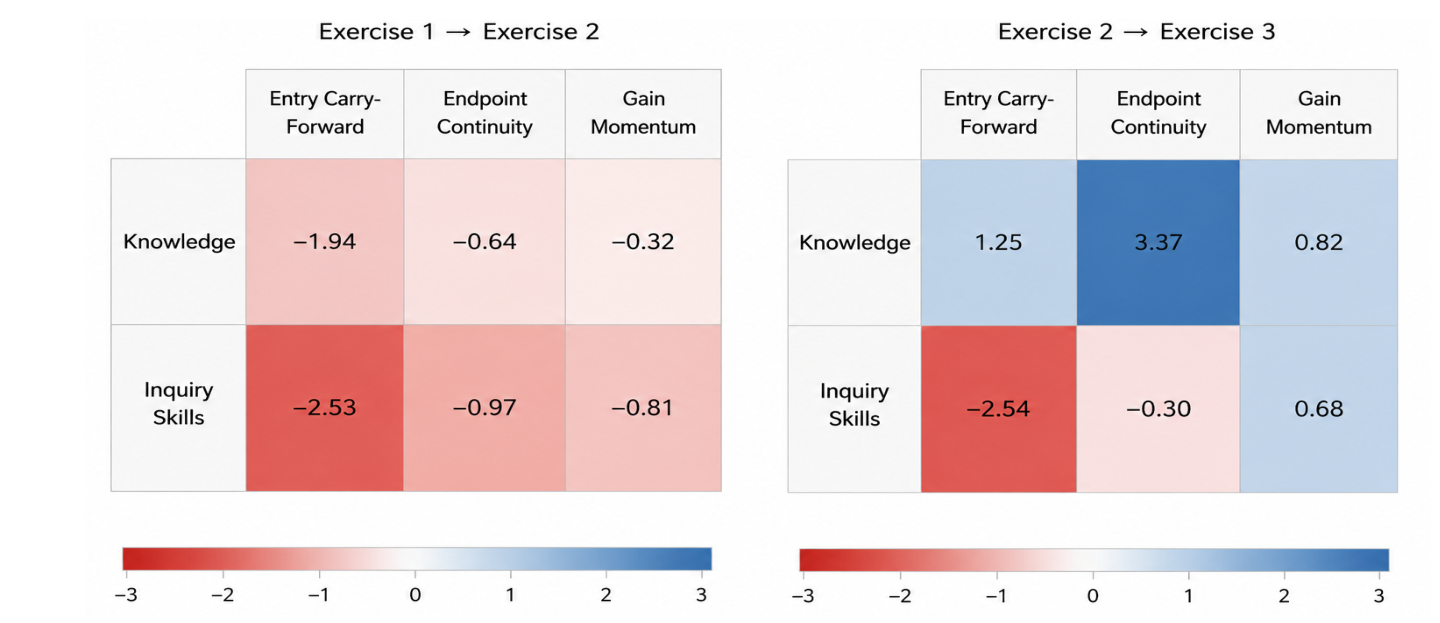
As can be seen from the color scheme presented in Figure 2, there is a significant difference between the two transitions. The left matrix represents negative values throughout, proving that the non-inverting amplifier disturbed the sequence in terms of both knowledge and inquiry skills. The right matrix presents the conceptual restoration in the case of the differential amplifier and the practical recovery, however, the latter is incomplete. Thus, the last task activated students’ activity in spite of low levels of readiness to perform it.
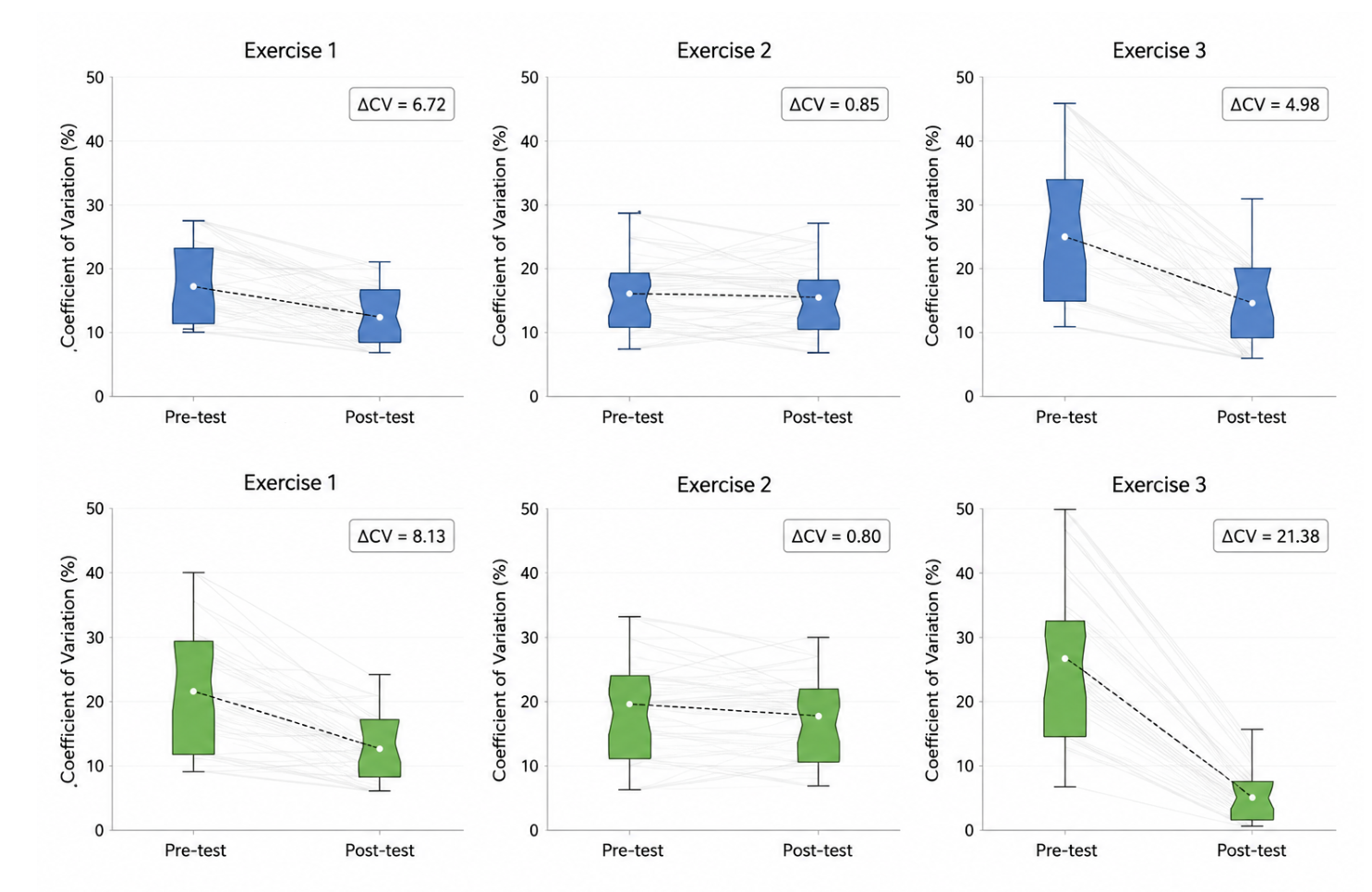
The visual depiction of the relative dispersion is provided in Figure 3. Exercise 2 is the least convincing task since the compression of knowledge and inquiry skills was less than one percentage point. The differential amplifier is the most effective narrowing task for inquiry skills when the coefficient of variation decreased from 74.26% to 52.88%. This result is important as the final task started at a high level of unevenness and resulted in the lower dispersion of practical performance.
In Figure 3, the panels that occur in pairs differentiate between average gains and dispersion compression. Although Exercise 3 did not yield the highest endpoint for inquiry, it yielded the highest dispersion compression for inquiry skills. This distinction is crucial to the conclusion of the paper; even a hard task at the end can be useful if it ensures that the performance becomes more uniform among the students. However, since the post-test average for inquiry was just 13.42, an additional practice is required.
Compact figures in Table 5 put the core conclusion in an easy-to-understand format. Exercise 1 has the highest average gain and the lowest post-test distance. Hence, this exercise can be considered the best-balanced task of the entire sequence. Exercise 2 is the weakest one in terms of average gain and virtually has not any compression of the spread of values. Finally, Exercise 3 is characterized by the biggest average gain and compression, but the big post-test distance proves that conceptual competence was well ahead of practical inquiry skills.
| Exercise | Avg. gain | Post distance | Mean CV compression | Inquiry-priority compression | Instructional meaning |
|---|---|---|---|---|---|
| 1 | 2.00 | 1.98 | 7.43 | 1.41 | Most balanced early task |
| 2 | 1.43 | 2.31 | 0.82 | -0.05 | Weakest bridge task |
| 3 | 2.18 | 5.98 | 13.18 | 16.40 | Strongest spread-reduction task |
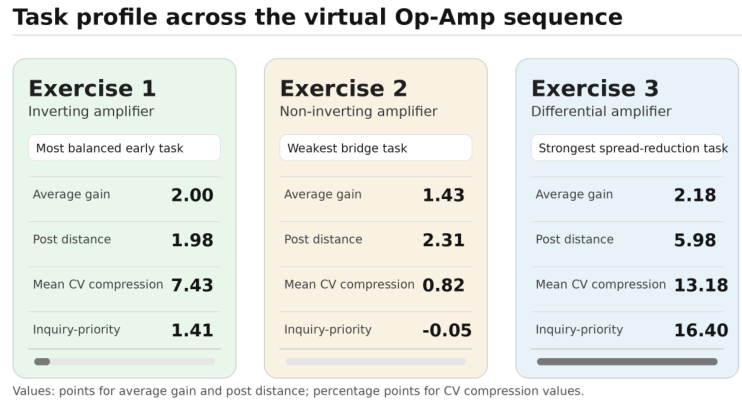
The cards with profiles on Figure 4 provide the similar contrast but in a journal format. The first card is good due to high values of average gain and distance. The second card is poor since all values show limited gain or compression. The third card is controversial since it provides the best average gain and compression but the biggest post-test distance between conceptual and inquiry skills. The visual analysis allows formulating a specific instruction answer, not generalizing about the virtual sequence success/failure.
The values of Pearson coefficients in Table 6 are rather high and demonstrate positive correlation between knowledge and inquiry skills. The total value equals 0.663. The corresponding value for guided condition equals 0.649, and for non-guided – 0.682. The difference between the coefficients is only 0.033, which means the stability of relations between concepts and practices in the two different support conditions.
| Condition | Coefficient | Distance from overall | Interpretation |
|---|---|---|---|
| Overall | 0.663 | – | Strong positive association |
| Guided | 0.649 | -0.014 | Association remains strong with support |
| Non-guided | 0.682 | 0.019 | Association remains strong during independent work |
| Guided–non-guided band | 0.033 | – | Narrow difference between conditions |
These values do not mean that the role of support was negligible; rather, they indicate that support had little effect on the relationship between knowledge and inquiry skills. Strong conceptual skills were accompanied by strong inquiry skills regardless of whether support was provided or not. The instructional recommendation that can be made is that more specific support should be provided for the decision points in the circuit problem.
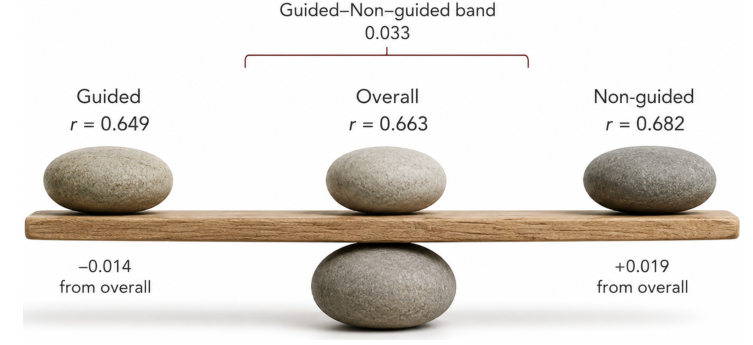
The balance plot in Figure 5 helps visualize the smallness of the difference between guided and non-guided conditions. The coefficient was not reduced during the independent work and did not increase greatly during the guided work. This finding makes us focus on the time and substance of the guidance, rather than on its presence. In an operational-amplifier learning task, support will be most useful at the point where the input location, feedback-path identification, wave form predictions or the mismatched output explanation is required.
The results address the research question by uncovering two separate instructional problems within one task sequence. The first problem is domain distance: knowledge remained higher than inquiry skills in all exercises. The second problem is task carryover: the non-inverting amplifier did not maintain the level reached after the inverting amplifier. These two problems are related but distinct: a task can develop both domains while maintaining domain distance, and a task can have positive within-task gain but lack carryover to the next task.
The inverting amplifier should be considered the most balanced entry task in the sequence. It generated a knowledge gain of 1.62 and an inquiry-skill gain of 2.37, and had the lowest post-test domain distance. This is pedagogically reasonable: the inverting amplifier provides students with a clear relationship between the input signal, the feedback resistor, the gain magnitude, and the output polarity. The circuit is complex enough to require actions but simple enough to make feedback effects visible. It is useful in an early virtual laboratory experience because students need a task that allows them to link a rule to a manipulated circuit without high representational load.
The non-inverting amplifier constitutes the primary drawback. It had positive within-task gains but all carryovers from the first task to the second were negative. This means that the second activity failed to translate the outcome of the first activity into a better starting point or endpoint. This is probably due to the fact that the non-inverting amplifier can be treated as a minor variant of the inverting amplifier. Students may know that a resistor ratio determines gain but underattend to the modified input terminal, lack of inversion, and altered relationship between input reference and output. The next task should not only ask students to build another amplifier but help them compare why the two circuits behave differently, predict the invariance in the new configuration, and understand the difference in the meaning of a resistor change.
The differential amplifier represents a third type of instructional challenge. It showed the highest knowledge endpoint and the highest reduction in inquiry-skill relative spread, but also maintained the highest post-test distance between knowledge and inquiry skills. This finding does not represent a failure of the final task. It indicates that a complex amplifier can provide stable practical performance for the class while maintaining practical performance below conceptual performance. Students may become more consistent in their inquiry behavior but need more practice in handling two inputs, assessing differential output, and matching resistors. The appropriate solution is therefore practical consolidation after the final virtual task, not task simplification.
The correlation results add an additional aspect to the interpretation. Strong positive knowledge–inquiry relation means that practical performance was not detached from conceptual performance. Narrow guided–non-guided band means that support did not significantly alter the strength of this relation. Feedback is most useful when it clarifies the next step for the learner rather than only encourage or correct them [16]. Effective feedback should also facilitate self-regulation [17]. Similar findings are also present in the evidence on inquiry learning: guidance is most effective when it is targeted at the requirements of the task [15]. In this virtual lab, the most relevant types of guidance would be those that appear in places where students have to predict the polarity, choose the measurement node, revise feedback resistors, and explain the output discrepancy.
The comparison with the existing literature on virtual laboratories is also necessary. Meta-analytic evidence shows that virtual laboratories increase access and learning opportunities [7]. Systematic reviews also highlight the advantages associated with safety, repeatability, and flexibility in time allocation [9]. However, these features do not guarantee the same type of learning in all domains. A student may use a simulation repeatedly and fail to develop practical transfer of knowledge between related configurations. Conversely, a task may reduce the variation in performance even if the final mean is low. This paper therefore provides support for a more precise use of virtual laboratories in electronics teaching: simulations should be designed as opportunities for comparison, correction, and justification, not independent exercises that simply verify formulas. The figures and tables together reveal why the conclusion is necessarily task-specific. The score table and endpoint panels show development but different end-points. The derived values show practical responsiveness but persistent domain distance. The carryover table and heatmap reveal the non-inverting amplifier as the point of weakest continuity. Relative-spread panels and profile card reveal that the differential amplifier narrowed the variation of performance most strongly. The correlation table and balance image reveal that the knowledge–inquiry relation remained constant under the guidance condition. Taken together, these results address the question of the paper more precisely than the general statement about virtual-laboratory effectiveness.
The practical implications are straightforward. The first task should be kept in the sequence because it provides students with a manageable task that allows linking theory to practice. The second task should be made stronger with prompts for contrasting inverting and non-inverting behavior. The third task should be followed with consolidation that asks students to troubleshoot, justify, and verify differential-amplifier behavior. These implications are directly informed by the descriptive values of three tasks. The central principle of this design strategy is placing instructional support where numerical data reveal loss of continuity or persistent domain distance. The current study has limitations that must be taken into account when interpreting its findings. The values are aggregate means, standard deviations, and correlations, so the analysis does not reveal individual learning trajectories or subgroup differences. The guidance condition is reflected in correlation values and instructional descriptions, not in observations of each support interaction. The exercises involve three basic configurations of an operational amplifier, so the results may vary for other configurations such as filters, comparators, instrumentation amplifiers, or non-ideal operational-amplifier behavior. These limitations do not undermine the central conclusion of this paper; they define its level of generality. The findings describe task-level behavior in a sequence of three virtual operational-amplifier tasks.
The research question concerned the development of conceptual knowledge and inquiry skills in three virtual operational-amplifier tasks and the identification of the point in the sequence that requires the greatest instructional strengthening. The answer is task-specific. All three tasks developed both domains, but did not contribute equally to the sequence. The inverting amplifier generated the best conceptual–practical balance, ending with the lowest knowledge–inquiry distance of 1.98 points. The non-inverting amplifier was the weakest point because knowledge and inquiry skills entered and ended below the endpoint of the previous task and because its gains were the smallest. The differential amplifier showed the highest knowledge endpoint and the largest narrowing of inquiry-skill relative spread, but failed to close the practical gap from knowledge. The key conclusion of this paper is therefore not whether virtual operational-amplifier laboratories are generally effective or ineffective. The numerical data reveal a more precise picture: virtual work allowed growth but practical carryover weakened at the non-inverting amplifier, and practical performance remained lower than conceptual performance after the differential amplifier. Guidance did not significantly alter the strength of the knowledge–inquiry relation, with the coefficients of 0.649 under guidance and 0.682 without guidance. The course should therefore retain the inverting amplifier as the entry task, redesign the non-inverting amplifier as a stronger comparison task, and add practical consolidation after the differential amplifier. This conclusion answers the paper’s question by identifying the exact point of instructional failure and the exact final condition that still requires practical consolidation.