
There is a clear uniqueness of the Dental Materials Science course in the context of the undergraduate dental curriculum because it combines materials science education and prepares for clinical practice. The learner should understand such concepts as setting reactions, dimensional stability, corrosion, polymerization, bonding, cementation, wear, finishing, surface behavior, and biocompatibility; however, the importance of this knowledge is demonstrated only if it influences material selection, manipulation, error identification, and justifications of material usage. Hence, the ability to describe glass ionomer cements, mention the applications of gypsum, or define polymerization does not guarantee the successful completion of the course if the student is unable to apply this knowledge in a clinical situation, handling material risks, and making justified decisions about using the material.
Competency-based approach increases this requirement. Competence of a dentist is not the result of recall, but the process of interpretation of the situation, decision making, safe performance, and learning from feedback. The need for moving beyond named outcomes to observable tasks in dental education curricula has been highlighted in literature [1]. Competency frameworks used for organization of dental education focus on reviewable professional performance [2]. Competence-based education in health professions has been defined through observable abilities. Entrustable professional activities connect abilities and professional tasks [3]. Competence as a developmental process is characteristic of milestone approaches [4]. Reform of health professions’ education warns against terminal test [5]. In other words, for Dental Materials Science, it means that one written answer cannot prove that students are able to proportion, mix, time, adapt, inspect, and correct materials in laboratory conditions.
Another challenge of the course is its location among others in the curriculum, meaning that many students will not be able to fully comprehend the impact of material behavior on further operative, prosthodontic, orthodontic, implant, endodontic, pediatric, and laboratory decisions. If topics of materials are organized separately, as scientific units, the students will feel that material science is something apart rather than a series of decisions in clinical and laboratory situations. Perception of the stand-alone dental materials education has proven relevance, integration, and feedback in this field [6]. However, the curricula of health professions should also protect scientific width; the reduction of content is not the aim.
Alignment is crucial for this problem. Constructive alignment connects outcomes, teaching activities, and assessment opportunities, but the syllabus can be aligned without revealing the exact moment when the competence expectation becomes observable [7]. Programmatic assessment will interpret multiple pieces of evidence over time [8]. This approach also incorporates formative feedback with summative assessment [9]. Direct observation and feedback provide an important performance dimension [10]. All this is especially relevant to Dental Materials Science because the timely feedback is very important. The student’s miscalculation of the time, proportion, conditions of bonding, contamination risk, thickness, or dimensional stability requires correction before OSPE, not only the mark after it.
MDSS responds to this educational problem through the reading of Dental Materials Science in terms of material decisions. A material decision episode combines scientific concept with handling/observation task, feedback opportunity, and justification of material usage or rejection. 25 lectures topics and 8 practical sessions can be read for the purpose of generation of evidence. CTA, ECR, and HRL help to answer the following research question: Can a Dental Materials Science course record containing 25 C4 lecture topics, 8 P5 practical sessions, and 6 delivery-assessment entries reveal the places where the students generate visible evidence of explanation, material selection, manipulation, feedback, assessment readiness, and interdisciplinary translation?
The overview of the course record in Figure 1 establishes the scope of the paper. Three panels combine lecture records, practical records, and delivery-assessment records in relation to the same competence target.
This record overview focuses on the record set at the level of curriculum evidence and not learner achievement. The 25 lecture cards cover the cognitive breadth of the course, the practical objects are examples of manipulation and observation, and the six record forms indicate the delivery-assessment structure. Interpretation of the record set thus pertains to record-visible competence: the crucial issue is how competence is visible in the design of the course, not how learners scored.
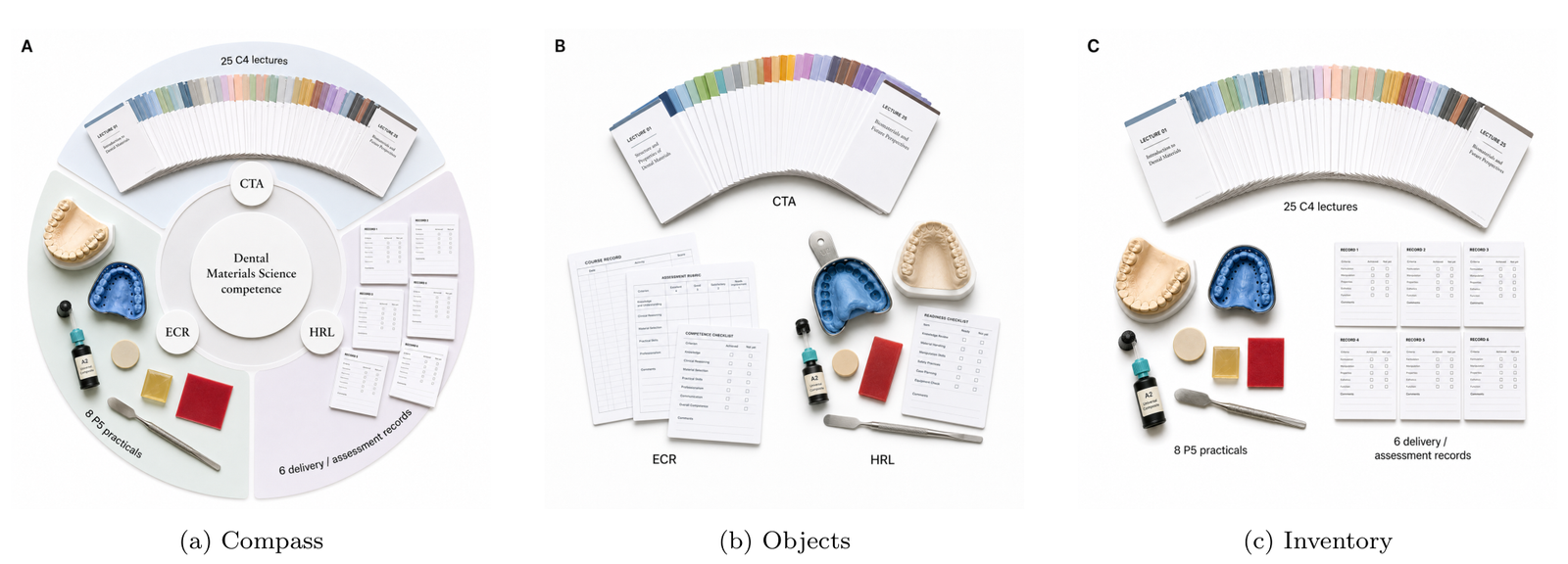
The curriculum record analysis in this study considered the course record as the unit of analysis. Individuals such as students, faculty members, patients, and clinical cases were thus excluded from the record set. It sought to identify whether the records in the Dental Materials Science course reveal an evidence pathway from content exposure to explanation, selection, handling, feedback, and readiness. There were no student scores, survey data, patient records, or faculty evaluations included in the analysis.
The input records in this curriculum record analysis were from the competency-based Dental Materials Science curriculum by Lin, Foong, and Kumaresan, which provided a list of 25 lectures, eight practical sessions, three course learning outcomes, target cognitive and psychomotor levels, teaching arrangements, assessment pathways, and delivery-assessment weighting ratios [11]. The topic-record section consisted of 33 records: 25 lecture records and 8 practical session records. Each lecture preserved its name, alignment with CLO, and C4 target level. Each practical session kept its name, alignment with CLO, and P5 target level. The weighting-record section had six entries: cognitive teaching delivery, psychomotor teaching delivery, cognitive formative assessment, cognitive summative assessment, psychomotor formative assessment, and psychomotor summative assessment.
Table 1 describes the exact sequence record: 33 topic records and 6 weighting records. The all-C4 lecture alignment determines the cognitive record level as explanation and justification. The all-P5 practical alignment determines the psychomotor evidence record beyond imitation and towards coordinated, independent handling. The main analytic problem, therefore, is the contact between the two record types.
MDSS divided lecture topics into material-decision families and established the connection of practical sessions to studio-laboratory episodes. Every studio episode consisted of four associated elements: material problem, handling or observation task, feedback and clinical justification. This way, outcome, activity, and assessment opportunities are aligned within the recorded course inventory [7].
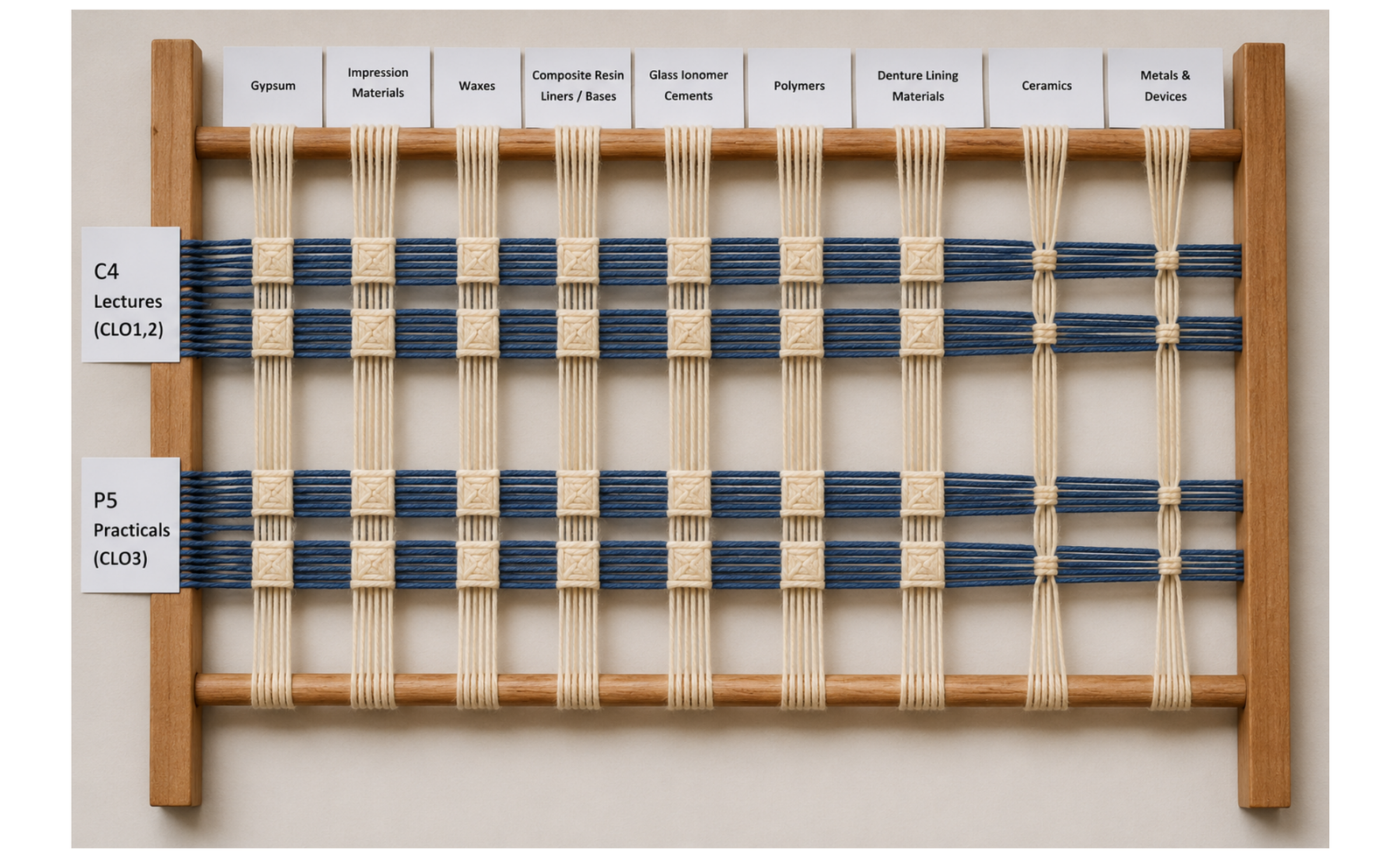
The C4–P5 alignment perspective in Figure 2 illustrates the sequencing in a contact map. Intersected woven intersections identify material groups with the direct contact of lecture explanation and laboratory handling such as gypsum products, impression materials, waxes, composite resin, liners, bases, glass ionomer cement, dental cements, polymers and denture lining materials.
Interpretation of the loom demonstrates that the alignment is uneven, not missing. Record-support materials and restorative-protective materials have high intersections because the laboratory contact is close to the lecture content. Ceramic, metallic, orthodontic and implant-related materials have low practical weave because the lecture area is broad but the practical contact is narrow. The distinction allows us to interpret dense and weak evidence contact rather than the topic count in the Results section.
| Type and no. | Course topic | Learning outcome | Target level |
|---|---|---|---|
| Lecture 1 | Introduction to clinical and laboratory dental materials | CLO1 and CLO2 | C4 |
| Lecture 2 | Properties of dental materials | CLO1 and CLO2 | C4 |
| Lecture 3 | Gypsum products | CLO1 and CLO2 | C4 |
| Lecture 4 | Tarnish and corrosion | CLO1 and CLO2 | C4 |
| Lecture 5 | Synthetic polymers | CLO1 and CLO2 | C4 |
| Lecture 6 | Denture base polymers | CLO1 and CLO2 | C4 |
| Lecture 7 | Bonding of resin-based materials | CLO1 and CLO2 | C4 |
| Lecture 8 | Impression materials | CLO1 and CLO2 | C4 |
| Lecture 9 | Principle of adhesion: acid etch and bonding agent | CLO1 and CLO2 | C4 |
| Lecture 10 | Dental composite resin | CLO1 and CLO2 | C4 |
| Lecture 11 | Glass ionomer cement | CLO1 and CLO2 | C4 |
| Lecture 12 | Resin-modified glass ionomer cement and compomer | CLO1 and CLO2 | C4 |
| Lecture 13 | Dental cements | CLO1 and CLO2 | C4 |
| Lecture 14 | Liners and bases | CLO1 and CLO2 | C4 |
| Lecture 15 | Dental abrasive and polishing materials | CLO1 and CLO2 | C4 |
| Lecture 16 | Dental wax | CLO1 and CLO2 | C4 |
| Lecture 17 | Denture lining materials | CLO1 and CLO2 | C4 |
| Lecture 18 | Introduction to metals and alloys: concept, structures, and properties | CLO1 and CLO2 | C4 |
| Lecture 19 | Cast dental alloys | CLO1 and CLO2 | C4 |
| Lecture 20 | Steel and wrought alloys | CLO1 and CLO2 | C4 |
| Lecture 21 | Dental ceramic | CLO1 and CLO2 | C4 |
| Lecture 22 | Porcelain fused to metal | CLO1 and CLO2 | C4 |
| Lecture 23 | Materials in orthodontics | CLO1 and CLO2 | C4 |
| Lecture 24 | Metal and alloys in dental implants | CLO1 and CLO2 | C4 |
| Lecture 25 | Emerging dental biomaterials and advanced technologies | CLO1 and CLO2 | C4 |
| Practical 1 | Introduction to clinical and laboratory dental materials | CLO3 | P5 |
| Practical 2 | Physical and mechanical properties of dental materials | CLO3 | P5 |
| Practical 3 | Mixing and manipulating gypsum products in dentistry | CLO3 | P5 |
| Practical 4 | Mixing and manipulating dental composite resin, liners, and bases | CLO3 | P5 |
| Practical 5 | Mixing and manipulating glass ionomer and other dental cements | CLO3 | P5 |
| Practical 6 | Mixing and manipulating impression materials and dental waxes | CLO3 | P5 |
| Practical 7 | Mixing and manipulating dental polymer and denture lining materials | CLO3 | P5 |
| Practical 8 | Introduction to dental ceramic and metal alloys | CLO3 | P5 |
CTA was used to every topic and weighting record. Every record was read for five evidence signals. Explanatory evidence meant whether the record requires the students to explain composition, properties, setting behaviour, physical reaction, mechanical performance, degradation and surface behaviour. Justificatory evidence meant whether the record allows the students to defend selection or rejection of the material for particular clinical or laboratory usage. Manipulation evidence meant whether the handling, proportioning, mixing, timing, adaptation, inspection or recognition of performance-altering mistake can be observed. Feedback evidence meant whether the record creates the possibility of correction before summative judgement. Assessment evidence meant the position of the signal: formative, summative or both. CTA was limited to course-design evidence.
ECR compared conventional and competency-based delivery-assessment structures. The percentage-point difference was calculated for cognitive teaching delivery, psychomotor teaching delivery, total formative assessment, total summative assessment, psychomotor formative assessment, psychomotor summative assessment and total psychomotor assessment.
Interpretation was based on whether the psychomotor evidence remained concentrated in the terminal OSPE performance or became distributed through laboratory practical assessment and summative OSPE. Repeated assessment information provides credible judgement [8]. It becomes more useful for learning if the evidence is interpreted in multiple assessment moments [9]. Dental assessment scholarship supports the same approach of learning-oriented evidence [12].
HRL converted the eight practical sessions into the readiness path. The five stages were material recognition, behaviour interpretation, controlled manipulation, selection justification and independent readiness. Recognition described identification of material groups and general use. Behaviour interpretation described connection of the observed property to its consequence. Controlled manipulation described the accurate handling under laboratory conditions. Selection justification required students to defend their choice using function, limitation and risk. Independent readiness described performance and justification under OSPE-like conditions. The feedback orientation of HRL is based on the understanding that students need to receive interpretable information on how current performance differs from the expected performance [13]. Feedback also needs to be clear enough to guide improvement [14]. Students also need to be supported in using feedback effectively [15].
Counts characterized 33 topic records and 6 weighting records. Percentage-point differences described the changes in delivery and assessment. Topic families were interpreted according to the decision demand and evidence strength. Practical sessions were mapped to HRL stages and associated with observable evidence demands. No interaction with human participants, identifiable records or patient information was included.
The curriculum trace record set comprised 39 items. The 33 item topic entries included 25 lectures and eight practical sessions, resulting in a lecture-to-practical ratio of 25:8. The lecture list included introductory dental materials, materials properties, gypsum, tarnishing and corrosion, artificial polymers, denture base polymers, resin bonding, impression materials, adhesion, composite resin, glass ionomer cement, resin-modified glass ionomer cement and compomer, dental cements, liners and bases, abrasives and polishing materials, dental wax, denture lining materials, metals and alloys, cast alloys, steel and wrought alloys, dental ceramic, porcelain fused to metal, orthodontic materials, implant-related metals, and emerging dental biomaterials. The practical list included material orientation, physical and mechanical properties, gypsum manipulation, composite resin with liners and bases, glass ionomer and other cements, impression materials and dental waxes, dental polymers and denture lining materials, and introductory ceramic-metal alloy manipulation.
The lecture-topic distribution shown in Figure 3 includes five material-decision families: foundations and material behaviour, adhesive-polymeric-restorative-protective materials, record-support-prostho-dontic-processing materials, ceramic-metallic-orthodontic-implant-related materials, and emerging biomaterials.
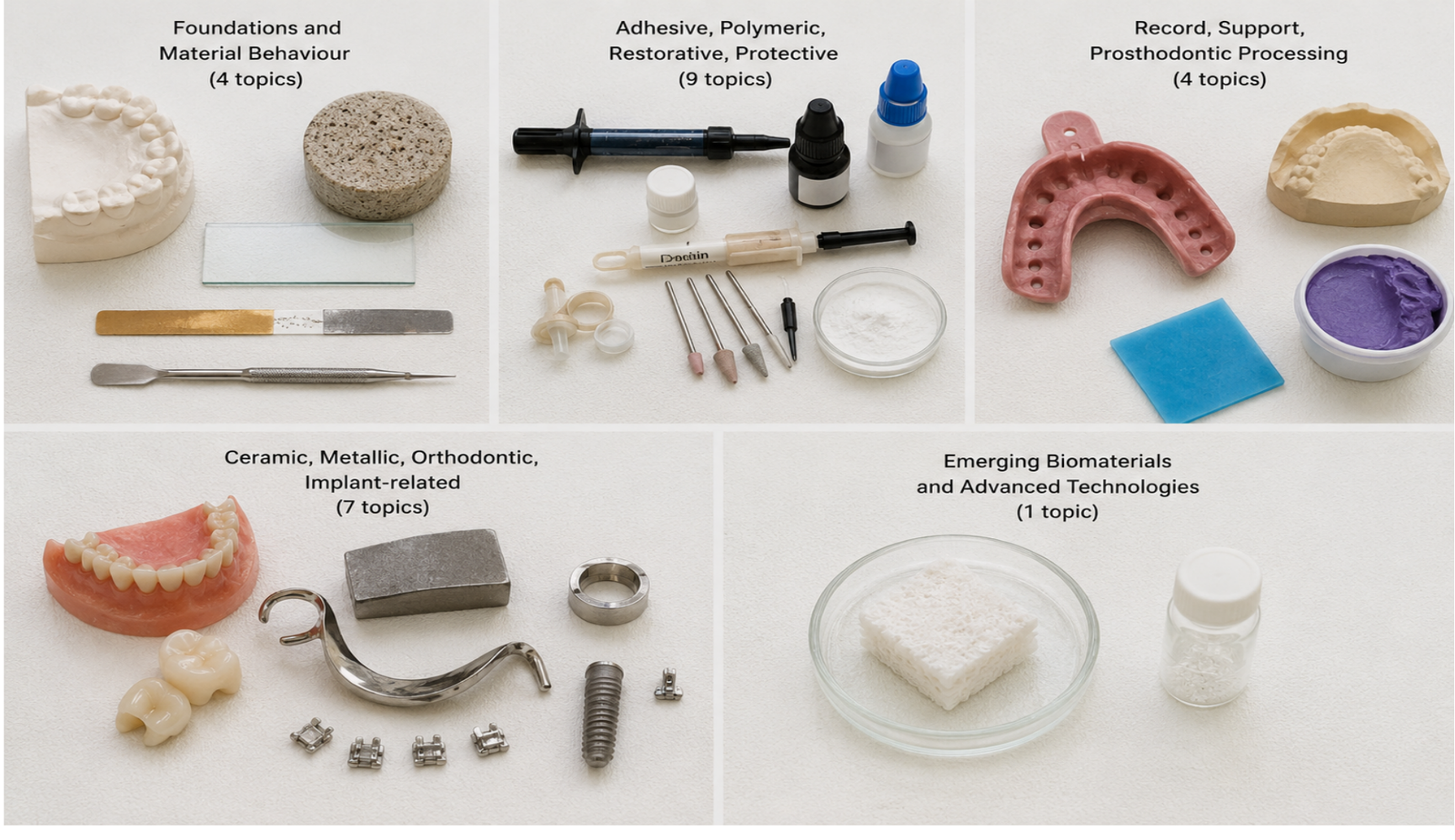
The arrangement into groups makes clear the major distribution result. Adhesive, polymeric, restorative, and protective materials are the largest family including nine topics, thus making this domain the most cognitively dense, and requiring the most explicit decision-justification records. Ceramic, metallic, orthodontic, and implant-related materials are the second largest family, including seven topics, yet their practical manipulation is limited to one introductory ceramic-metal session. Foundations and record support topics both include four topics and perform different functions – the former supplies explanatory vocabulary, while the latter provides strong manipulation links. The emerging biomaterials are limited to a single topic, thus requiring an evidence appraisal task to make the topic produce more than awareness.
All lecture records were aligned with CLO1 and CLO2 at C4, thus providing for explanation and justification. All practical records were aligned with CLO3 at P5, thus providing for independent and coordinated manipulation. The curriculum question was about meeting of these two traces in observable locations. CTA produced the strongest links between the trace and topic where there was a nearby practical analogue to a lecture topic, such as gypsum products, impression materials, dental waxes, composite resin, liners, bases, glass ionomer cement, other cements, dental polymers, and denture lining materials. Weaker links appeared where several lecture topics were dependent on a single practical encounter, such as ceramics, metal alloys, porcelain fused to metal, orthodontic materials, and implant-related metals.
The weighting records show a small delivery adjustment and a larger timing adjustment of evidence. The cognitive delivery of teaching fell from 82% to 79%, losing three percentage points. Psychomotor delivery rose from 18% to 21%, gaining three percentage points. This did not undo the dominance of cognitive delivery, but it clarified the role of laboratory contact in delivery.
There was a larger change in assessment. Formative assessment went up from 40% to 50%. Summative assessment decreased from 60% to 50%. Psychomotor assessment went from 25% summative OSPE to a new two-part pattern of 10% laboratory practical assessment and 10% OSPE. Psychomotor assessment decreased from 25% to 20%, but it achieved a stronger position in the learning process since half of psychomotor evidence was moved to before the terminal examination. This is important since errors in proportioning, mixing, timing, contamination control, adaptation, and dimensional stability need to be corrected while there is an opportunity to correct technique.
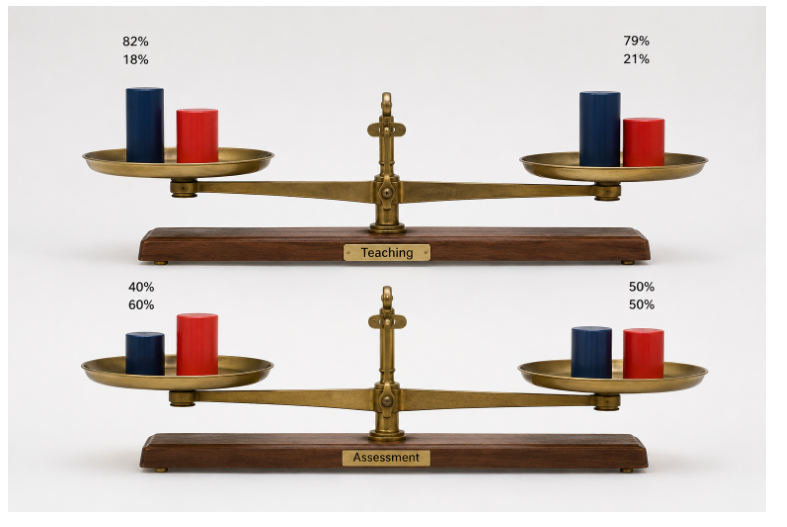
Paired balances in Figure 4 show the separation of delivery adjustment from assessment adjustment. Teaching balance is barely adjusted, but assessment balance adjusts the educational role of psychomotor evidence.
The balance display supports the central quantitative analysis: the major gain was not three percent increase in psychomotor delivery, but the repositioning of psychomotor evidence into formative space. A 10% laboratory practical component gives faculty a legitimate position to observe and correct technique prior to OSPE, while a 10% OSPE component retains a judgment of final performance. This provides an answer to the first part of the research question.
| |c|c|c|p8cm Curriculum element | Conventional | Competency-based | Change | Interpretation |
|---|---|---|---|---|
| Cognitive teaching delivery | 82% | 79% | −3 points | Cognitive teaching remains dominant while practical contact becomes slightly more visible |
| Psychomotor teaching delivery | 18% | 21% | +3 points | Laboratory contact receives a clearer place in delivery |
| Total formative assessment | 40% | 50% | +10 points | Evidence is collected during learning rather than mainly at the end |
| Total summative assessment | 60% | 50% | −10 points | Terminal judgement becomes balanced with formative information |
| Psychomotor formative assessment | 0% | 10% | +10 points | Practical performance becomes visible before OSPE |
| Psychomotor summative assessment | 25% | 10% | −15 points | OSPE remains present but no longer holds all psychomotor evidence |
| Total psychomotor assessment | 25% | 20% | −5 points | Total weight is lower, but timing is stronger for feedback |
The rows of ECRs in Table 2 illustrate that reduced total weight of psychomotor assessment does not automatically result in less strong psychomotor evidence. Conventional 25% OSPE places evidence burden at the end. Competency-based 20% split produces two evidence events: practical checkpoint during learning and OSPE end event. Educational benefit comes from this altered evidence sequence, not from the increased percentage.
CTA grouped 25 lecture topics into five material-decision families. Foundations and material behavior included four topics: introduction to clinical and laboratory dental materials, properties of dental materials, tarnish and corrosion, and dental abrasive and polishing materials. It generated strong explanatory evidence since students need to learn about the categories of materials, physical and mechanical properties, surface changes, degradation, and finishing. Trace vulnerability of this family was abstraction: if there is no related observation or decision event, students might have a knowledge of the concept but lack its application to handling errors or clinical situations.
Adhesive, polymeric, restorative and protective materials included nine topics: synthetic polymers, denture base polymers, bonding of resin-based materials, principle of adhesion, dental composite resin, glass ionomer cement, resin-modified glass ionomer cement and compomer, dental cements, and liners and bases. It was the largest and cognitively complex family. High justification potential of this family was in the necessity to compare indications, contraindications, moisture sensitivity, bonding condition, polymer behavior, protective properties, and restorative properties. Its risk was of overload if the topics were taught separately as separate material categories.
Record, support and prosthodontic processing materials included gypsum products, impression materials, dental wax, and denture lining materials. This family had the highest connection potential between the lecture and practical work since all four topics had obvious manipulation or serviceability relevance. Trace importance of this family was not whether the students can manipulate the materials, but whether they can explain the effects of manipulation on the accuracy of the dimensions, set response, patient comfort, further prosthodontic quality, repair and maintenance.
Ceramic, metallic, orthodontic and implant-related materials included seven topics: introduction to metals and alloys, cast dental alloys, steel and wrought alloys, dental ceramic, porcelain fused to metal, materials in orthodontics, and metal and alloys in dental implants. High clinical importance of this family was in engagement of such characteristics as strength, esthetics, corrosion, surface behavior, biocompatibility, and device function. The trace vulnerability point of this family was lack of practical evidence relatively to the topic diversity. Emerging dental biomaterials and advanced technologies included one topic. The importance of this family was in the awareness of innovations, but the evidence signal was narrow until students assessed the clinical potential, handling issues and readiness to use the new technologies.
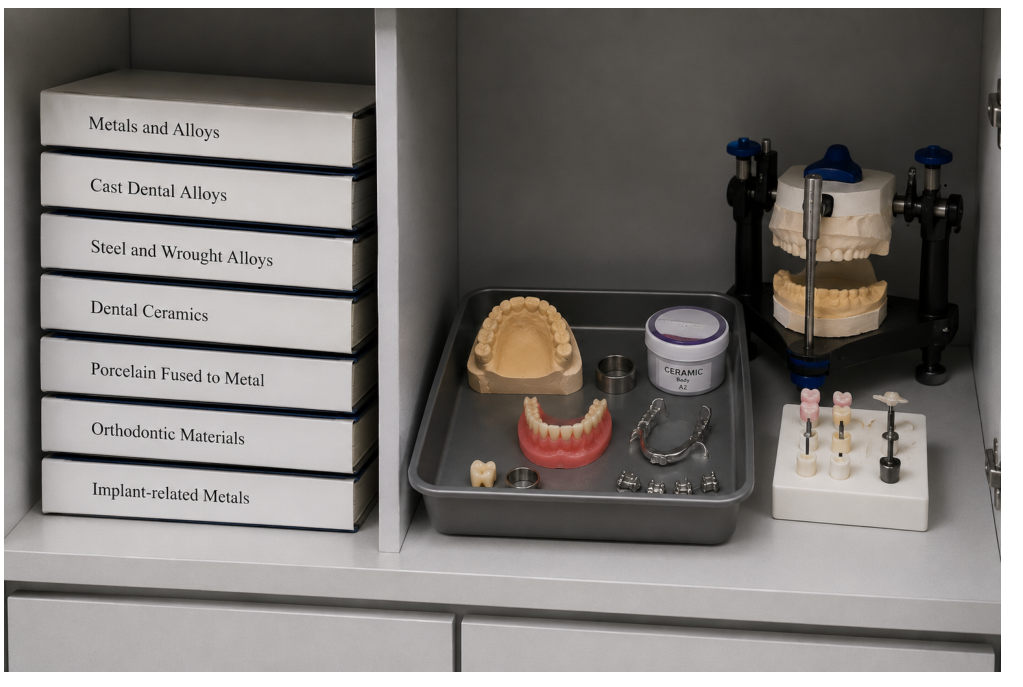
The ceramic-metal-device contact issue is highlighted in Figure 5. Seven C4 lecture topics are contrasted with the narrow P5 practical contact provided by the introductory lecture on ceramic and metal alloys.
The cutaway message is not in removing ceramic, alloy, orthodontic or implant-related lectures. The point is that the selection reasoning is wider than practical observations in this family. Specimen identification task, material selection note, or decision-ledger entry may improve evidence visibility among the recorded topics. This is the most detailed trace vulnerability point in the lecture-practical record (Table 3).
| |l|p7cm|p7cm Material-decision family | Topics | Primary evidence strength | Trace action |
|---|---|---|---|
| Foundations and material behaviour | 4 | Explanation of material categories, properties, corrosion, and surface finishing | Attach short fault-recognition prompts to prevent abstraction |
| Adhesive, polymeric, restorative, and protective materials | 9 | Justification of bonding, restoration, cementation, protection, and polymer use | Use decision ledgers for indication, limitation, and handling-risk comparison |
| Record, support, and prosthodontic processing materials | 4 | Manipulation linked to accuracy, stability, processing, comfort, and serviceability | Connect every manipulation task to a clinical or laboratory consequence |
| Ceramic, metallic, orthodontic, and implant-related materials | 7 | Selection reasoning for strength, esthetics, corrosion, compatibility, and device function | Add specimen identification and selection-justification tasks |
| Emerging biomaterials and advanced technologies | 1 | Awareness of innovation and advanced material use | Require evidence appraisal rather than descriptive exposure alone |
Family-level conflicts contain the qualitative results of CTA. It is important to notice that the evidence is of different quality depending on material families: some material families produce manipulation evidence more naturally, some produce explanation evidence, and some require specific prompting to make justification evidence observable. At the same time, the table does not allow making an overgeneralized interpretation of curriculum alignment: one course might be aligned at the CLO level but at the same time require different evidentiary actions in different material families.
HRL has helped transform eight practical sessions to a step-by-step readiness ladder. Introduction to clinical and laboratory dental materials practical has been allocated to material recognition position. Physical and mechanical properties of dental materials practical has been assigned to behaviour interpretation position. Gypsum manipulation and composite resin with liners and bases practical have been allocated to controlled manipulation position. Practical five and six of glass ionomer and other cements, impression materials, and dental waxes have been assigned to selection justification position. Dental polymers and denture lining materials practical has been allocated to serviceability justification position. Finally, introduction to ceramic and metal alloys practical has been allocated to independent readiness position.
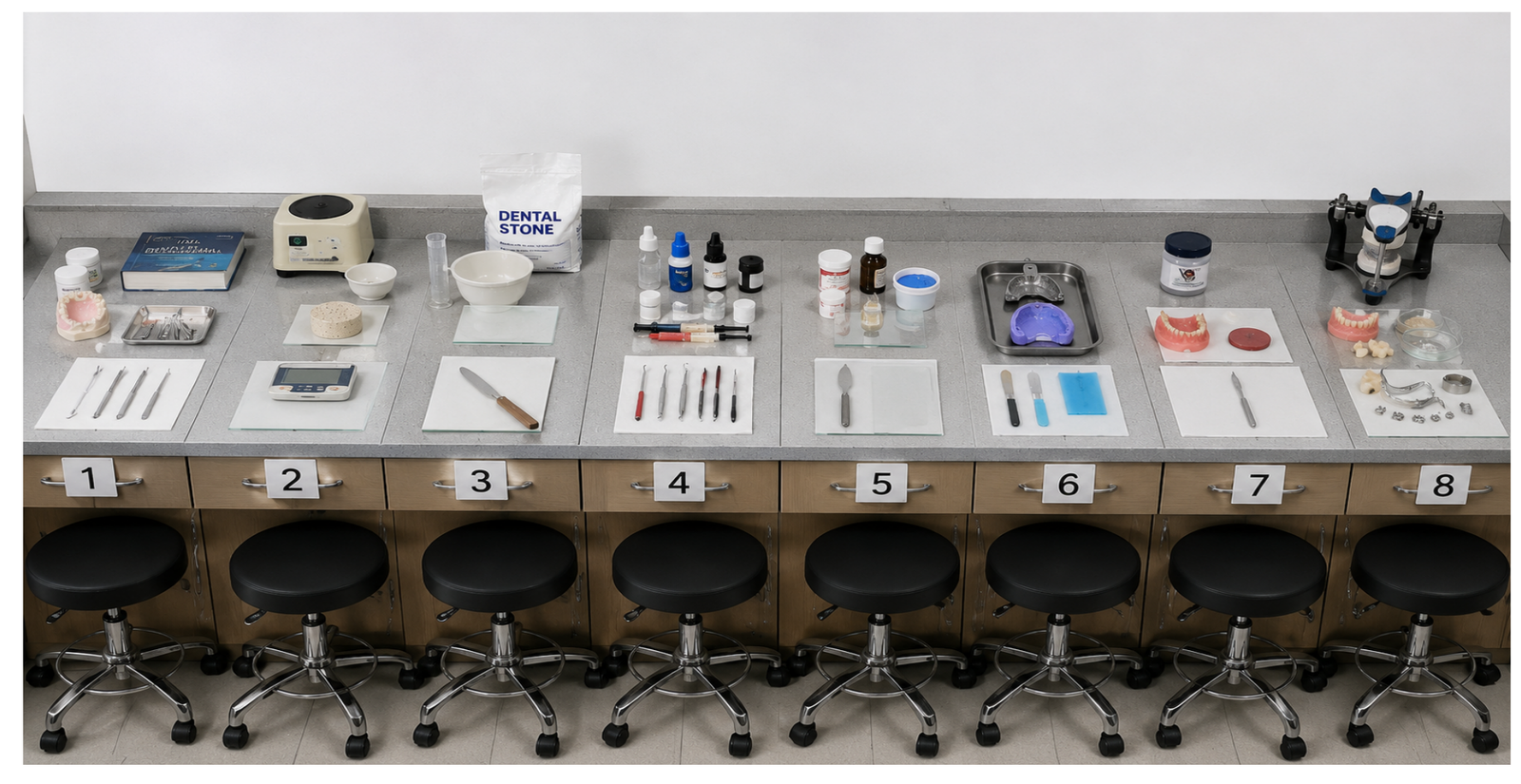
The eight practical sessions of P5 course are illustrated in Figure 6 as a benchline of laboratory activities.
Interpretation of the benchline explains why practical inventory is important for research question. Material vocabulary is created through recognition and behaviour interpretation. Material behaviour is transformed to a handling event with controlled manipulation. Finally, selection and serviceability justification link handling to clinical or laboratory consequences.
| |l|p8cm Practical | Laboratory topic | Readiness stage | Observable evidence required |
|---|---|---|---|
| 1 | Introduction to clinical and laboratory dental materials | Material recognition | Student identifies representative material groups and states their role in care |
| 2 | Physical and mechanical properties of dental materials | Behaviour interpretation | Student links an observed material property to a likely clinical consequence |
| 3 | Mixing and manipulating gypsum products in dentistry | Controlled manipulation | Student proportions, mixes, and explains setting or accuracy consequences |
| 4 | Mixing and manipulating dental composite resin, liners, and bases | Controlled manipulation | Student handles restorative or protective materials and recognises handling-sensitive error |
| 5 | Mixing and manipulating glass ionomer and other dental cements | Selection justification | Student selects a cement for a defined use and defends the choice by function and limitation |
| 6 | Mixing and manipulating impression materials and dental waxes | Selection justification | Student connects manipulation to record accuracy, stability, and prosthodontic quality |
| 7 | Mixing and manipulating dental polymer and denture lining materials | Serviceability justification | Student explains how handling affects comfort, repair, maintenance, and durability |
| 8 | Introduction to dental ceramic and metal alloys | Independent readiness | Student identifies material class, states clinical use, and justifies selection under OSPE-style conditions |
The readiness rows in Table 4 explain why HRL is not just a list of practical sessions. The column of observable evidence gives a performance significance to each laboratory topic. Early practicals develop language and interpretation; mid-practicals develop handling control; late practicals need to justify material selection and suitability. The final practical is the readiness check because it integrates material selection, use in the clinic, and justification in constrained circumstances.
CTA, ECR, and HRL come together in a decision-ledger for the studio and the laboratory sessions. It is a compact formative document instead of a replacement of written assessment or OSPE. It invites students to document the clinical cue, the material selection or rejection, the handling risk that could threaten the success of the task, the evidence that supports the selection and the feedback actions necessary to be ready for independent performance.
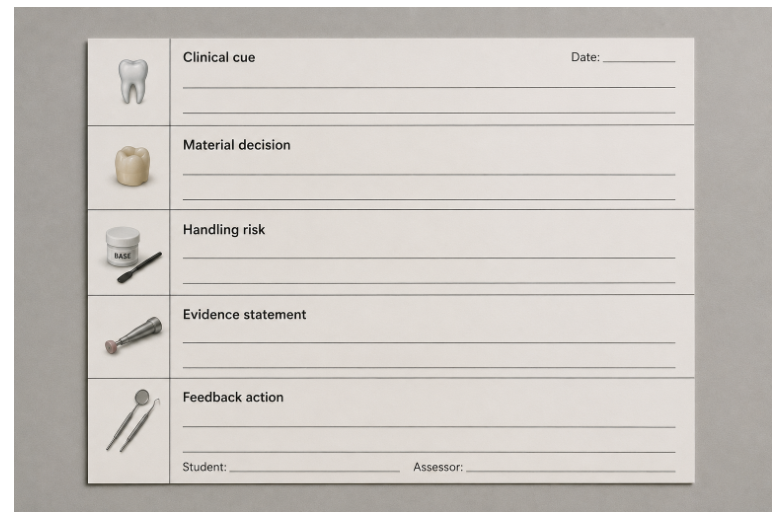
The five-field document in Figure 7 contains the clinical cue, material decision, handling risk, evidence statement and feedback action in one sheet.
The visual format emphasizes the practical value of the decision-ledger. Each field screens a typical weakness in materials education: disconnected facts, unconnected material selection, unknown handling risk, removed from the context scientific evidence, or unlinked feedback and action. Because of its brevity, the document can be used during laboratory sessions but will still present readiness evidence before summative assessment.
| |p7cm Ledger field | Student-facing prompt | Competence evidence produced |
|---|---|---|
| Clinical cue | What clinical or laboratory need is being addressed? | Recognition of indication and treatment context |
| Material decision | Which material is selected or rejected? | Justification of material choice |
| Handling risk | Which manipulation error would most likely compromise the outcome? | Awareness of proportioning, timing, mixing, contamination, or dimensional stability risk |
| Evidence statement | What property, behaviour, or observation supports the decision? | Connection between material science and clinical reasoning |
| Feedback action | What must be corrected before independent performance? | Formative action tied to readiness stage |
The five fields in Table 5 turn material science into a concise competency record. The clinical cue prevents material selection from being a memorized preference. The decision field requires a responsible material decision. The handling-risk field transforms technical error into an explicit target for correction. The evidence statement connects material properties or clinical consequences to reasoning. The feedback-action field completes the process by demanding a step toward further action before independent performance.
The record analysis answers a precise curriculum question: whether MDSS can reveal learners’ competencies across C4 lectures, P5 practicals, and assessment weights. The answer is affirmative when the course is interpreted as an evidence system rather than a topic catalogue. The curriculum includes clear elements of competency-based design: all lectures are at the C4 level, all practicals are at P5, formative assessment weight reaches 50%, and psychomotor evidence is not limited to OSPE anymore. The findings are educationally significant because competence in Dental Materials Science requires evidence of material explanation, justification, manipulation, feedback, and readiness.
The literature review helps interpret this finding. Competency-based education puts an emphasis on observable performance [5]. Entrustable professional activities link performance to professional tasks [3]. Developmental framework facilitates judgement of learners’ competencies at different stages of development [4]. Programmatic assessment is based on multiple evidence points [8]. It also stresses feedback-oriented assessment activity [9]. The literature about dental education similarly acknowledges the importance of learning-focused rather than summative feedback and assessment [12]. The present record set gives these principles a material-specific interpretation. In this course, the main issue is not whether the language of competencies is used; it is whether the curriculum records reveal locations of material explanation, justification, manipulation, feedback, and readiness.
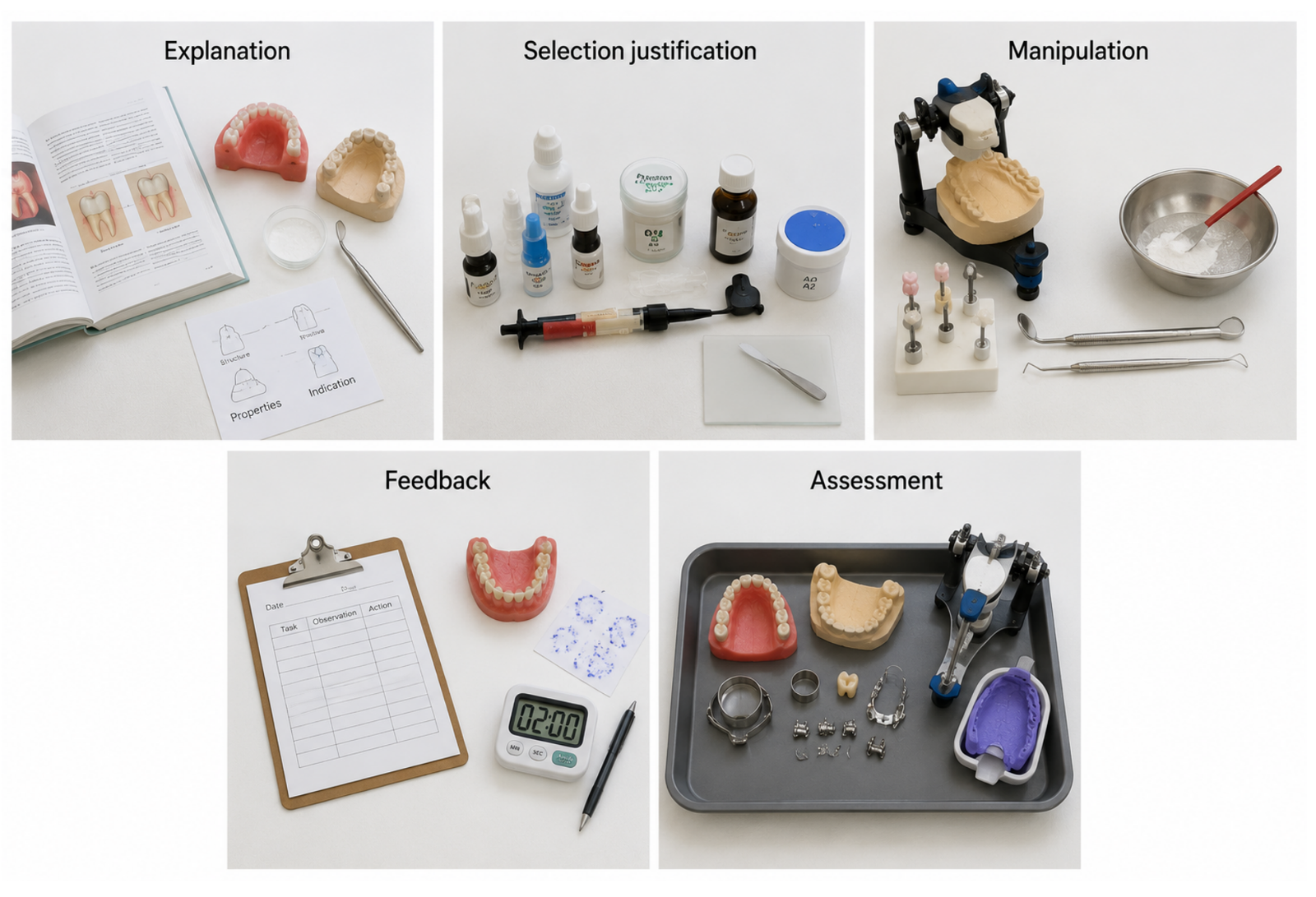
The evidence signals throughout the course are visualized in Figure 8. The five panels symbolize explanation, selection justification, manipulation, feedback, and assessment as recordable course events.
The panels provide further explanation by distinguishing types of evidence from formats of teaching. Explanation may take place in a lecture, but it becomes stronger when it is connected to a material property or clinical consequence. Manipulation may take place in a practical, but it becomes educationally more powerful when handling error is named and corrected. Assessment may take place in OSPE, but it becomes more credible when prior records reveal the development of readiness. This interpretation makes clear why the course should be evaluated on the basis of evidence visibility, not just contact hours or topic number.
The topic-family results clarify the difference between coverage and competence. The adhesive-restorative family includes the largest topic count and, therefore, requires repeated selection-justification records allowing to compare indications, limitations, moisture sensitivity, bonding conditions, and handling errors. The record-support family has fewer topics but better practical contact due to natural connection between manipulation and dimensional accuracy and prosthodontic quality of gypsum, impression materials, waxes, and denture lining materials. The ceramic-metal-device family has good clinical relevance, but one introductory practical cannot reveal readiness for seven lectures. Emerging biomaterials require evidence evaluation because one lecture can raise awareness without revealing whether students can judge clinical maturity and handling implications.
The ECR result should not be understood as a mere increase in practical teaching. Teaching delivery is changed marginally. The more important result is that psychomotor evidence becomes available during learning via the 10% laboratory practical component. Students require information which can help to improve their future performance, not just remarks given after the opportunity to improve is lost [16]. Feedback also has to be specific and actionable [14]. Learners have to get chances to interpret and use the information [15]. It is aligned with evaluative judgement as well, because students learn to assess the quality of material handling and justification through repeated visibility of the criteria [17].
The HRL result provides the developmental reading of the psychomotor part of the course. Practical work may turn into a procedure checklist if students follow instructors’ instructions blindly. HRL changes the reading of the same practicals by posing questions about readiness evidence each of them may generate. Recognition and behavior interpretation provide the language of materials. Controlled manipulation allows students to feel how manipulation influences material behavior. Selection and serviceability justification link manipulation to patient treatment and laboratory quality. Independent readiness prepares students for OSPE-type judgements by asking them to identify, explain, manipulate, and justify under constraint. The literature about OSCE stresses the value of performance assessment which involves tasks aligned with assessed competence [18].
The decision ledger is the most practically oriented translation of the findings. It allows students to concisely connect a cue, a material decision, a handling risk, an evidence statement, and a feedback action. The ledger also facilitates faculty calibration, because instructors are able to compare specificity of evidence statements and feedback actions. Entrustment judgements are strengthened by linking to observable behavior [19]. Readiness decisions also benefit from shared descriptions and explicit performance standards [20]. In Dental Materials Science, those descriptions can be material-specific: correct proportioning, accurate mixing, controlled timing, appropriate selection, risk recognition, and justified use.
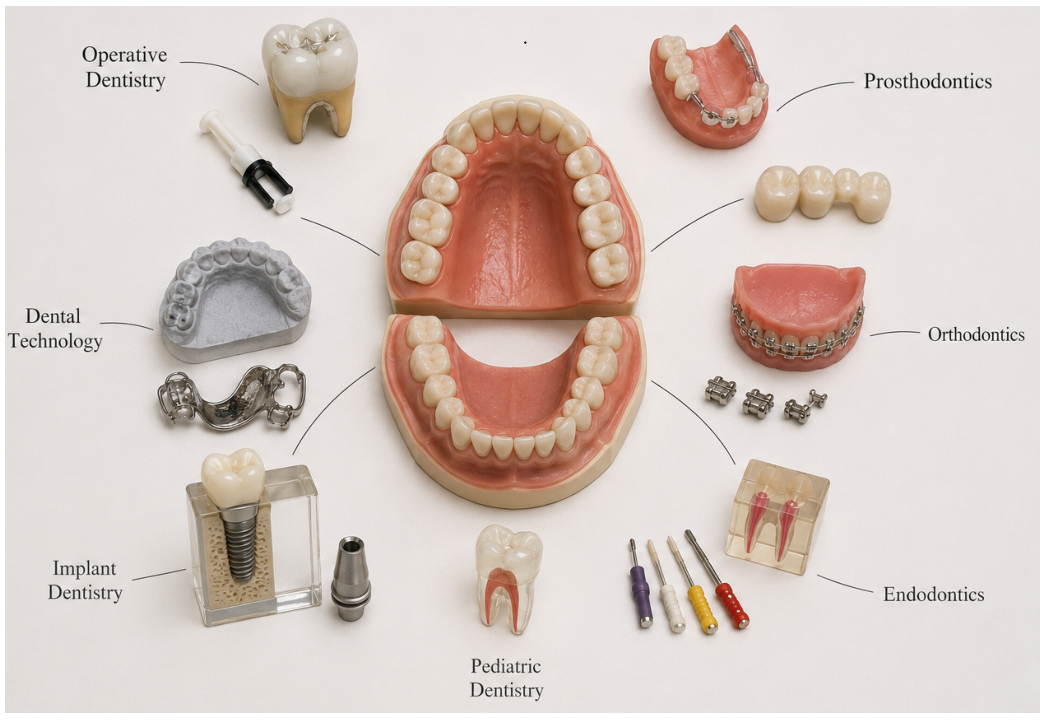
The interdisciplinary translation of the record set is represented in Figure 9. The dental arch displays the locations of material groups relative to operative dentistry, prosthodontics, dental technology, orthodontics, implant dentistry, pediatric dentistry, and endodontics.
The dental arch illustrates why Dental Materials Science cannot be considered an isolated preclinical discipline. Composite resin, glass ionomer cement, liners, bases, and adhesion materials facilitate operative dentistry. Impression materials, dental waxes, gypsum products, denture base polymers, and denture lining materials facilitate prosthodontics and dental technology. Metals, ceramics, orthodontic materials, and implant-related materials facilitate prosthodontic, orthodontic, and implant-related decisions. Curriculum coherence depends on shared educational goals across teaching domains [21]. It also relies on deliberate connections between subjects and learning environments [22].
The findings are included in the curriculum record set. The curriculum-level records do not measure student achievement, faculty workload, patient outcomes, or test-score reliability. Therefore, the results illustrate the visibility of evidence positions, not the proof of improved student performance. Faculty calibration remains important, especially for judging the specificity of decision-ledger evidence statements and consistent application of HRL readiness stages. The ledger should also stay concise; otherwise, it may become a burden rather than a means of formative feedback.
The overall contribution is a material-specific answer to a curriculum quality question. A material-rich Dental Materials Science course may be educationally poor if it does not demonstrate where students are observed, corrected, and asked to justify decisions. At the same time, a course involving minor changes in contact percentages can become more accountable if evidence for assessment approaches learning and practicals are read as readiness stages. In this record set, the most important result is the combination of C4 cognitive alignment, P5 practical alignment, split psychomotor assessment, and decision-ledger fields. Together, they indicate where students can explain material behavior, justify material decisions, manipulate materials precisely, receive correction, and prove readiness for further learning.
The research question was whether MDSS would reveal competence evidence visibility in a Dental Materials Science course with records of 25 C4 lectures, 8 P5 practical classes, and 6 entries of delivery-assessment weighting. Yes, but the qualification is that competence visibility requires reading of the curriculum via evidence positions rather than only topics presented. C4 lectures provide a good level of C4 explanation and justification. P5 practical classes present a good potential for P5 handling. In ECR, an educationally meaningful role of the assessment is achieved through moving psychomotor evidence from the single 25% OSPE entry to the combined 10% laboratory practical + 10% OSPE endpoints. In CTA, areas of evidence strength are shown to be the adhesive-restorative and record-support material ones, while areas of vulnerability include ceramic-metal-device and new biomaterials content. In HRL, the 8 practical classes build up a readiness progression from recognition to independent justification. Thus, the answer is not only the alignment, but also the demonstration of where learners have to explain, select, manipulate, correct, and justify their knowledge of dental materials.