
The field of dental materials science has a unique place in undergraduate dental studies since it expects students to relate the composition of materials, handling conditions and the performance of the material after service without the burden of any clinical responsibility. The subject goes beyond the listing of polymers, alloys, ceramics, cements, impression materials, restorative materials, denture base materials, and laboratory processes. Instead, it is a reasoning field in which a learner must be able to explain the significance of setting reaction, moisture influence on adhesion, impression distortion, unreliability of cast, change in metal work due to investment or casting process and the failure of material listed in a suitable indication despite its suitability. Thus, pre-clinical teaching requires evidence that the students use material knowledge, not just remember material names.
The course in focus is a Year 2 undergraduate dental materials science course offered in a Malaysian Bachelor of Dental Surgery programme. The course is divided into four modules and includes 25 lectures and three practical classes. The course record includes learning outcomes, programme outcome alignment, course content, learning opportunities, learning materials, learning locations, assessment methods, student learning time, staffing, curriculum management, and prerequisite information. The two directions of active learning for this course are explanation of the material properties, composition, setting reaction, indication, contraindication, manipulation factors and application; and practical manipulation or handling of dental materials in restorative and removable prosthesis scenarios. The course is categorized at C1-C2 cognitive levels and P4 psychomotor level, where 82% of the curriculum is categorized as cognitive and 18% as psychomotor. The learning takes place via lectures, practical classes and self-learning in lecture halls, simulation laboratories and dental technology laboratories. The assessment process involves MCQ, SAQ, OSPA, seminar presentation, assignment, laboratory practical assessment, written final examination, OSPA, and viva voce, where 40% of the final grade is allocated for continuous assessment and 60% for final examination [1].
Curriculum mapping would be an appropriate framework to refer to since it highlights relationships between outcomes, topics, assessment, learning sites, materials and governance of the curriculum. Harden’s work on curriculum mapping has remained relevant due to his consideration of curriculum as educational windows interconnected with each other rather than personal list of topics possessed by the teacher [2]. Pharmacy education studies prove that mapping can contribute to program evaluation and communication between the faculty members [3]. Higher education research also confirms the role of mapping for making curricula transparent [4]. However, for dental materials science, it is only the first requisite since the visibility of the map can only reveal where the topics such as gypsum, waxes, polymers, cements, impressions, metals, ceramics and practical classes are located, but not where the student can explain the appropriateness of material, detect the mistakes in handling, predict the casting defect or explain how the record distortion influences the indirect restoration.
Constructive alignment and assessment literature further elaborates this point. According to Biggs, learning activities and assessment should direct the students to the desired form of understanding and not just provide them with the exposure to the content [5]. The feedback literature emphasizes the necessity of the provision of information about the gap between the current and desired performance [6]. The feedback also should allow learners to act upon the provided information when the desired performance requires judgement [7]. In the field of health professions education, the research on assessment has moved away from the dependence on isolated tests [8]. Program-level approach implies interpreting evidence across time and context [9]. Moreover, the coherence of the complete assessment system is emphasized [10]. The practical guidance also draws attention to the need to balance validity, feasibility and educational effect [11]. The principles mentioned above are relevant for the field of dental materials science since material readiness cannot be inferred from one written test, one practical observation or topic name. It requires the evidence across explanation, handling, selection and error recognition.
Furthermore, dental education literature warns against regarding technology or simulation as an automatic solution for the imbalances of courses. Simulation improves performance when it is connected with clear instructional goals [12]. Deliberate practice and feedback play the key role in this improvement [13]. The reviews of dental simulation indicate targeted use of simulated environment [14]. The digital undergraduate dental education also depends on task design and feedback [15]. Accessibility and authenticity are other prerequisites of educational value [16]. The period of COVID-19 has shown the importance of the flexible delivery in dental education [17]. At the same time, it has demonstrated that virtual delivery cannot replace practical training needs in dentistry [18]. Therefore, the course with limited number of staff, fixed assessment weightings and three practical classes has to find a way to make existing evidence more visible instead of requiring full replacement of the curriculum.
The central research question is: how can a documented Year 2 dental materials science course demonstrate visible evidence of material readiness judgement while maintaining its recorded four-module structure, lecture hall, simulation laboratory and dental technology learning locations, MCQ-SAQ-OSPA-laboratory-seminar-assignment-viva voce assessment forms, and 40%/60% assessment weighting? This question is answered by considering the course record as a set of evidence objects, i.e. named topics, practical classes, outcomes, assessment entries, learning contexts and curriculum risk signals. The analysis pinpoints where the documentation and assessment will allow the collection of evidence that the students can articulate behavior of materials, identify avoidable failures, manage materials properly, and make decisions within realistic constraints.
This analysis was carried out using the course-item record methodology. The unit of analysis was the curriculum-evidence item, which means a visible table entry of topics, practical classes, course learning outcomes, learning context descriptors, assessment types, curriculum management indicators, or risk statements from the SWOT analysis. The analysis did not include any grades, interviews, questionnaires, patient records, workload logs, or any newly collected observation data, and thus does not claim any measurable learner achievement. The present analysis focuses on identifying evidence of curriculum-readiness for pre-clinical materials in the course record.
The course record is an article describing curriculum mapping of a Year 2 dental materials science course in a Malaysian dental school [1]. The curriculum mapping article contains all the evidence about the curriculum elements needed to conduct the analysis: course learning outcomes, programme learning outcomes alignment, contents, cognitive and psychomotor level, teaching and learning opportunities, learning materials, locations, assessments, schedule, staffing, curriculum management, student information, and SWOT analysis. The mapped course consists of four modules, 25 lectures, and three practical classes. There are 23 visible lecture topics and three practical topics. The total of 26 visible items was included in the analysis. The total number of 25 lectures was considered as a course-level descriptor, and no additional unnamed lectures were included.
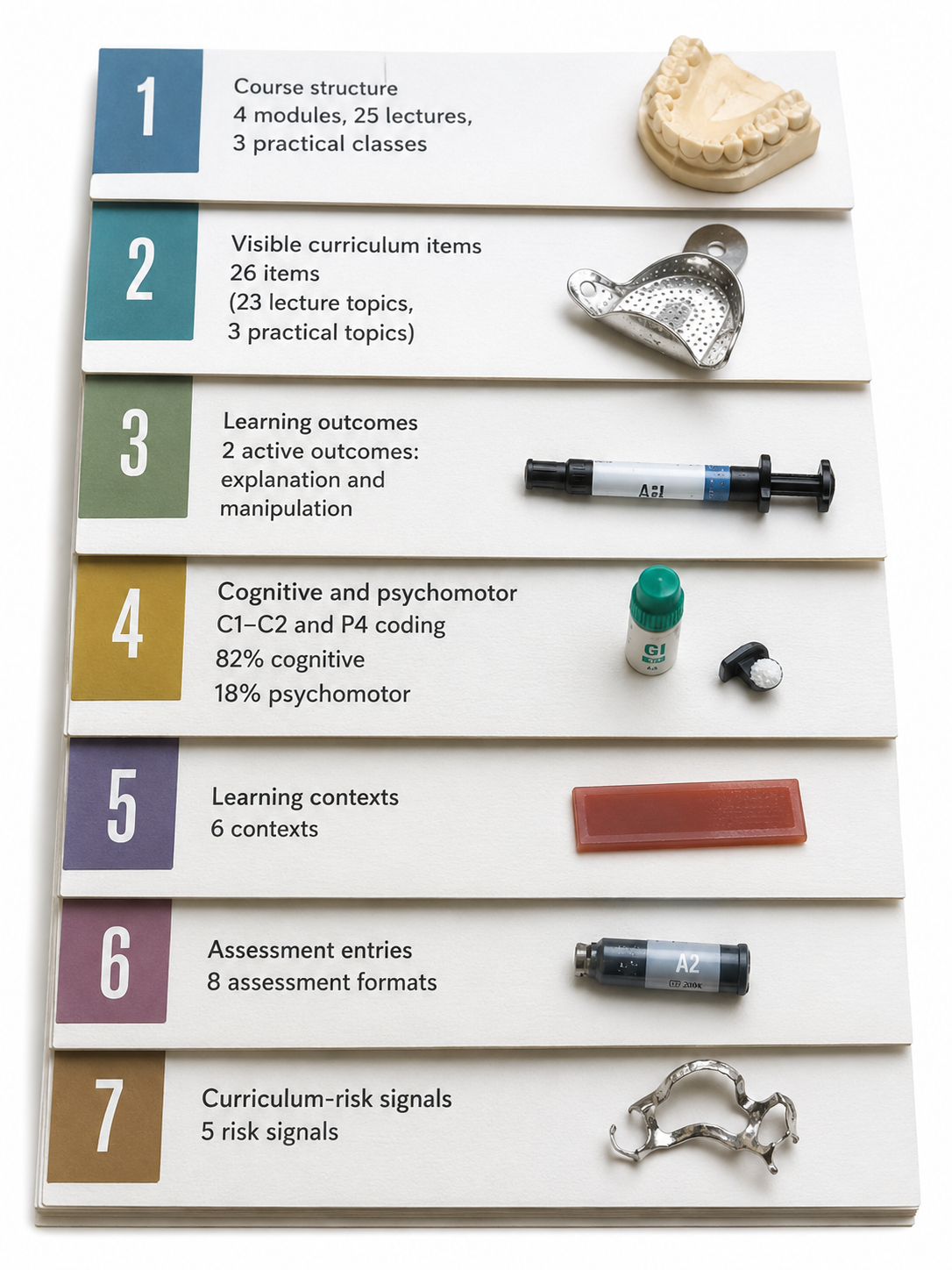
Compact visual representation of evidence layers is shown in Figure 1. The stacked layers separate the four modules, 25 lectures, three practical classes, 26 visible curriculum items, two active outcomes, C1–C2/P4 coding, learning contexts, assessments, and curriculum risks so that no course elements without evidence are introduced in the interpretation.
The visual representation of the course record helps define the scope of the analysis. The analysis is grounded on named course records and visible item entries, and the reported lecture total is still a course-level description rather than a call to reconstructing the unnamed lecture content. Every layer refers to a particular record that can substantiate, constrain, or validate a material-readiness claim.
The analysis employed the course records required to assess whether the curriculum is capable of producing evidence of material readiness. The outcome record includes two active learning outcomes of the course – the first being knowledge oriented and corresponding to the explanation of properties, composition, setting reactions, indications, contraindications, manipulative variables, and applications; the second one being skills oriented and pertaining to the handling and manipulation of dental materials in restorative and removable prosthesis situations. The level record consists of C1-C2 cognitive levels and P4 psychomotor level, the cognitive-to-psychomotor ratio being 82:18. The learning opportunity record features lectures, practical classes, and self-learning. Locations of learning include lecture halls, simulation laboratories, and dental technology laboratories. Entries in the learning material record consist of textbooks, printed notes, and demonstrations. Assessment entries consist of MCQ, SAQ, OSPA, seminar presentation, assignment, laboratory practical assessment, theory written examination, OSPA, and viva voce. The weight of assessment is 40% continuous assessment and 60% final examination. Other details about the course context include approximately 135 credit hours of student learning time, the prerequisite that Year 1 should be passed to enroll into Year 2 of the course, and one academic staff member who taught the content and was the subject coordinator [1].
The topic evidence visible in the course was categorized according to modules. The first module contains the introductory and basic material science topics: introduction to dental materials, properties of dental materials, gypsum products for dental casts and waxes, synthetic polymers, impression materials, denture base polymers, and denture lining materials. The second module contains the direct restorative and supplementary topics: introduction to direct filling materials, bonding of resin-based materials, resin-based filling materials, glass ionomer restorative materials, resin-modified glass ionomers, advances in tooth-coloured restorative materials, dental amalgam, and dental cements. The third module contains the metal and laboratory process topics: gold and alloys of noble metals, base metal casting alloys, casting techniques, investments and refractory dies, steel and wrought alloys, and practical classes on mechanical properties and manipulation of dental materials. The fourth module contains impression materials, ceramics, porcelain fused to metal, and practical class on viscoelastic properties. These items make up the documented course entries and provide the basis for finding threshold tasks and evidence artifacts.
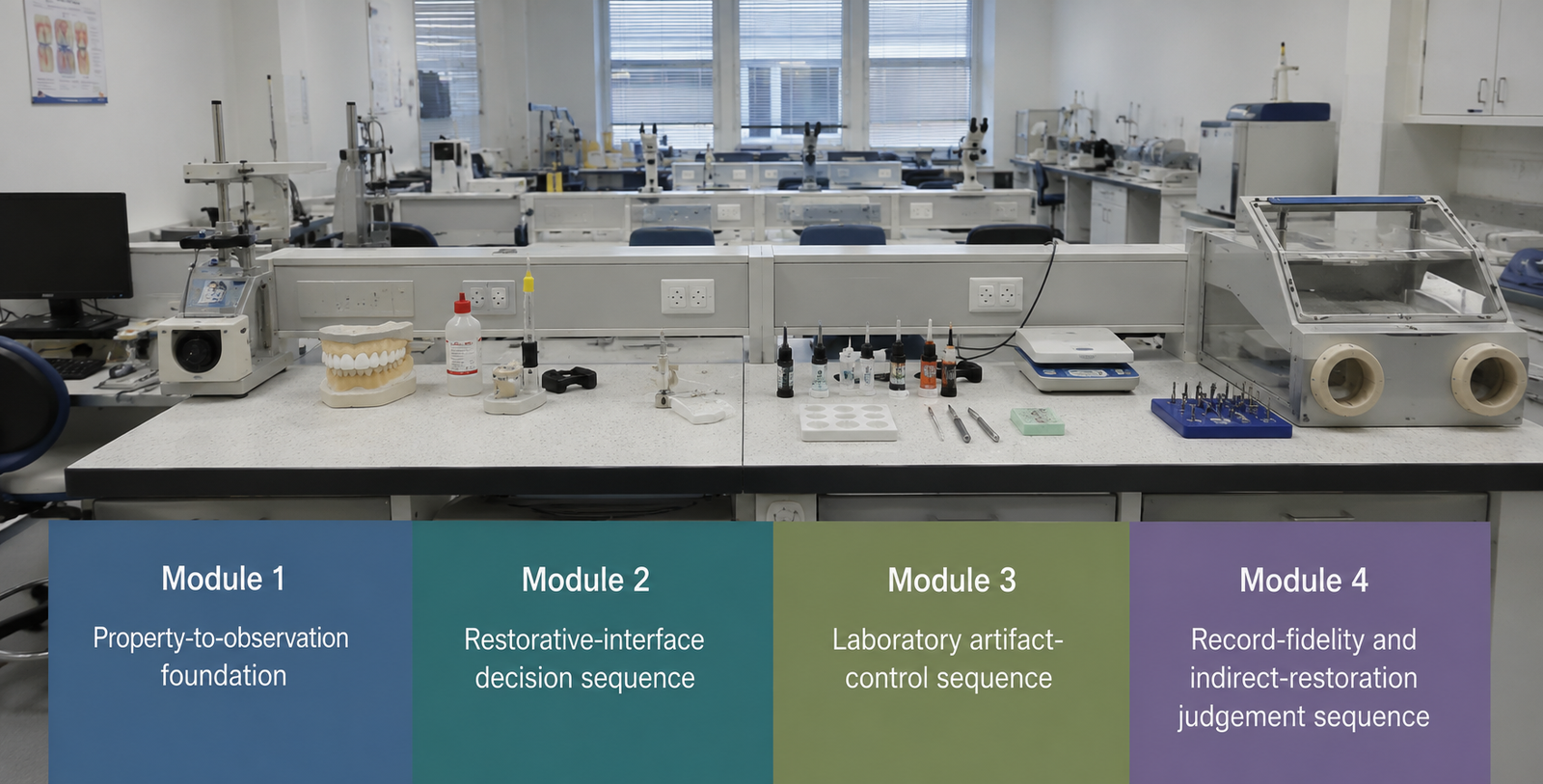
Then the four modules were read as separate teaching rooms, as shown in Figure 2. This system maintains the order of recording while exposing the identity of evidence through each component module: property observation, restorative-interface decision, laboratory artifact control, and record-fidelity judgment.
It is clear from the module-room image above that the modules do not consist of interchangeable topic containers. While the modules retain their recorded content, they create different types of material-readiness evidence. Therefore, foundational and applied material content would require separate evidence claims: property observation for Module 1, restorative interface judgement for Module 2, artifact control for Module 3, and record fidelity judgement for Module 4.
The analysis involved one course-record procedure. In the first place, a course-item evidence record converted the curriculum record into units that can be analyzed: visible curriculum items, outcome records, module records, learning-context descriptors, assessment entries, and curriculum-risk signals. The evidence recording used the relational logic of curriculum mapping [2]. This is an approach to understanding a course in terms of the relationships between educational elements rather than topic names [3]. Secondly, practice-proximal reading was employed to classify topics according to how close they are to material use, manipulation, clinical selection, or laboratory artifact production. In other words, some of the topics were differentiated from those which only introduce concepts by the degree of their relation to material decisions.
In the third place, threshold-task elicitation was performed as identifying the smallest possible performance demonstrating the ability to use the material knowledge for each curriculum item. The performance was required to be observable, feasible in the context of the current course design and assessable using any of the documented assessment forms. Fourthly, failure-mode anchoring was performed by linking each threshold task to a preventable material failure or a curriculum risk. The impression-material topic, for example, was linked to record distortion, delayed pouring, elastic recovery, or cast unreliability; the restorative-material topic was linked to unsuitable selection due to moisture, adhesion, strength, pulpal protection, working-time, or esthetic limitations. Finally, micro-evidence recording was performed by linking each threshold task to the compact artifact: short written explanation, annotated practical record, OSPA response, comparative material justification, laboratory defect interpretation, or viva voce justification. The design of the micro-evidence recording drew upon the principles of valid and feasible assessment [11]. Moreover, several artifacts were required because evidence should be gathered from multiple assessment events [8]. Consistent evidence from various contexts backs a coherent interpretation of the programme level [10].
A few controls ensured the traceability of the analysis to the course records. No additional lecture topics, practical classes, learning venues, faculty, weighting of grades, groups of learners, or types of assessment were added to the analysis. The four-module format and the 40%/60% weighting of assessments remained unaltered. The frequent occurrence of impression items in Modules 1 and 4 was left in its original module formats and was interpreted using different threshold functions. The psychomotor skewness was not considered as an indicator of the poor performance by the students, since no data on learners’ outcomes were available. It was viewed as an indication of the signal from the course showing that the current course requires more explicit handling evidence. Low-cost digital verificational efforts were undertaken only if they could verify the presence of an existing threshold task through photographs, annotated video clips, electronic rubrics, or low-cost virtual demonstrations. Digital technologies are particularly effective if they are associated with a certain instructional goal [16]. Their effectiveness also depends on the consistency with assessment and feedback [15]. Virtual methods may be used for particular learning tasks if their function is clearly understood [19]. In this case, low-cost digital demonstration was viewed as documentation support instead of curricular substitution [20].
The first finding was the transformation of the mapped course into a course-item evidence record. It resulted in changing the object of analysis from the list of topics to the bounded curriculum-evidence record as well as separating what could be seen and what had to be considered a course-level report only. The record comprised 26 visible curriculum items, two active outcome records, four module records, six learning-context descriptions, eight assessment records, and five curriculum-risk markers. The number of visible items is essential since the course has been stated to include 25 lectures and three practical lessons, but only 23 lecture topics and three practical topics have been visible for the item-level analysis. This helped not to make up facts during the analysis while retaining the course-level information on the presence of 25 lectures in the course. The course evidence created by the documented record is presented in Table 1.
| Record component | Entry count | Evidence function in the analysis |
|---|---|---|
| Visible curriculum items | 26 | Supplied topic-level and practical-class units for threshold-task elicitation without inventing unnamed lectures. |
| Active course-outcome records | 2 | Preserved the two essential learning directions: scientific explanation and practical manipulation. |
| Module records | 4 | Maintained the documented sequence of foundational, restorative, laboratory, and indirect-restoration content. |
| Learning-context descriptors | 6 | Located feasible evidence opportunities in lecture, self-learning, simulation laboratory, dental technology laboratory, demonstrations, and printed or textbook-supported preparation. |
| Assessment entries | 8 | Identified available instruments for written, oral, observed, seminar, assignment, OSPA, laboratory, and final examination evidence. |
| Curriculum-risk signals | 5 | Converted repetition, limited psychomotor emphasis, limited technology integration, single-staff dependence, and possible unrecorded omissions into evidence priorities. |
The course evidence record differentiates between content units, expected learner actions, assessment sites, and curriculum risks. Visible entities give the content units, outcome records indicate the expected forms of explanation and manipulation, assessment entries tell where evidence may be collected, and risk signals specify where evidence is most important. Bounded record provides for evidence placement without adding any new lectures and learner outcomes.
The course evidence record indicates that evidence opportunities are distributed unequally among lectures, practical classes, outcome records, and assessments. The lecture about dental cements can continue being a lecture but at the same time produce the threshold artifact if the student will justify the cement choice in terms of retention, moisture, pulpal protection, and working time considerations. The practical class about viscoelastic properties can continue being a practical class but document the influence of elastic recovery or time-dependency on record quality. This reading is aligned constructively as the threshold artifact is chosen to fit the intended form of learning rather than the form of delivery [5]. It is also aligned according to feedback literature since the artifact provides teachers with the concrete object of feedback [6]. The artifact helps learners act on that feedback [7].x
Threshold task elicitation produced six bands. These bands are not typical material categories. They describe the abilities of learners concerning what they should be able to do with the material. The first band, causal material-property interpretation, requires from students going beyond definitions and explaining why the material property predicts the behavior during manipulation or service. The second one, record and working-model reliability, establishes the connections between gypsum, waxes, impression materials and viscoelasticity with respect to the reliability of casts and prosthodontic records. The third band, restorative interface selection, involves justification of direct restorative, adhesive and cementation choices according to specific clinical considerations. The fourth band, prosthodontic support material judgement, demands from students comparison of denture base, lining, ceramic and porcelain-fused-to-metal materials in terms of strength, comfort, fabrication and support. The fifth band, metallic laboratory artifact control, relates alloys, casting, investments, refractory dies, wrought alloys and mechanical properties to laboratory artifacts quality. The sixth band, cross-cutting manipulation readiness, utilizes the practical manipulation class for documenting safe handling, timing, mixing, observation and correction.
Table 2 shows the connection between the types of content and threshold tasks. Material topics relate to explanation tasks, record-making topics relate to reliability tasks, restorative topics relate to constrained selection tasks, laboratory topics relate to defect control tasks. The visible 26 items have a different function of the evidentiary kind; each item corresponds to a different readiness claim.
| Threshold-task band | Curriculum items feeding the band | Assessable evidence expected from the learner |
|---|---|---|
| Causal material- property interpretation |
Introduction to Dental Materials; Properties of Dental Materials; Synthetic Polymers; Metals and Alloys | A concise explanation linking one named property to manipulation, service behavior, or material selection. |
| Record and working- model reliability |
Gypsum Products for Dental Casts and Waxes; Impression Materials in Module 1; Impression Materials in Module 4; Practical: Viscoelastic Properties | An explanation of how recording, pouring, elasticity, dimensional change, or time-dependent behavior affects cast or prosthesis reliability. |
| Restorative-interface selection | Introduction to Direct Filling Materials; Bonding of Resin-based Materials; Resin-based Filling Materials; Glass Ionomer Restorative Materials; Resin-Modified Glass Ionomers; Advances in Tooth-coloured Restorative Materials; Dental Amalgam; Dental Cements | A justified material choice under stated constraints involving moisture, adhesion, strength, pulpal protection, working time, esthetics, or longevity. |
| Prosthodontic support-material judgement | Denture Base Polymers; Denture Lining Materials; Ceramics; Porcelain Fused to Metal | A comparative judgement explaining support, esthetic, comfort, fabrication, and service considerations for removable or indirect treatment situations. |
| Metallic laboratory artifact control |
Gold and Alloys of Noble Metals; Base Metal Casting Alloys; Casting Techniques; Investments and Refractory Dies; Steel and Wrought Alloys; Practical: Mechanical Properties | An annotated interpretation of a defect or property problem tied to alloy choice, investment behavior, casting procedure, refractory support, or mechanical response. |
| Cross-cutting manipulation readiness | Practical: Manipulation of Dental Materials | A practical record showing safe handling, mixing, timing, observation, and correction of common manipulation variables. |
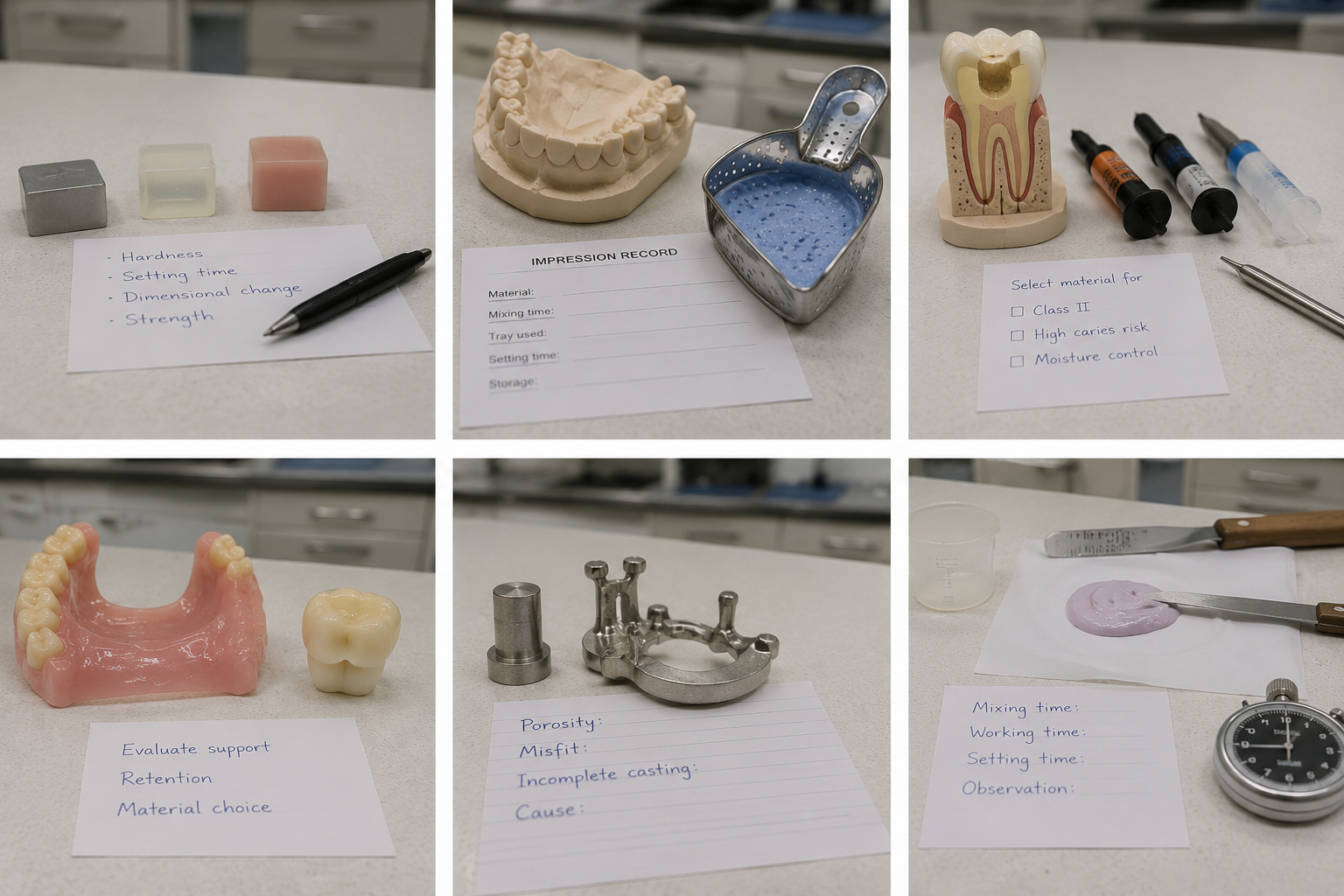
The six threshold-task bands are turned into evidence cards centered around material objects (Figure 3). As is evident from the figure, each band demands the production of a learner product: property explanation, impression record, restorative choice, prosthodontics decision, laboratory defect interpretation, or handling record.
The material objects depicted in Figure 3 explain why the bands are assessable rather than descriptive. The property sample, impression tray, tooth model, denture base, casting artifact, or mixing record offers an assessor the tangible object through which explanation and decision can be assessed. This fact also limits the scope of the present study: the course itself is not supposed to prove the competence of learners; however, it helps to determine the precise objects through which the competence-related reasoning can be analyzed.
The six bands show that the threshold tasks can help to create higher-order evidence without disregarding foundational knowledge. The course record demonstrated that cognitive learning was mostly concentrated at C1-C2 levels [1]. Threshold task does not demand that every topic will become an advanced evaluation activity; it requires at least one observable action which would transform the recall and comprehension into useful decision. The difference is important since dental materials science students might be able to name indications and contraindications of materials but unable to explain why this material is appropriate in a certain, imperfect situation. Graduate preparedness studies suggest inconsistent readiness across dental areas [21]. Student-based evidence confirms the necessity of creating readiness evidence earlier [22]. The threshold bands offer a practical solution to combine preclinical content and competence-oriented dental education [23]. They are also consistent with the current trend in dental education towards entrustable activities [24].
Failure-mode anchoring recontextualized the interpretation of the repeated impression-material content. A traditional topic audit might identify repetition as inefficient. The course map placed impression materials as repeated lecture topics in Modules 1 and 4 [1]. In the current analysis, the repetition is educationally justifiable only if each instance serves a separate threshold purpose. Module 1 provides an opportunity for impression-materials content to support the development of fundamental comprehension of material classification, context, elasticity, and handling. Module 4 allows the same content to be applied in the context of record fidelity, viscoelasticity, ceramic or porcelain-fused-to-metal planning, and indirect restoration outcomes. If the repetition involves definition only, it demonstrates the weakness identified in the course. If the repetition asks students to account for the effect of impression behavior on cast fidelity and indirect restoration planning, then it becomes a spiral application of the information.
Failure-mode anchoring also enhances the three practical classes. The practical class about mechanical properties will produce evidence that a student comprehends not only the test or term but also the implications of mechanical behavior for alloy, wrought, or support material selection. The practical class about manipulation of dental materials will produce evidence that a student appreciates the impact of time, mixing, proportioning, surface, and handling variables as opposed to completing the procedure alone. The practical class about viscoelastic properties will produce evidence that a student understands the impact of time-dependence of deformation for impressions and record-keeping. These artifacts are brief, and their educational utility arises from the connection between practical experience and deliberate practice and feedback [13]. The dental simulation literature also supports such a connection between practical activities and standard-setting and decision-making consequences [14]. The usefulness of simulation or laboratory learning does not consist of having a simulator or practical room. It consists of the chance to observe performance and correct mistakes prior to a learner entering into more serious clinical situations [12]. Digital simulations are particularly useful when they facilitate such an observable correction process [15].
The four failure-mode anchors directly related to repeated and practical content are represented in Figure 4. The panels identify the educational risk inherent in the material events themselves: distortion of records, constrained bonding, creation of casting defects, and timing or mixing errors.
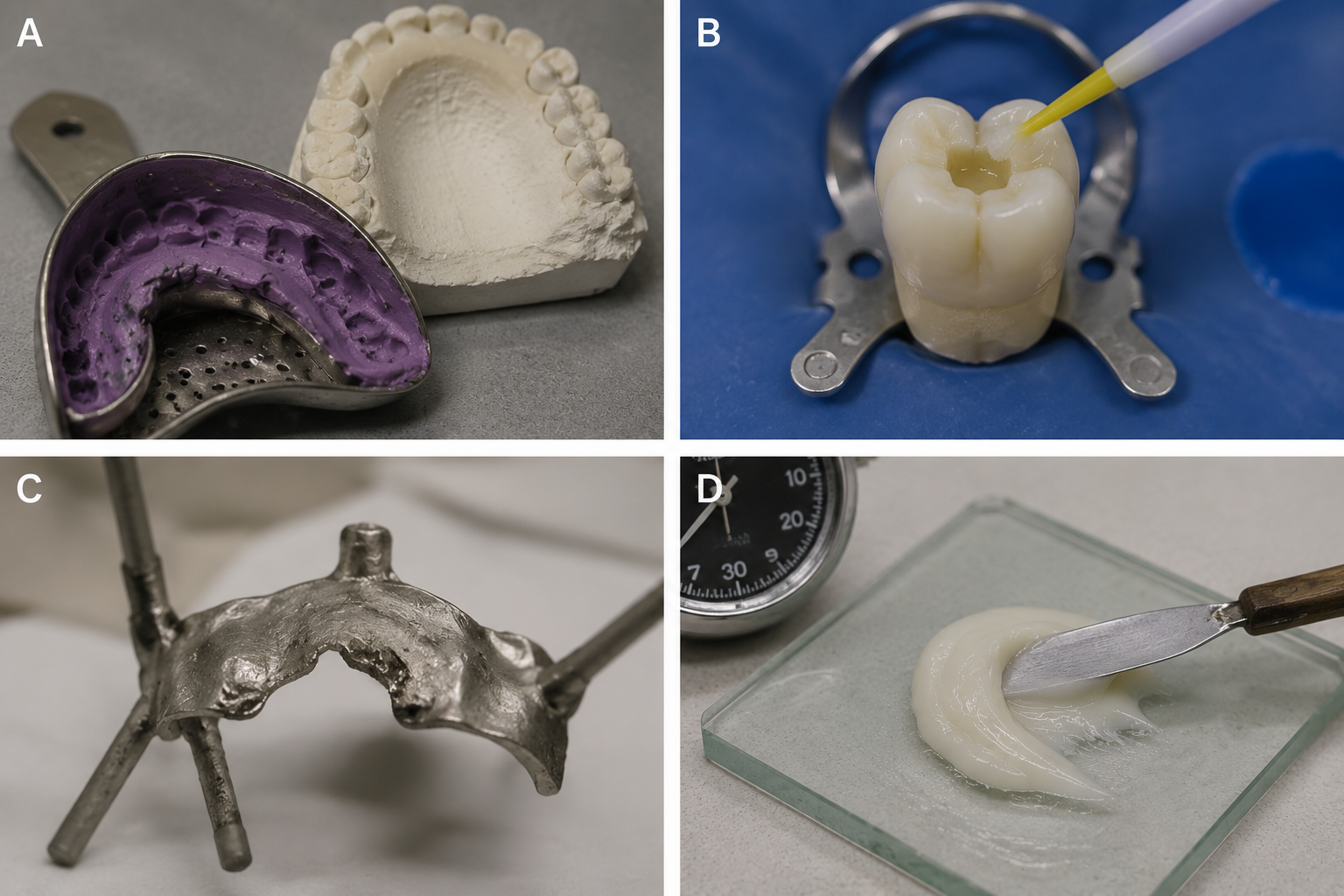
The photograph format helps keep the analysis close to the materials encountered by students in pre-clinical work. This is also the reason behind the possibility for repeated impression material content to have an entirely new instructional value if the second exposure is linked with record fidelity and indirect restoration reliability. This does not mean anything against repetition; this means criteria for meaningful repetition, since the second exposure will need to require an explanation that is more meaningful than the first introduction.
The four modules were assigned specific evidence identities that ensure the documentation of the content within each one while at the same time identifying what each module needs to demonstrate. Thus, Module 1 becomes a property-to-observation basis. The evidence goal here is not merely an introduction of dental materials but to see whether the students can relate the properties to manipulation and service behavior. Module 2 becomes a restorative interface decision process. The evidence goal here is to determine whether the students can make decisions on the direct restorative materials, adhesives, glass ionomer systems, amalgam, and cements. Module 3 becomes a laboratory artifact control process. The evidence goal is to determine whether the students can relate alloys, casting, investment, refractory die, wrought alloy, and mechanical behavior to laboratory artifacts. Module 4 becomes a record fidelity and indirect restoration judgment process.
| Module | Evidence identity | Failure-mode anchor | Micro-evidence artifact |
|---|---|---|---|
| Module 1 | Property-to-observation foundation |
Treating properties as definitions rather than predictors of manipulation or service behavior | Short note linking one property to one observable handling or service consequence. |
| Module 2 | Restorative-interface decision sequence |
Selecting a direct restorative, adhesive, glass ionomer, amalgam, or cement without considering constraints | Comparative material justification or OSPA response using a constrained restorative case prompt. |
| Module 3 | Laboratory artifact-control sequence |
Treating alloy, investment, casting, and mechanical-property topics as descriptions disconnected from defect production | Annotated defect interpretation tied to alloy choice, refractory support, casting step, or mechanical response. |
| Module 4 | Record-fidelity and indirect- restoration judgement sequence |
Failing to connect impression behavior with cast reliability and indirect restoration planning | Brief explanation connecting impression behavior, viscoelasticity, ceramics, or metal-ceramic planning to record fidelity. |
According to the module identity Table 3, each module can be analyzed using a distinct material risk lens. The strength of Module 1 lies in property consequence explanation, while Module 2’s strength lies in selection under the constraint of restoration. Module 3’s strength lies in the control of artifacts in laboratory operations. Meanwhile, Module 4’s strength is record fidelity in indirect restoration planning. This interpretation adds some internal logic to the course beyond its chronological topic list.
As mentioned above, these identities are useful for integration, but do not require re-designing the entire course. The course map indicated that dental materials science would be isolated from clinical applications if it was mostly preclinical theory [1]. These module identities solve this problem by attributing specific evidence functions to each module. Moreover, they facilitate the management of the coherence of curriculum by a single staff member, who has a well-defined task for each module instead of a vague demand for extensive redesign. Documentation helps reduce the influence of single-staff dependency, which is another concern of the course record. An evidence identity traceable to students, examiners, and further contributors decreases the influence of tacit expectations of one coordinator.
Assessment evidence result did not change the existing assessment structure. It already included multiple assessment tools and 40%/60% continuous assessment/final examination [1]. The problem here was not lack of assessment tools, but the need to specify the type of evidence that each assessment format was supposed to prove. Therefore, the micro-evidence record maintains the structure of assessment tools, changing their evidentiary role. The available assessment tools may be used for obtaining threshold evidence, as demonstrated in Table 4.
| Assessment format | Recorded assessment function | Threshold evidence function |
|---|---|---|
| MCQ | Tests terminology, indications, contraindications, and core material facts. | Includes retrieval items that return to threshold decisions across modules and expose persistent misconceptions. |
| SAQ | Tests concise explanation of material properties, setting behavior, and manipulation variables. | Requires explanation of a material failure mode, handling consequence, or selection trade-off. |
| OSPA | Tests observed practical or applied performance. | Records whether the student can recognize a material-handling problem and state an appropriate correction. |
| Laboratory practical assessment |
Tests manipulation and observation in practical classes. | Produces an artifact showing timing, mixture quality, handling variable, dimensional issue, or mechanical-property interpretation. |
| Seminar presentation | Tests communication and topic preparation. | Functions as a comparative material-selection defense using a specified constraint set. |
| Assignment | Tests independent learning and synthesis. | Requires a threshold-task commentary rather than a purely descriptive summary. |
| Viva voce | Tests oral explanation and examiner questioning. | Samples the student’s ability to justify a material decision when conditions are varied by the examiner. |
| Final written examination | Tests cumulative knowledge. | Confirms whether students can integrate properties, manipulation, indications, contraindications, and likely failures across modules. |
Evidence record suggests that all mentioned assessment tools already contain elements of written, observed, oral, practical and self-regulation evidence. The problem, thus, does not lie in variety of assessment forms; the problem is the need to allocate an evidentiary function to each tool. MCQ and SAQ can safeguard core knowledge, OSPA and laboratory assessment can prove correction and handling abilities, whereas viva voce and final written exam can assess whether the reasoning stands after a change of circumstances.
The visual presentation of the assessment structure is represented in Figure 5. In the given case, the horizontal rails preserve the traditional 40%/60% ratio while demonstrating how the current format can collect a number of pieces of readiness evidence.
The assessment bench demonstrates that no new assessment categories are necessary for material readiness. Current tools can be better utilized if every tool corresponds to a certain named learner action such as explanation, correction, justification, documentation or cumulative integration. In this way, the current 40%/60% ratio can be preserved and every tool will acquire its own evidentiary function.
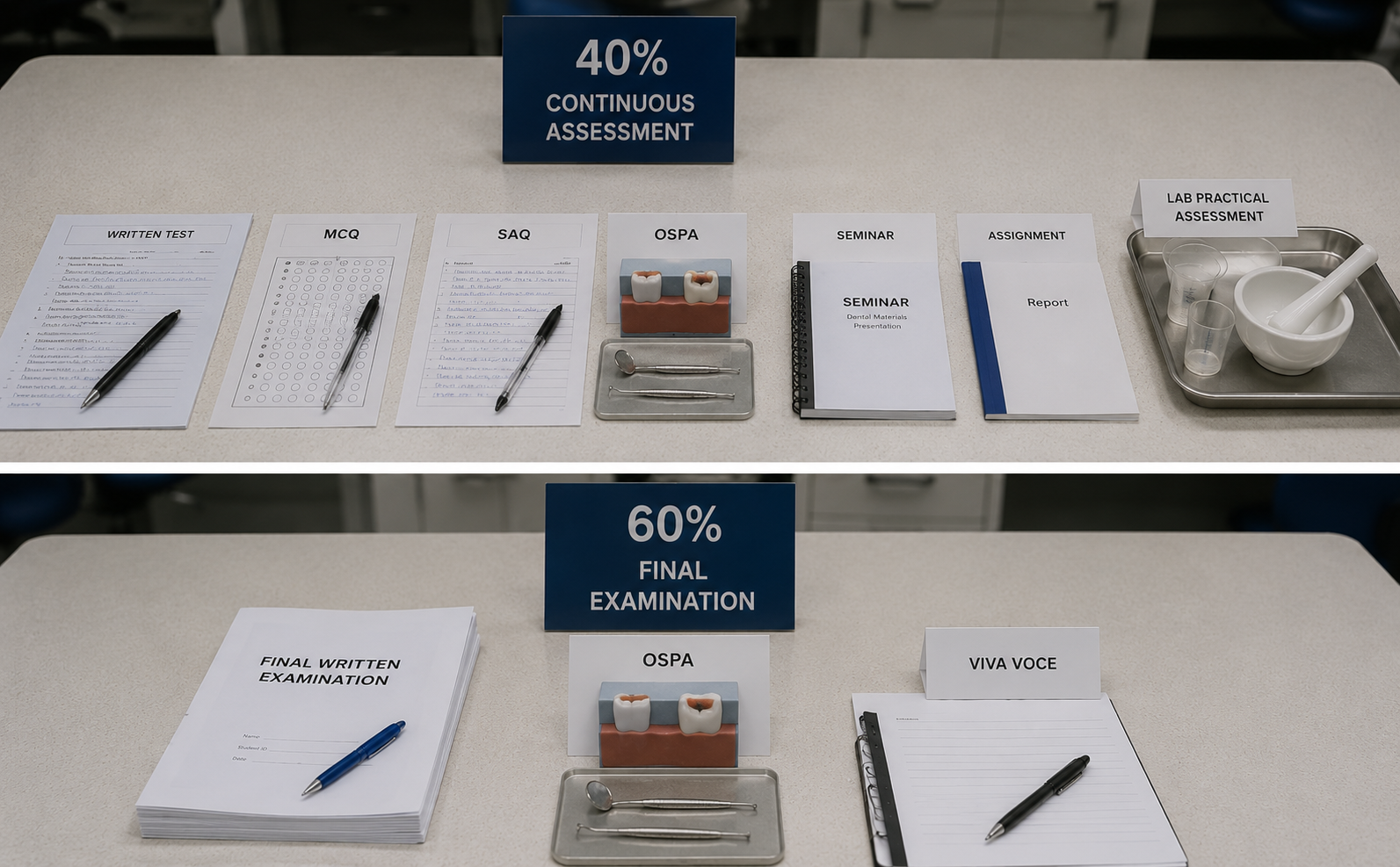
Three implications result directly from the assessment evidence record presented. Continuous assessment acquires a formative character without any change of the current weights. MCQ and SAQ can continue to assess factual knowledge but selected items should go back to the initial threshold tasks in order to force learners to experience retrieval, explanation and decision-making again. OSPA and laboratory practical assessment acquire a stronger validity since now they have to confirm whether a learner identified the handling variable, a property consequence or a correction. Viva voce and final written examination acquire a cumulative role since now they have to assess whether reasoning withstands a change of circumstances. A sound assessment system needs to rely on validity, educational effect and feasibility [11]; additionally, it needs to take into account multiple evidences rather than just isolated test results [9]. Moreover, it needs coherent interpretation of multiple pieces of evidence at the programme level [10].
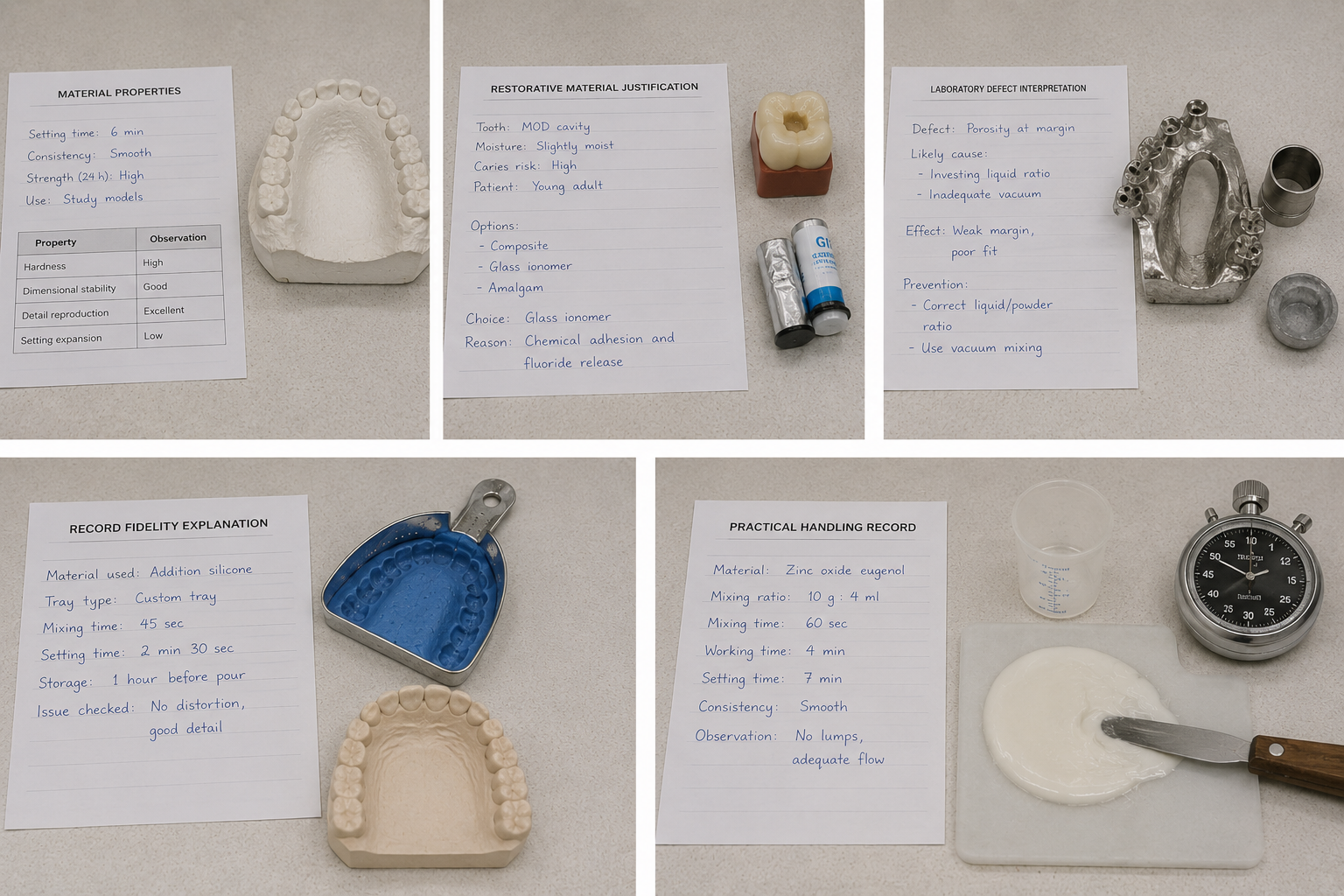
Micro-evidences that can be collected without large assessment event are presented in Figure 6. These artifacts are designed to be small: property observation note, restorative material justification, laboratory defect interpretation, record fidelity explanation and practical handling record.
The documents in Figure 6 make feedback more specific since the teacher can comment on an observable product rather than on participation itself. These also help to have evidence for psychomotor and judgement abilities in a cognitive-heavy course through written, oral, observed and practical assessments. A course which is 82% cognitive and 18% psychomotor can prove readiness in handling materials provided cognitive assessments are formulated on material consequences rather than on its isolated definition.
The assessment evidence record not only deals with 82% cognitive and 18% psychomotor problem without unjustified claims about ineffectiveness of the course but also provides means for practical evidence collection. Indeed, a cognitive-heavy course can provide practical evidence of readiness if the written, oral and observed assessments will require explanation of handling, failure and choice of material. Adding practical hours in such a course without threshold evidence collection will not resolve the problem as well. Every practical or written interaction should include evidence target which is a specific skill or activity to prove. Digital methods will be relevant only if evidence targets are explicitly defined. Thus, short videos about mixing techniques, pictures of material artifacts or electronic rubrics for OSPA stations can be used to collect evidence without expensive virtual system implementation. Digital tools may be useful for some selected dental skills [16]. Virtual methods are efficient only when related to the defined learning task [19]. Haptic tools should also serve an educational purpose rather than decorative [20]. The COVID-19 period proved the importance of flexibility in the dental education delivery process [17]. Moreover, it proved that online delivery by itself cannot resolve problems of practical skills development [18]. Thus, low burden digital verification can be applied as an effective way of evidence gathering in the course with limited teaching and learning resources.
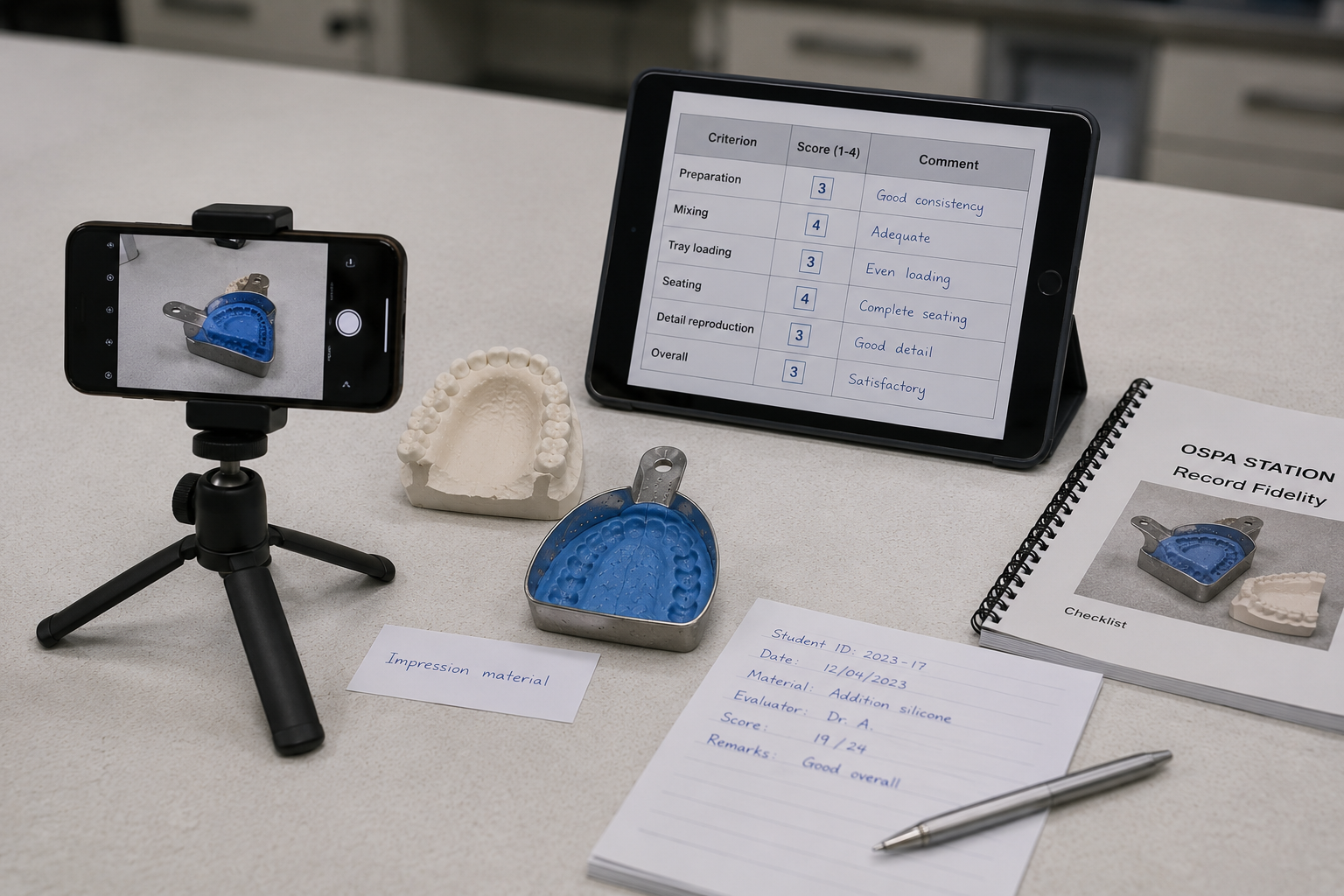
The low-burden digital evidence record shown in Figure 7 is the modest verification kit rather than replacement for practical training. It is represented by photographs, handling records and electronic rubrics related to the same OSPA and laboratory tasks existing in the course.
The reason for the visual documentation in this case is practical traceability. Small digital evidence of the process of mixing, tray loading, seating, surface detail, or quality of handling is available in a limited amount of staff and consistent feedback across attempts. The digital image keeps the claim concise: documentation is valuable only in terms of its ability to capture particular handling and assessment events already occurring in the course.
The documented course contains comprehensive content coverage, institutional outcome alignment, assessment methods, opportunities for learning, learning materials, and course management. The same record also captures repetition of content, lack of psychomotor focus, lack of technology usage, dependency on one staff member, and potential unrecorded curricular deficiencies [1]. Course signals identify areas in which documentation would be most beneficial. Repetition becomes justifiable only in cases where the second instance generates a different threshold performance. Psychomotor deficiency becomes more manageable when each practical class generates some sort of evidence. Lack of technology use becomes less important when digital documentation is used sparingly. Staff dependency becomes less dangerous when the identities of evidence modules and assessment artifacts become evident for other instructor/examiner to assess.
The analysis changes the conceptualization of dental materials science readiness in this course. Readiness is not merely an ability to pass a written test, perform a practical lesson, and categorize material. Readiness is the ability to provide justified explanations and actions in terms of interaction of material properties, manipulation variables, and constraints of clinical or laboratory environment. Such conceptualization of readiness is in tune with competence-based dental education because of its focus on observable tasks rather than on topic exposure [23]. Furthermore, readiness concept is also aligned with entrustable activities in dentistry [24]. Readiness research suggests that learners need more practice in showing readiness prior to taking up more complex tasks [21]. Student-centered documentation in dental education makes readiness expectations even more clear [22]. The analyzed course can therefore be characterized as a curriculum containing sufficient content scope but lacking evidence names.
First of all, implementation should start with the pilot consisting of one cycle. The course team can choose one threshold task among modules, implement it into one existing assessment or learning event and create one micro-evidence artifact. The first module can use a property observation note. The second module can use a justification of a constrained restorative material. The third module can use an annotated explanation of laboratory defects. The fourth module can use a fidelity of record explanation in connection with impression behavior and indirect restoration. In order to do this, the course team should not increase the burden of the assessment. This should be done in order to check whether the students understand the standards, whether the teachers can apply the rubric and whether the artifact reflects material reasoning.
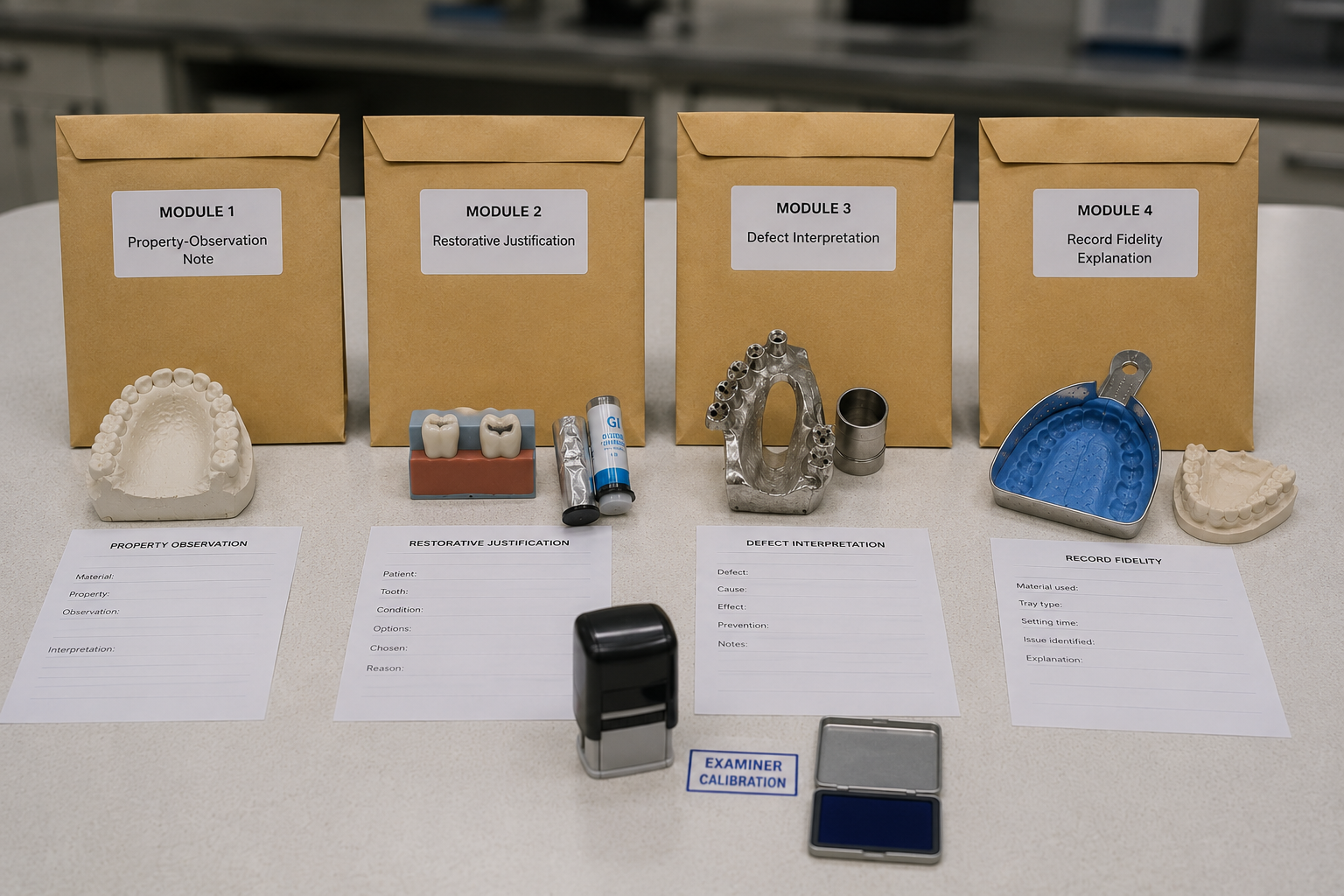
The implementation of the first cycle is shown on Figure 8. There are four module envelopes that support examiner calibration. Every envelope includes one artifact of evidence that corresponds to recorded module content and learning or assessment event.
The organization of the envelopes indicates that the first cycle is organized in a very controlled way. First of all, the course team can start with one artifact per module, check the rubric consistency and review the student’s understanding. After that, the topics, for which additional evidence record will be necessary, can be decided.
After the first cycle, the same evidence record can be used with additional topics after examiner calibration. MCQ and SAQ items can be evaluated in such a way that the selected questions return to the threshold decision rather than to some isolated facts. OSPA stations can have a recognition and correction prompt. Laboratory practical assessments can require students to make notes about one observation, consequence and correction. Seminar presentations and assignments can act as material selection defense. Then, low burden digital verification can be added to the selected tasks with image-supported feedback, handling record or electronic rubric entry. The most expensive simulation should be used only in cases when the virtual or haptic technology provides additional evidence that cannot be received with existing laboratories or OSPA.
The design of the course record specifies the boundary of inference. This analysis does not establish that threshold tasks enhance grades, psychomotor skills, clinical decision-making, lab quality, or patient outcomes. Nor does it consider student perception of the tasks, teaching load, exam reliability, or transfer to the practice of clinical dentistry. These matters require information at the level of learner and examiner experience. The visible topic record also provides the interpretive boundary. The course record included 25 lectures and three practical classes, with 23 topics for lectures and three practical topics visible for item-level analysis. Analysis was restricted to the visible items for item-level inferences and to the lecture count as a course-level descriptor. This boundary prevents the use of unsupported inferences and ties conclusions to evidential visibility rather than effectiveness.
The research question asked what a documented Year 2 dental materials science course would look like if it provided visible evidence of material-readiness judgement while preserving its recorded modules, learning locations, assessment methods, and 40%/60% grade structure. The answer is that a course record can be evidentially readable by assigning material-readiness functions to the visible items and by making the existing assessment methods responsible for collecting the required learner actions. The 26 visible items of curriculum provide support for six readiness bands: property-consequence explanation, record and working-model reliability, restorative-interface selection, prosthodontic support-material judgement, metallic laboratory artifact control, and manipulation readiness. Foundational topics thus account for property-to-observation reasoning; restorative topics account for material choice; laboratory topics account for artifact control reasoning; and impression or indirect restoration topics account for record-fidelity reasoning. The documented MCQ, SAQ, OSPA, practical assessment of laboratories, seminar presentations, assignments, viva voce, and written examination can be retained, but their evidential meaning is revealed through explanations, corrections, justifications, handling notes, or cumulative integrations. The conclusion is thus specific to this course: its quality cannot be assessed simply on the basis of visible dental materials topics or multiple assessments. Its quality can be assessed in terms of evidentiary visibility of material-readiness judgments in explanations, handling, selection, and failure recognition prior to students’ moving into more consequential lab and clinical work.